We build products and services consciously. But most often than not, we’re building our brand subconsciously. We focus on what we want to say to the customer and the problems we want to solve.
The brand is what the customer sees. It tells them whether they should trust you or not. It tells them whether you have a quality product on offer or not.
A brand is a perception in the minds of the customer. It is a shortcut to faster decision-making. As Jack Trout and Al Ries describe it in their seminal marketing book, Positioning, there is usually one slot per category.
Here’s an excerpt from an NYTimes review of ‘Thinking, Fast and Slow’ by Daniel Kahneman that explains how our brain thinks and decides:
More generally, System 1 uses association and metaphor to produce a quick and dirty draft of reality, which System 2 draws on to arrive at explicit beliefs and reasoned choices. System 1 proposes, System 2 disposes. So System 2 would seem to be the boss, right? In principle, yes. But System 2, in addition to being more deliberate and rational, is also lazy. And it tires easily. (The vogue term for this is “ego depletion.”) Too often, instead of slowing things down and analyzing them, System 2 is content to accept the easy but unreliable story about the world that System 1 feeds to it. “Although System 2 believes itself to be where the action is,” Kahneman writes, “the automatic System 1 is the hero of this book.” System 2 is especially quiescent, it seems, when your mood is a happy one.
With the proliferation of brands and high competition today, a customer might have 3 brands per category. Do this exercise now: – Pick any category or industry or service – List the first 3 names of companies that come to mind – Pick another category – Do the same thing – list the 3 names that are top of mind
Now go back to each category and think of all the other brands that exist there and why they don’t occupy your mind space. What is your perception of their value and why don’t they feature in the top 3.
You will also notice that once a brand is established in your mind space for a category, it is very hard to dislodge it.
Now if you’re a business owner, how do you ensure your product or service is in the top 3 in your category?
What can you say or do that no one else can claim?
Can you create a new category altogether? Can you redefine your competitors in a way that elevates you to a customer’s top of mind? Again, this positioning needs to find resonance with a customer.
Sales and marketing for a product or service often have a direct line to revenue generated.
A brand does not have a direct line that can be drawn to revenue. It’s hard to measure. It has no easy or simple feedback mechanism. Your ‘Brand’ value is a lagging indicator.
Brand building activities would fall in the important but not urgent quadrant of the Eisenhower Matrix. Business is important and urgent and so that takes up most of your attention.
A brand is an asset. A long-term asset that gradually increases in value or depreciates depending on how you maintain and grow it.
Brand is about consistency over a long period. A product can be built in a sprint, a brand cannot be.
Writing is a must for everyone. And not all of it needs to be published.
I consider myself a beginner with writing, so I’ve put together this beginner’s guide to writing online based on my failed experiments, reading and learning.
“I can’t write” is like saying “I can’t think”. We develop a mental block with writing because we misunderstand the meaning or the purpose of writing.
For a long time, I believed that if you couldn’t write in flowery language, describe a story vividly and be free of grammatical mistakes, you shouldn’t publish your writing. This unrealistic expectation still stops me from writing on occasions.
Writing is self-therapy, brainstorming and self-expression all rolled into one.
I have to remind myself of this every day, that the benefits of writing are enormous.
The inner critic, the unrealistic expectation and misunderstood need for writing are often why most don’t do it. I want to argue that writing, like reading, is a must for everyone. It is essential for personal growth.
And in this post, I hope to convert the self-doubters and uninformed that writing is an important life skill. If you’re an entrepreneur, even more so.
No, I’m not going to say you have to publish 1 post every day or read 100 books in a year to be successful. Do what works for you. I tried the #100blogposts challenge and failed.
Not all writing is published or needs to be published.
The first objective of writing is self-care. The second is to achieve clarity with your thinking. And if what you write for yourself can benefit one other person, then you share it.
Writing for yourself and writing for others to read
The easiest way to pick up writing is journaling. I started this daily practice a year ago called Morning Pages. Pick a pen and a book, write down your thoughts for 3 pages non-stop. Anything goes, no holds barred. No pressure, no rules and certainly no editing of words or thoughts. This is called stream of consciousness writing.
This simple act of writing down everything that’s in your mind helps unclog your mind. You feel lighter. It’s a strange but good feeling to have as you start the day. And the more you do it, you start to see the benefits of it.
Journaling gets you into the habit of turning the thoughts in your head into words on paper. To be able to turn those thoughts into words and words into action is a superpower.
So I look at journaling as the first step towards building a writing habit. It’s like toddlers learning to crawl, exploring the world around them and being fascinated with their discoveries.
Unless you’re a professional writer, you don’t write for others, you write for yourself first. Even when you decide to share your writing.
Once you get into the habit of journaling, you get used to the idea of setting aside time to write. This was an important realization for me. I now schedule an additional hour or more every day (I try) and write on topics that interest me and what I’m currently reading or working on.
I tried to publish 100 consecutive blog posts last year and I failed. The difference between writing every day and publishing every day is vastly different. The former is doable and I’ve managed to journal consistently. The latter I realize differs from people to people. Some are able to publish every day, but what is not visible behind the finished article is the process involved. 100 days of journaling is a better starting goal.
I believed for the longest time that writing was a one-time effort and with some editing, you could publish it live. All done in one sitting, maybe two. However, learning this the hard way and also reading about it has made me realize that this is an iterative process.
Each piece of writing is like building a product. You don’t build a finished product in one sprint. It develops over time, it needs iterations, changes, etc. Writing to publish follows a similar pattern. You go from an idea you want to write about, outline it, expand on it and then iterate. When you cut out all the fluff, the writing is ready to go live.
The writing rules don’t apply while writing.
They apply while editing. The structure, grammar, transition words, avoiding adverbs and filler words etc. These are applied after you’ve written your first draft.
The different stages of the writing process
Step 1: The first step is to put out the first ugly draft as Ann Handley calls it. This is an uncensored dump of all your thoughts related to this topic.
This could be a vomit of all your ideas or it could be in the form of an outline. Bullet points of all the major ideas or arguments.
The former is when a topic is an exploration, an area you are still learning of. The latter makes sense when you know the subject well and you can identify the sub-topics clearly.
The science-fiction in non-fiction
Exploring ideas, connecting them, teasing them out, contemplating consequences and pre-conditions for them to work is fiction. They don’t necessarily have to be true. We’re in the realm of exploring possibilities, so why rule out ideas or subconsciously constrain yourself when writing the first draft.
Science fiction is based on some truths, but it’s not reality.
The first draft is also based on internalised truths, but the ideas you are exploring is not necessarily reality, could be impractical, absurd etc.
Step 2: In the next step of reviewing what you wrote in the first draft, look for and add counter-intuitive and counter-narrative points. Points that get people’s attention.
Synthesising your thoughts into fewer words but still being able to communicate the same thing makes it easy for the reader – more value in lesser time. This round of rewriting and editing is to sharpen your points, add additional points and make your hook stronger.
As you do this, there are parts where you are uncertain or need to read up more on, especially if you are writing on a topic you are still learning about. Highlight these “to be filled out” spaces.
Schedule a separate session to explore the holes, find information, make notes and fill in the blanks.
Julian Shapiro has an excellent thread on writing if you suffer from procrastination.
Step 3: In the next round of drafting, as Julian says, you need to work on making your ideas stick. To make them stick you have 3 tools:
Stories – personal anecdotes, fiction. Look at the past experiences that you can write about. This makes the writing unique because your experiences are unique. This is the flavour that reflects your life and experiences.
Analogies – find metaphors and analogies as ways to explain your point. Analogies are a powerful way to communicate ideas. They use a familiar mental model that the reader is aware of to explain a new concept that they’re unfamiliar with. Old bottle, new wine.
Examples – data and case studies can be used to buttress your arguments. During your research session where you might enter into one of the many internet rabbit holes reading and exploring related topics, make notes and bookmark interesting facts you discover. And then when you come back to the post, you can add it to points that support or contrast what you’re saying.
Step 4: It’s finally time to let the grammar dogs out of the kennel. You’ve been holding them back from trying to correct spellings, grammar and flow so far. You must also cage the demons along with the dogs. The self-censoring, overly critical demons that won’t let you explore new boundaries because they’re scared.
I use Grammarly at this stage to iron out the kinks.
When you get to this stage without having self-censored or worried about the grammar, you will be surprised with what you’ve written. Give yourself a pat on the back.
Not everyone is proficient in English and this is not GRE or SAT exam. So use the tools available online like Grammarly, Hemingway app etc to help you correct grammatical issues in your writing.
Once this is done, you can apply some writing rules to make your writing more efficient. I have a list of rules here that you can look at and which I now use during my editing.
“writing well is part habit, part knowledge of some fundamental rules, and part giving a damn”
Ann Handley, Everybody Writes
Easy To Follow Writing RulesFrom ‘Everybody Writes’
Avoid using the following phrases: According to… There is a… It is [important, critical, advised, suggested, and so on]… In my opinion… The purpose of this [email, post, article] is… In 2014 [or any year]… I think [believe] that…
Trim word bloat. Sub in single words for phrases (some samples: sub although for despite the fact that; when or in for when it comes to; when or at times for there will be times when; remains for continues to be; and about or regarding for in regard
Ditch adverbs unless they are necessary to adjust the meaning.
Ditch the weak verbs in favour of stronger ones.
Create transitions between paragraphs.
Short sentences and short paragraphs. (Try reading a long sentence with many commas and conjunctions and you’ll see how tiring it is.)
We didn’t do any content marketing from 2018 to mid-2020 for Pixelmattic. But in that period, we continued to generate leads every month. This was possible because the website had accumulated SEO value from the content marketing assets created between 2015 and 2017.
This was the first time I truly understood the power of content marketing. Our website had turned into a 24X7 sales and marketing asset for us. Once you had built a well-optimized website, it could run like a self-driving Tesla car.
It wasn’t just about generating leads, but the leads were qualified. There wasn’t much selling or negotiating to be done because our website did a lot of that for us.
Of course, the value of positioning our brand as WordPress experts helped immensely. Our processes and communication have consistently improved in providing transparent information to clients, and that helps too.
Content marketing assets
In 2020, we renewed our efforts and published an epic content marketing asset, our WordPress Guide for Marketers. 30,000 words and 20 chapters of in-depth and comprehensive content that covers every aspect of WordPress that a marketer would be concerned about.
But creating these kinds of content marketing assets is not always possible or sustainable. It took us 6 months to plan, write, edit and publish. And the work doesn’t end there as we continue to promote it through various channels for better distribution and organic growth.
It’s an asset that will serve us for the next 3-5 years in many ways. It was created with that intention. An investment to build our credibility, answer a lot of questions potential clients might ask, educate our market and build a pipeline of leads from an engaged audience.
Very soon this content will be repurposed as podcasts and maybe even videos. That’s the great benefit of content marketing, once you create content, you can repurpose it in many ways with minimal effort.
However, creating “epic content” is not sustainable, unless you have a large content team that can produce this kind of content often. Instead, build a content calendar and create SEO-optimized content consistently.
A non-salesy way of generating leads
So much of the business communication is focused on sales and promotion. The maxim “show, don’t tell” holds true. And content marketing gives you the platform to do just that.
Content marketing lets you build an audience of people in your industry who want relevant but curated information and points of view. There is no shortage of information out there, but what people value is someone making sense of that information.
Content marketing builds your credibility and authority with the audience. Talk is easy, but to be able to think, write and publish original and authentic content takes skill, experience and effort. People value that.
If you said the same thing over a phone call it has less value and reach of 1, versus putting your views, thoughts, and opinions on the internet. And doing it consistently brings attention to an audience.
Consistency with content marketing
Content marketing rewards those who are consistent. The same could be said of marketing as well.
A lot of attention and media space is given to growth hacks, ad spends and quick impact tactics. But solid marketing that produces consistent results over a long period is a result of consistent, well-thought-out daily effort.
To do content marketing consistently, you need 3 things
Someone to drive it for you – a marketing manager, VP of marketing, or an agency with access to senior partners you can collaborate with (not outsource, more on this later)
A documented strategy of who you till target, what will you create and how will you reach them
A team, in-house or outsourced (more on this again later), to produce consistent quality content
A documented content marketing strategy can be the difference between consistent high-quality content marketing and haphazard tactics-driven marketing. The latter also popularly known as growth hacking can produce stunning results in the short term.
The question for any smart business owner is how long can you sustain it? And when it starts to taper off, do you have any value that was built from all that marketing work that you can repurpose and sustain your lead generation?
Social media (paid) marketing is often the first refuge for those looking for instant results.
But as with so many short-lived marketing efforts, these are very rarely sustained. And the business jumps from one agency to another trying to find the next “creative” person who can do something to get you quick results.
Social media is ideal for creating brand awareness, audience engagement, and customer retention. There are some exceptions where it could be used to generate leads with reasonable consistency.
Create content marketing assets on your own platform
This requires the business owner or the CEO to create a personal content strategy for Twitter or LinkedIn, and then build an audience for themselves on either or both of these platforms. There are many successful examples of this approach.
The content strategy document is what you often refer to give you direction and stay “on brand.” The tactics wrapped in a project plan ensure you execute it. Quarterly or weekly reviews ensure it is always relevant. And to do this, you need someone to drive it. Internally and externally when needed.
So that brings us to the question of whether content marketing can be outsourced.
Outsourcing content marketing
You can choose to build your product and focus only on that while you outsource all of the marketing to an external agency. But with how the nature of products has evolved over the years, product and marketing are intertwined much closer than before. So it is not so simple to just outsource all of the marketing to someone else.
If you have the funds you might consider hiring a senior marketing professional to be the head of marketing. The marketing head can then build internal resources to do the core marketing strategy work and outsource low-end marketing work to an agency, like creating/printing marketing collateral, content production, etc.
This however takes time. It takes time to hire a head of marketing and then fill up a team of good marketers. It also can be cost prohibitive for many companies.
The third option is to co-create the marketing strategy with an external expert who can help you manage and execute the marketing strategy. With this approach, there is better collaboration between the product team and marketing teams compared to outsourcing all of the marketing. While you may not hire anyone in-house, it is still important to have a project coordinator or driver of this from within the company. This is true for any engagement with an external agency.
A well thought out content marketing plan has a strategy and a set of tactics. The strategy is based on understanding of the customer and insights about the business/industry.
The marketing expert can tell you what are the key elements needed to create the strategy, structure the process and manage it. It could also include doing market research and customer interviews to gain these insights.
But most importantly, what the marketer should do is facilitate the process of mining your first-hand knowledge of the industry and customer to extract insights that are an important ingredient in building the marketing strategy.
It’s easier once you have a strategy in place to outsource the execution. And convenient to have one point of contact to create strategy and execution, so the agency generally takes the responsibility of doing it.
However, one must be wary of the fact that an agency will not have the skills or capabilities to create all types of content in-house. Skills like video animation, voiceovers, photography, memes, and content writing are best outsourced to experts in each of these areas. Managing all of them can become problematic for a company, so the agency usually ends up fronting this.
You can’t outsource content strategy, you can co-create it. If you do it in-house, either hire an experienced marketer. Or build a content strategy document with templates, and hire a junior to execute.
Content marketing = Content strategy + tactics
Content strategy = Insights (customer + business + industry)
Document the insights, build your strategy, and then hire someone to execute the tactics. You can outsource if you know the strategy and have a specific set of tactics that you know will work.
Co-creation of content marketing strategy and execution > outsourcing content marketing.
An old post on early mistakes we did with content marketing when starting out.
Sustained and long-term growth requires a different mindset, team culture that enables, and systems that support foster growth. Most teams or companies are set up for the efficiency of execution.
Short Summary
Growth is as much about mindset as it is about execution. A corporate entity eventually evolves into an efficient machine focused on maximising productivity. Risk is avoided at all costs.
For those companies and teams looking for new growth opportunities, this book provides a set of tools to identify and manage growth experiments. A systems approach to controlling and managing an inherently uncertain and risky activity.
For a manager or a business owner, the authors share how growth behaviours need to be recognized and rewarded, as they are different from behaviours that maintain the status quo and avoid risk.
Subscribe to my newsletter and get notes and summaries of marketing and strategy books in your inbox.
Long Summary
Physics of Growth
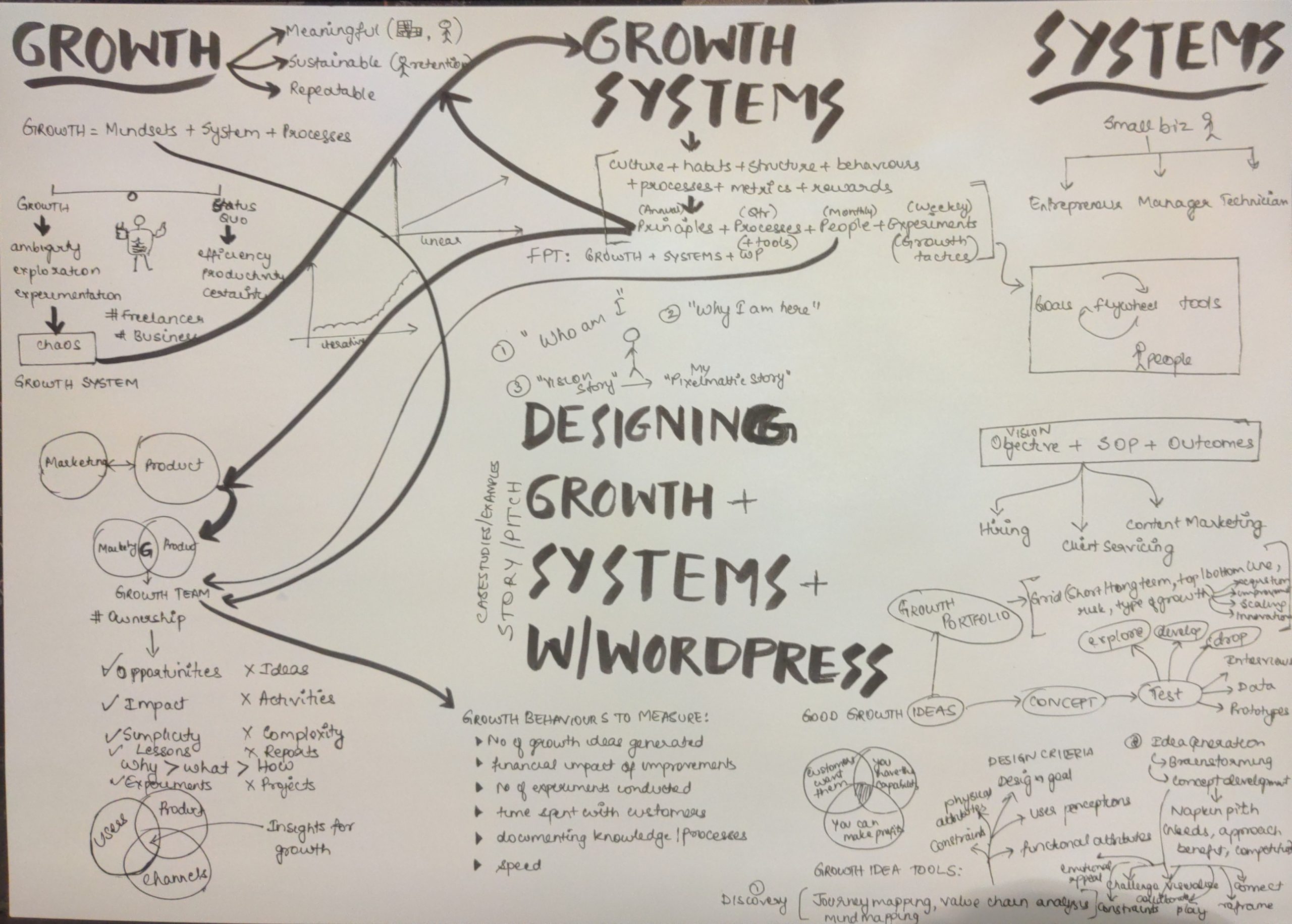
Growth = Mindsets + System + Processes
Growth is an iterative learning process.
Large orgs are set up for efficiency and execution. Growth involves exploring uncertainty.
Growth myths: Businesses do not have to grow to stay alive; growth is not always good; bigger is not always better; and continuous linear growth is the rare exception, not the rule.
Growth isn’t about taking big bets, but many small ones which are then scientifically experimented and narrowed down to those with the best chances of succeeding
Growth can’t be outsourced in the long run nor can it be achieved solely through acquisition.
Even more sobering, continuous acquisition in the absence of organic growth is akin to a drug addiction—it keeps taking bigger hits to get the same kick.
Goal = Growth + Execution
Complexity theory – orgs observe, adjust and adapt to a constantly changing environment
ants’ search for food in a process she calls “communication via sampling”: Ant foraging uses a parallel-terraced-scan strategy: many ants initially explore random directions for food. If food is discovered in any of these directions, more of the system’s resources (ants) are allocated, via feedback mechanisms, to explore those directions further. . . . As in all adaptive systems, maintaining a correct balance between these two modes of exploring (random and focused) is essential. Indeed, the optimal balance shifts over time. . . . As information is obtained and acted on, exploration gradually becomes more deterministic and focused in response to what has been perceived by the system.
Successful companies are not necessarily those with the most unique products, visionary leaders or better R&D capabilities. Instead these companies have a highly engaged workforce, compassionate leaders and a learning culture even if that means by imitation. They build an internal system of growth that enables these behaviours and culture to foster innovation.
Ideal growth team members have a growth mindset motivated to achieve an idealized outcome versus avoiding negative ones, a wide range of T-shaped experiences, and customer empathy #Mindset
Growth System
Growth System is a seamless, consistent, self-reinforcing alignment of culture, structure, leadership behaviour, HR policies and processes, and measurements and rewards that enable and promote defined growth behaviours.
Growth Behaviours
Active listening
Asking questions
Experimenting with new approaches
Paranoid about complacency
Continuous learning
Measure and reward these behaviours
Ownership
Leading by example
Toolkit: Questions to help define growth behaviours
What behaviors encourage or evidence a Growth Mindset?
What behaviors evidence a fixed mindset?
What behaviors promote or evidence utilization of growth-creating processes: identifying opportunities, experimenting, and building Growth Portfolios?
What behaviors inhibit the effective utilization of growth-creating processes?
Toolkit: What growth behaviours to measure
number of growth ideas generated
the financial impact of improvements,
number of experiments conducted,
time spent with customers exploring needs,
populating knowledge management content,
utilization of knowledge management content,
proficiency in Growth Processes (Black Belts), and
speed
Three approaches to structuring a company to enable growth within are:
to integrate growth functions inside each business unit,
create a separate growth center in the organization and finally,
a hybrid approach where labs experiment with ideas and when validated are integrated or spun off into business units.
The more radical an idea, the more protection it needs within the organization.
A well-designed system can become a competitive advantage.
Good ideas are when customers want them, you can make them and do it with a profit
Creative ideas = creating value for customers
Ideation tools
Discovery
Discovering the “adjacent possible” is to find a “shadow future hovering at the edges of the present state of things”
Talking to the customer is unfruitful if you ask the wrong questions like “what do you want?”. Customers don’t know what they want until they see it. Instead, ask questions focused on the job they’re trying to get done.
Journey mapping to understand the emotional highs and low of a customer experience and find your blind spots
Value chain analysis looks for strategic opportunities and vulnerabilities in the value chain
Mind mapping provides output to drive the Concept Development stage.
The outputs of the discovery stage must meet design criteria for them to be successful.
Design Criteria
Design Goal
What have you learned about the target customer?
What needs (functional, emotional, psychological, social) does the design have to fulfill for the target customer?
Why is it strategically important for your organization to address those needs?
User Perceptions
How important is your proposed offering to the target customer’s well-being?
Are there aesthetic attributes necessary to succeed with the target customer?
Does the target customer expect the offering to have certain social, ethical, or ecological attributes?
What does ease-of-use mean to the target customer?
Physical Attributes
Must the offering be able to capture, store, and/or transmit information about usage?
Does the offering need to be designed for use in specific environments or situations?
Are there weight or size considerations for lifting, use, or transport?
Are there memory, bandwidth, or connectivity issues?
Functional Attributes
Does the design of the offering need to accommodate specific use-case scenarios? List them in order of importance to the target customer.
Does the design need to address compatibility or standards issues?
Constraints
Does the final offering need to be completed by a specific date?
What constraints does your current business impose (the offering must use the existing manufacturing base, provide higher profit margins than current offerings, leverage proprietary technologies, etc.)?
Are there ecosystem and regulatory concerns (height of shelves at retailers, OSHA regulations, etc.)?
Idea Generation
Brainstorming
Concept development
Ideas = possibilities x constraints x uncertainties #[[Mental Formulas]]
[[Cognitive Blindness]] filters information that doesn’t fit our existing mental models. [[Cognitive Dissonance]] minimizes the importance of discomforting data.
You tackle these problems by building a diverse team with different skills, experiences and points of view.
Unpacking the assumptions
Toolkit:
5 Whats – “what must be true for a statement to be true?”
5 Whys
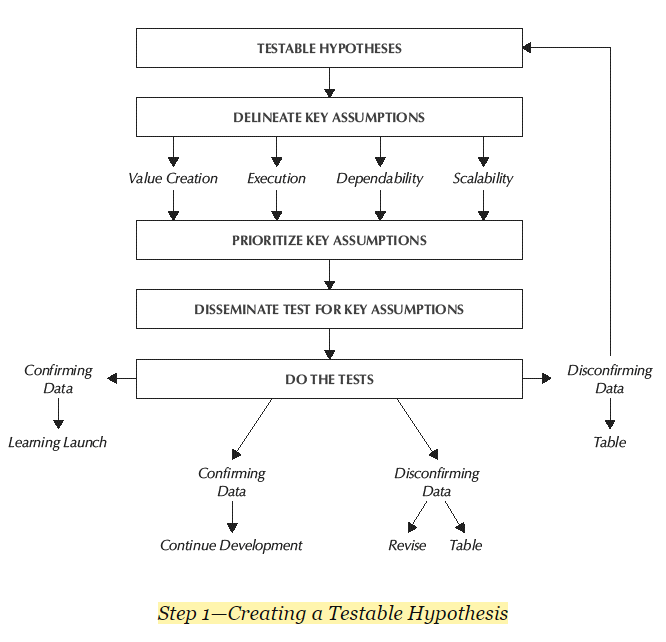
Test the 4 kinds of assumptions
Customer Needs Test – Do customers really need it?
Execution Test – Can we do it?
Testable hypothesis: You build a product a customer needs and values at a profitable price of $X. Test needs to validate this statement.
Defensibility Test – Can competition quickly copy it?
This test forces your to acknowledge that your idea is probably not unique
Scaling Test – Are there enough customers with this need?
Prioritize the important assumptions
[[Ownership bias]] might cause people to get attached to their ideas.
A company’s culture might also influence what assumptions to focus on. For example, a tech/product company might focus on its capabilities to build the product.
Fatigue for lengthy deliberations on the assumption could cause a build up of a need to do a test before carefully picking out the foundational elements of the assumptions.
Designing each test
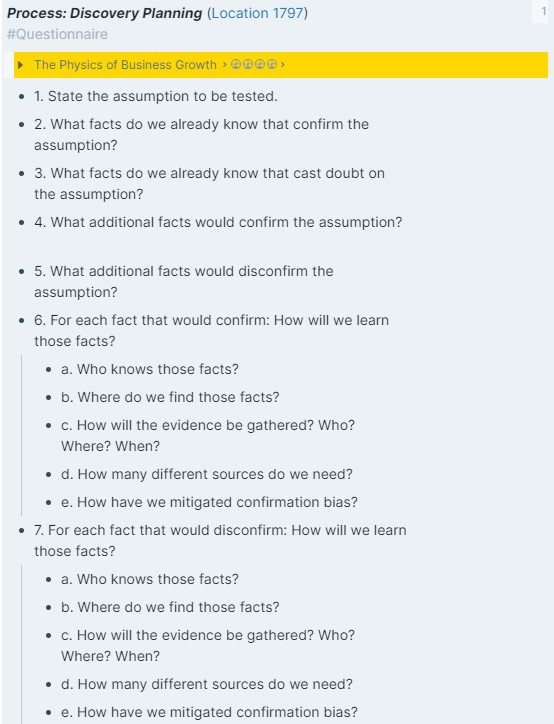
We need to be clear on who will look for what data, where and when.
The Discovery process is not the same as a sales process. Have two people attend the interview with one of them being a skeptic.
Managing the process
Weekly meeting to review process and data, focusing on the quality and interpretation of data gathered
Check whether search for disconfirming data is as aggressive as the other.
Make a decision
Continue explorations
Move to development
Drop
Growth experiment might take 3 months to run and cost an average of $40,000
Growth experiments are not to be confused with development. It is a pre-product idea discovery, exploration, and validation phase, similar to the [[Validation Board]] popularized by [[Lean Startup]]
Growth Portfolio
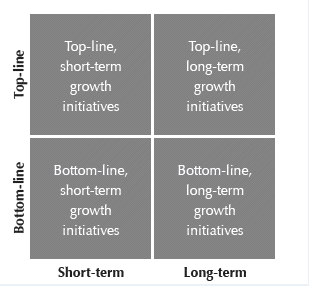
Growth Portfolio = Growth experiments (short term needs, long term needs)
The strategy will define the boundaries and scope of the growth ideas and processes.
S-curve depicts the lifecycle of most successful products – startup phase, growth phase, product maturity phase, steady decline. The speed of this progression varies across industries.
Map your current revenue streams on the S-curve to create a baseline of your current reality. This will tell how much new growth is needed to avoid a decline in revenues
What kind of growth do you want or need: #Growth
Growth can be classified into top-line (revenue) and bottom-line (efficiency). Rapid growth or steady growth
Pixelmattic’s [[Digital Growth System ????]] is a top-line long-term growth initiative primarily with some short-term growth measures
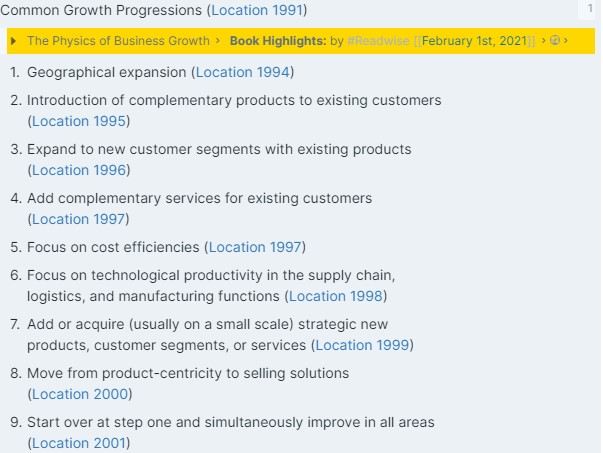
You can grow through acquisitions, improvements, innovations and scaling.
Improvements – faster, better
[[Scaling]] – doing more of the same
[[Innovation]] – doing something different than before or 10x better
[[Acquisitions]] – grow inorganically
Another dimension to growth initiatives is risk
Color coding growth initiatives with risk levels
Green – a high probability of success, low financial risk
Yellow – medium success, medium risk
Red – low success, high risk
A good portfolio will diversify and hedge the risks.
A 2 x 2 x 4 x 3 growth portfolio grid will show timeline of initiative (short-term/long-term), character (top-line/bottom-line), type (improvement, scaling, innovation, acquisition) and risk (green, yellow, red)
We’ve internalised the idea of quality over quantity. You hear and read that often. We understand that if we don’t make anything of quality, the world will reject it.
Quality becomes a filter through which you view your tasks, small or big. It turns into a self-limiting factor preventing you from trying things.
New ideas and shoots of optimism die at the altar of quality. The Quality monster looks for any sign of weakness in an idea, chomps it up and spits it out. All you end up with are a pile of dead ideas that never see the light of day.
If you achieved quality in your first attempt at something, that’s mostly down to luck. It’s not repeatable or scalable—a one-hit-wonder.
However, if you arrived at quality through experiments and failures, tweaked and improved your method along the way to finally produce a quality outcome, then you can systemise that process. And then scale it.
Quality is a by-product of a process. You can’t start with quality. It’s what you end up with. You measure the outcome, not what you start with.
No one remembers the bad stuff. Unless it’s so spectacularly bad that it turns into a meme.
To create quality you need quantity.
Quantity is the precondition to quality. Quantity is the precursor to quality.
Investors hedge their bets. They don’t make a single bet and go all-in on it. That is extremely risky. They make many investments. The success ratio is small, but those that succeed make up for all the bad investments—the 80/20 principle.
How does this impact our work? One big project, that one big campaign or that mega launch. It’s tempting.
Our work experience shows that a quality website is an end product of an iterative process. A process that involves many experiments done over a period of time. And it’s an ongoing journey.
You run many marketing experiments; some succeed, some don’t. But you keep tweaking. You write many blog posts or YouTube videos; some do well, others don’t.
You keep composing songs; some turn out great, others are average. But do it for long consistently enough, and people appreciate the body of work along with the few great ones you produced during that process.
I blogged 5 nights/week for 3 years before my blog got any serious traffic.
My first 2 years of WB Friday, it was the worst performing content we published.
My first 2 years of public speaking, I was a mess on stage.
— Rand Fishkin (follow @randderuiter on Threads) (@randfish) March 29, 2021
Definitely little wins along the way: – A mention or link here or there – A comment or two – A new client who mentioned they found us via a blog post – Some nice threads about the blog on an industry forum – Even just having posts I could send people who asked questions via email
— Rand Fishkin (follow @randderuiter on Threads) (@randfish) March 29, 2021
Creativity is often associated with quality. Something ethereal. Unexplainable beauty created through a moment of inspiration and magic.
As Steve Jobs once said, “Good artists copy, great artists steal”, you can argue nothing is original. But also the notion that creativity happens during certain moments, and you need to wait for it.
Some of the myths around it include drugs, alcohol and other intoxicants or that one must have deep sadness and sorrow to produce art which is considered great. Many great artists were tormented souls, but it shouldn’t be a condition to produce great content.
As Elizabeth Gilbert suggests, ancient philosophies treated genius and, therefore, creativity as external. Something that you were not responsible for. Creativity is not internal but external.
When someone is in ‘flow’ and producing their best work, you say they’re in a trance or possessed. So your work of art is not because of you, but an external force, and you’re just a vessel.
The later centuries created this idea of the artist and the genius being one, which meant the ownership and responsibility of creativity were on the individual. She says this is too much of a burden to put oneself under, and it is rather easier for the mind to consider “genius” as an external source. And to tap into it means to be diligent in your work, show up every day, and produce, even when you don’t feel up to it.
Full Title:: What Great Brands Do – The Seven Brand-Building Principles That Separate The Best From the Rest
Book Type:: Kindle
Why
Brand building as a strategy has long term impact on the longevity and profitability of a company. While you cannot measure in quarterly or annual reports necessarily, it provides a guiding framework on how to build and grow a company
Short Summary
Great brands have a strong core. They are confident of who they are and what they stand for. They are not swayed by the trends of the season. Great brands attract customers, they don’t go chasing after them. Any minute detail that impacts the brand is of vital importance. Brand building is a marathon that never ends and successful brands keep at it. Brand building is the same as building a business.
Long Summary
[[Brand]] is what your company does and how you do it. It’s your unique way of doing business. They are complete strategic platforms (Brand as business)
Advertising or marketing that is divorced from the realities of the company’s actual offering is counterproductive.
7 Brand-Building Principles:
1. Great brands start inside
Put internal brand culture first
Make culture matter
Using a [[Brand]] tool box for brand management #Tools
Brand strategy explanation – background and rationale that provides context
Principles & guidelines that deliver brand values and attributes to the outside world
Sample applications of brand expression and delivery
Guides that walk people through important decisions
Increasing [[Brand]] understanding through Brand Engagement Sessions #Tools
Presentation of the brand platform followed by discussions, games, interactive exercises
Get employees excited about working on the brand and help them identify decisions and behaviors aligned to the brand
Address common misconception that brand building is the job of marketing people
Organize a “Brand Day” by gathering all the employees/stakeholders
“Models of success” – cross functional groups research nd discover best brand building steps taken by other brands and apply it to the company
“Breakthrough sessions” – where department teams identify how to align their work
Extend your brand building culture externally and align stakeholders
Culture drives business – benefits of culture must be felt and benefited by customers
Execute first, communicate later
2. Great brands avoid selling
Emotions first, product features second
Emotional brand building requires you to develop a personal dialogue with your customers on issues that are most meaningful to them
Discovering insights at the moment of truth:
Segment the market based on customer’s needs instead of the usual demographic segmentation
Connect at the moments when these needs are the greatest
What business is your brand in?
Google – organizing information
USPS – connecting communities
Airlines – business productivity
Mapping your brand #Tools
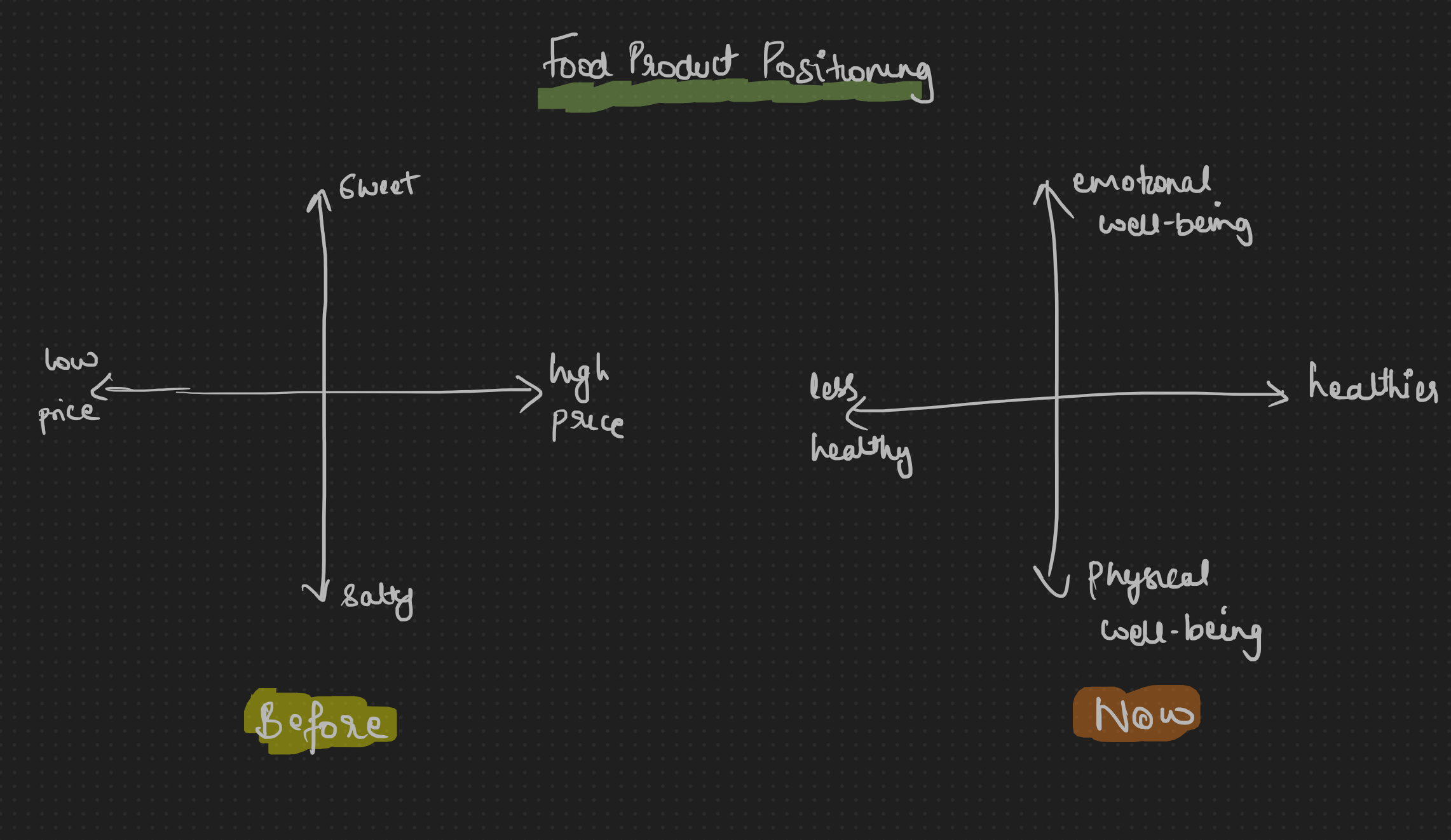
Traditional v/s new competitive landscape map
eg: Food product
3. Great brands ignore trends
Avoid “-er positioning” problem which puts you just a better version of something
Challenge “business as usual” approach
THE BUSINESS VERSION of our contrarian question is: what valuable company is nobody building? (Location 236)
Ideas = possibilities x constraints x uncertainties #[[Mental Formulas]]
Challenging conventions
Anticipating & advancing cultural movements
Looking to horizon – scanning, listening and forecasting
Performing a Brand Diagnostic #Tools #[[Brand Audit]]
What if you can build an asset that works for you even while you sleep and provide predictable revenues for the next 5 years?
What if you could build a machine that would consistently generate traffic, leads and revenue for you over a sustained period of time without you doing the grunt work every day. What if you spent 6-12 months of your time building something that produced these results consistently for 5 years.
We’ve done just that at Pixelmattic. We built something without realizing it but recently we’ve been looking at what we did right and what would we have liked to know when we first started that would help us do it better and faster.
We were doing many of the things right, we had positioned ourselves well, productized some of our services, had clear workflows and processes for servicing clients and generated new business consistently.
As with any business looking to grow, we wondered what it would take to do what we were doing, but do it better and more efficiently. Karan and me also have been discussing the idea of not getting involved in the nitty gritty of each project. With a team in place and processes to support them, we want to step back from operational details. We want to spend our time growing our business and working on problems that provide the most value to our clients.
So the idea of designing a growth system came from the need for personal productivity and freedom from the daily chores of running a business. What if we could take this idea of personal productivity across to the business and build better habits and also free up our time executing tasks to focus on identifying growth opportunities or even do personal projects.
Here’s me talking about this at WordCamp India 2021
Systems we’ve built
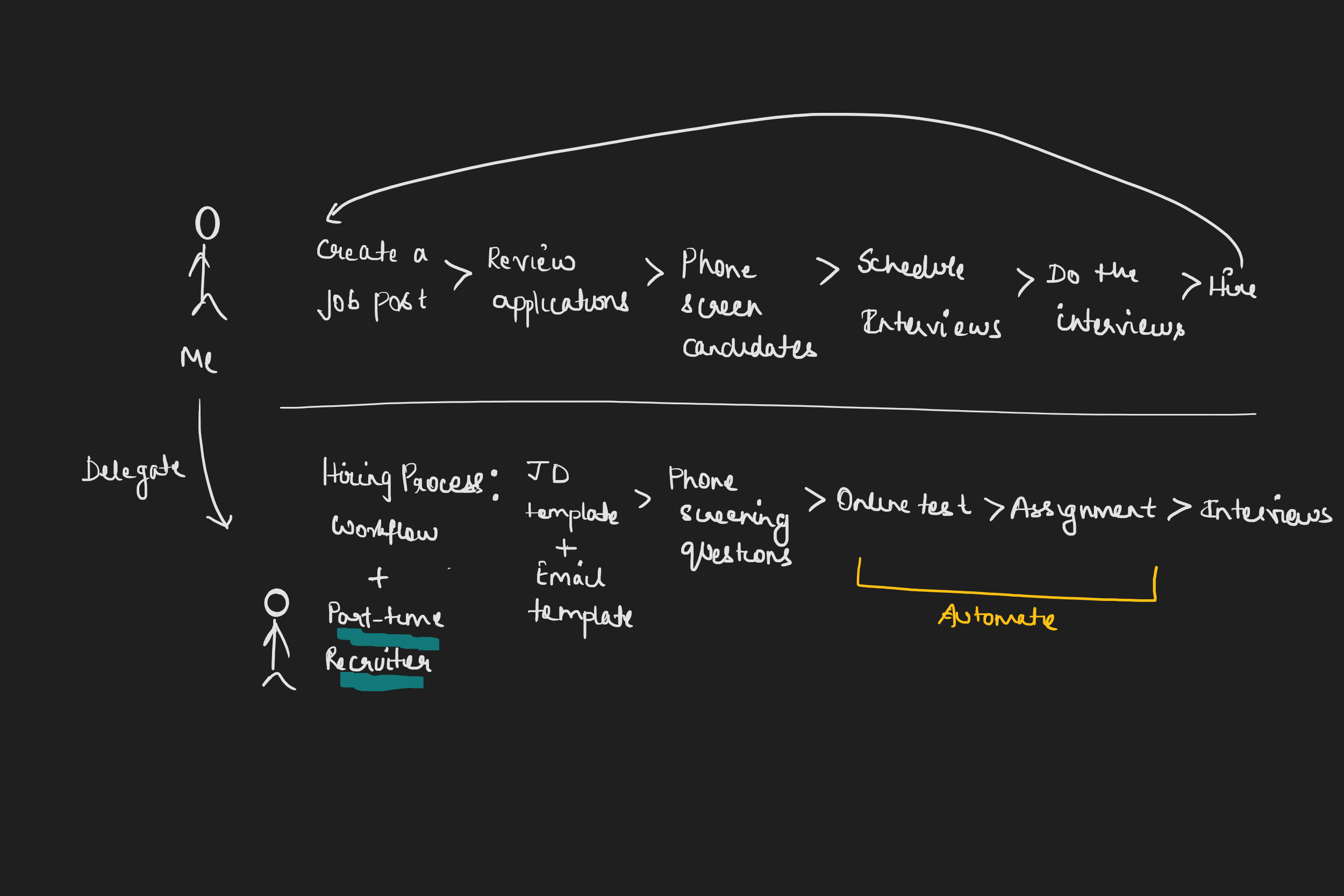
One of our earlier experiments with building a system was around hiring. I spent time writing the job description, posting the job, sharing it on social media, and reviewing candidates every other day. There was a natural time it took for this process to be completed, but this time was being spent by me when I could have been doing other things.
So over a period of time, I began documenting the steps that were being repeated, we built a quiz and added an assignment to our interview process. And when the opportunity presented itself, we hired a part-time recruiter, who was trained on this hiring workflow for a week and given access to the instructions and tools we were using to manage to hire.
Today, I only get involved at the latter stages of the hiring process with the recruiter doing the bulk of the work, to do final rounds of interview and signing the offer letter and employee contract.
This saved us a ton of time over the last two years and not just that it also now gives me the confidence that we can hire good people consistently through a reliable process that works without my involvement for the most part.
What if we could take this approach and apply it to different functions of our business?
In fact, a rudimentary version of this had been implemented unconsciously from day 1. Our content marketing efforts began at the same time when we launched Pixelmattic as a WordPress focused agency. I worked with interns and junior content writers over a 2 year period creating templates and documents refining them along the way.
I never connected the dots or looked at it as a system. You can only connect the dots in hindsight.
Early last year when these different dots came together, we decided to put all of these prior experiences together to create a digital growth system, for ourselves and for our clients.
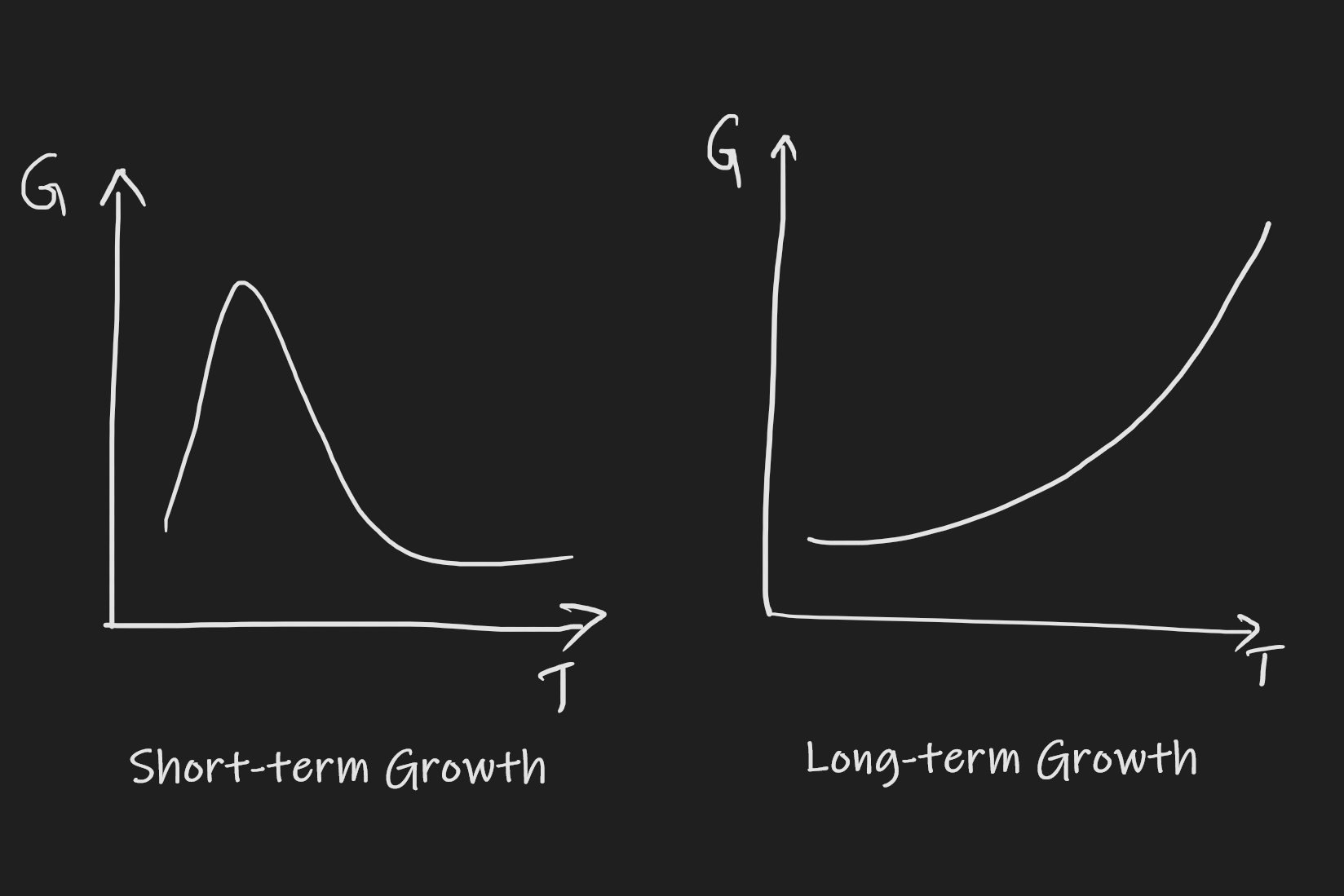
Often growth plans are too long term or too short term. So we created ours as a combination of long term thinking, medium-term planning and short term execution implemented as 2-week sprints.
So how do you design a growth system?
We’ll need to explore the definition of growth, systems thinking, components of a growth system, how do you build one for marketing, what role does WordPress play and finally look at some examples.
What is Growth?
Growth could mean more top-line revenue or bottom-line. Growth could be rapid and short-term focused or long-term. It can be achieved through acquisition, improvements to your existing practices, scaling your efforts or innovation.
Growth mindset
A mindset that wants to build long-term value through an easily repeatable system with predictable outcomes. Quite often we look for that one-hit wonder, or to somehow make the content go viral and so the need for growth hacking.
I’m talking of a different kind of growth, one that might take time to build, but once established, it becomes an asset that generates returns with lesser effort every time.
That’s the kind of growth I’m interested in.
If you’re a freelancer, you would like a portfolio of retainer clients that can provide a stable income. An agency would eventually realize that it needs recurring revenue to sustain itself and grow. A business not married to quarterly results will want it too.
This long term thinking is like investing in stocks. The day trader is very different from a long term value investor. Both require different mindsets and approaches.
Growth mindset = Build assets
When you look at building assets, assets that help you generate revenue, you build defensive structures for yourself. Assets can depreciate but they generally tend to occur over a period of time and not suddenly, giving you time to make adjustments or further investments in it.
Let’s apply this mindset to marketing.
Many are lured to the short-term boosts and benefits that some tactics provide. For well-funded businesses, they can continue to operate this way spending their way through marketing and advertising to grab attention.
But if the high spending tactics stop, so does the growth because no effort has been spent on building marketing assets. Assets that can generate traffic, leads and revenue passively.
Marketing and product teams
The focus in the mid 20th century was on the products. Because there was less competition, you could market yourself on the strength of your product and its features. The marketing was driven by the product’s features. And the marketing’s job was to push the message out that the product team wanted. That is a legacy that can still be seen in many companies that are product focussed.
However, over the last decade or so we’ve seen the lines blur between product and marketing. Features built into the product have driven marketing leading to user acquisition through referrals, invites and word of mouth. Or app notifications to keep pulling you back for user retention. Marketing is now integrated with the product and vice versa.
There is a need for product and marketing teams to work and collaborate with each other much more than before. In fact, the old structure of having two separate teams each with different objectives and responsibilities doesn’t lend well to tight collaboration
Growth teams
Businesses need to look at their marketing team as a growth team. Not a silo that is responsible for coming up with creative campaigns when the business or product teams demand it. This might require cultural and structural changes in how the company operates.
A growth team could include business analysts, product managers, marketers and designers.
Companies tend to adopt different approaches to building growth teams. A growth team can be incorporated inside each business unit making them responsible for growth, or a separate function carved out to do R&D and incorporating them into an existing business unit later or fork them into a new business unit.
Pharma companies for example set up dedicated R&D centres and handover the products to sales/marketing teams. Large companies like IBM setup business excellence centres in-house to come up with new growth initiatives. These teams are then incorporated into existing business units or spun off as new business units. Retail food chain companies treat each outlet as a growth unit responsible for managing and driving growth on their own.
A balancing act – Growth v/s status quo
Growth by its very nature brings ambiguity, uncertainty and requires exploration and experimentation. It requires doing things you’ve never done before and exploring the unknown.
On the other hand, you also have your current state (which can include servicing your existing clients, maintaining your current product etc). This needs you to focus on execution, efficiency and productivity.
As a freelancer or a business owner, you will need to learn to balance your time between growth and execution.
A growth system helps you manage the ambiguity and uncertainty of growth through a scientific process-driven approach.
Controlled chaos.
A mental model from Michael Gerber’s E-Myth that helps with this is the following: An entrepreneur has 3 roles to fulfil and they start with one role and eventually graduate to incorporating all 3 roles.
A freelancer or business owner starts off being the technician or the artist, doing the work themselves. As you get a few customers and are ready to hire your first employee, you transition from doing all the work to delegating some of it and managing an employee or a team.
Eventually, you should transition from being a manager of employees to a leader with a vision charting the future growth path for your business.
If at this stage, you find yourself constantly involved in the technical areas so much so that you’re unable to allocate time to manage or lead, you will notice issues with the quality of the team’s output.
Focusing only on the manager role or technical role will result in a lack of direction and slowing down of growth. So be conscious of how you evolve and divide your time between these three.
Start with identifying what are your responsibilities or skills that add the most value to your client? Is it design, writing, coding? Do you want to do it every day and for all clients? Or you want to hire someone else to do it so that you can focus on growing your business?
If you want to continue to grow your business, you also need time and space to think about new opportunities and areas for growth. But you can’t do that if you’re busy with execution and management all the time.
A template for delegating
One of our lessons has been to learn to delegate responsibilities as your business starts to grow and you have a team in place. But simply delegating isn’t enough.
To set your team up for success and free up your time from operational or administrative work, you need to do more. You rely on processes, tools to automate, the right team and a clear vision of what you want to achieve and the outcomes you expect.
Once you prioritize areas that you don’t want to do every day, hire an employee and or automate it.
David Perell succinctly articulated this in one of his tweet threads.
If you ever need to delegate a task, follow these steps.
1) Outline the vision. 2) Share resources. 3) Describe your definition of done.
If you’ve made a good hire, the above document can ensure they are well set up to succeed and take that responsibility off your plate.
There are many of these tasks which can be automated too using tools like Zapier, Notion, Trello, Airtable etc.
Building a growth system
With a mental model of the different roles in mind and a system to delegate tasks you no longer need to do yourself, we can now look at how to build a growth system.
A growth system is a framework for setting a direction, delegating responsibilities, automating tasks, documenting the processes, periodically measuring progress and course-correcting along the way.
Everything I’ve mentioned up to this point but put together in a coherent way towards achieving your clearly defined growth goals.
Principles + Processes + People + Experiments
What are the principles of a growth system?
You focus on opportunities, not ideas. (Idea + Value = Opportunity)
Emphasis on impact and not on activities. (But the process is as important as the outcome)
Reflection on lessons learned from growth experiments. Not dashboard addiction.
If you look at your notes or inside your own head, you will find a graveyard of ideas that never saw the light of day. For most of us, the idea-to-execution route is a highly inefficient one.
We either choose the wrong ones or take on too many or don’t stop to reflect on the ideas we implemented.
One way to find reliable and focused ideas is to look at the intersection of your users, product and channels.
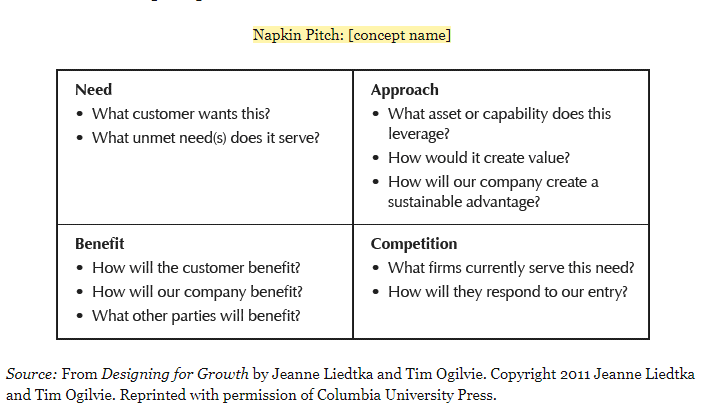
Brainstorm and develop the best ideas into concepts using tools like the Napkin pitch.
Assess the idea for its emotional appeal, apply constraints, reframe the problem, connect the dots from another area, challenge the accepted norm, visualize the idea or look for synergies in collaboration.
We usually rush through these steps or skip them entirely because of our belief that we know what the customer wants or the urge to build something quickly because we have the technical and design skills.
It’s crucial to test these shortlist of developed ideas using these 3 tools:
Looking at data that confirms or disproves your hypotheses
Building an MVP to test
To keep a steady flow of growth experiments running, building a pipeline of ideas that feed into your growth system is important.
What are the processes that make up the growth system?
Since we are talking about long-term, repeatable growth, we will focus on SEO and content marketing as key pillars around which we need to develop repeatable and scalable processes.
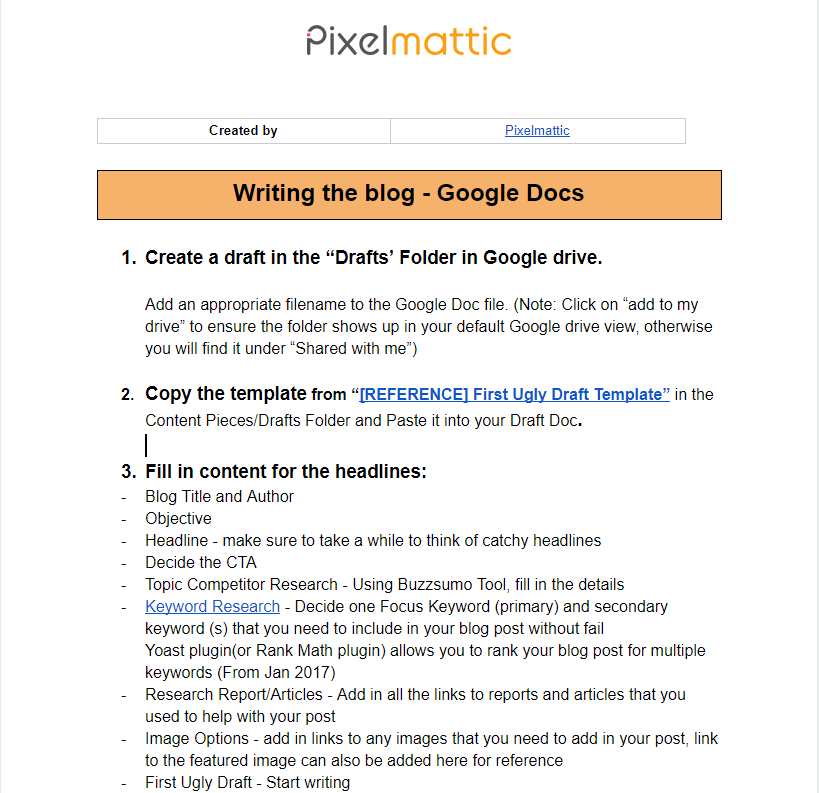
Let me take you through some of the workflows and processes we ended up creating for our content marketing. These are not perfect and are always updated when we something better or missing.
Content Ideation
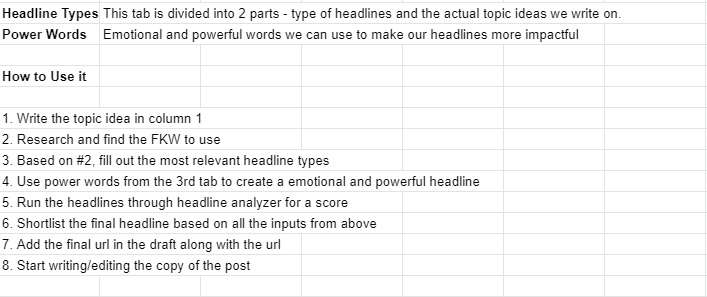
A headline writing and content ideation tool taken from Ann Handley’s book ‘Everybody Writes’ with some additional bits added. This document helps us with prompts for headlines and quick reference of power words to use.
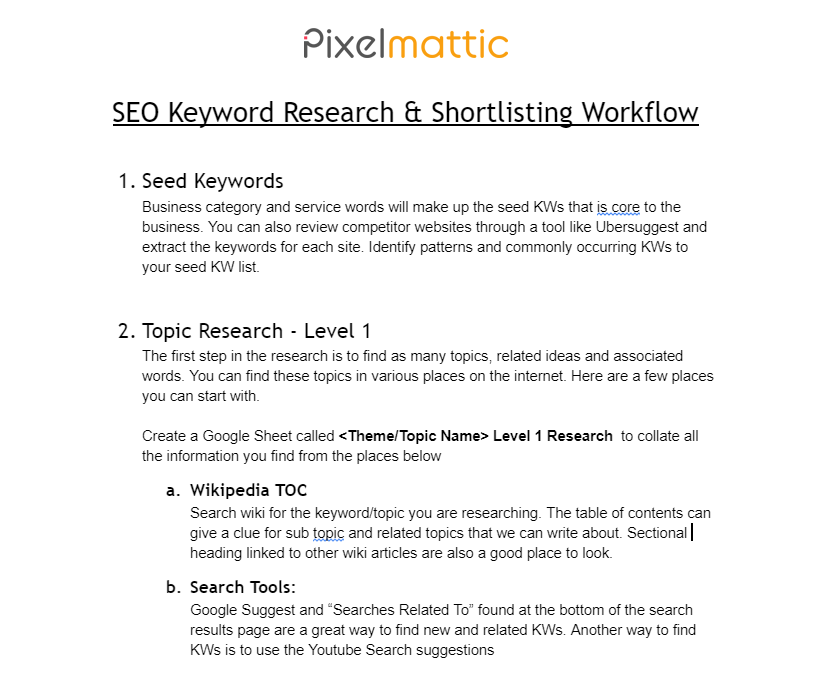
A step by step workflow of listing seed keywords, generating additional keyword ideas, finding search data and then shortlisting them through filters like search intent, keyword difficulty and so on.
This seems boring, but when you add a new member to your team or even outsource your work, a documented workflow reduces your back and forth significantly. It also ensures that you maintain a consistent quality in the output.
Once a piece of content is published, promoting it is the next big challenge. We have a list of channels and tactics we’ve collected in a document. Not all of them are used for every content piece that is published, but its good to have a central repository of promotion tactics.
(Link will be updated here once the document is cleaned up a bit)
If you remember the growth principles, the goals and expected outcomes from these processes is growth that can be measured through leads, subscribers, lead conversion rates and revenue generated.
Pageviews, number of users, followers etc are vanity metrics. You should keep an eye on them, but don’t stop there, see if they add up to something meaningful and impactful for the business.
What kind of people do you need for the growth system?
In the beginning, it’s usually one person bootstrapping and doing many things in parallel. But as you grow and hire a team, in house or freelancers, you need to keep a few things in mind, because the mindset and skills required in your execution or product teams are different to what is needed in the growth team.
Growth teams don’t necessarily work on anything too complex, so pick people motivated by impact they can create than those who want to be challenged.
Measure and incentivize this team on the number of growth ideas generated, the number of growth experiments run, the number of processes documented, the number of processes automated and most importantly the financial impact of the improvements and the time spent with the costumes. Make it a habit to spend time with your customers, measure it and incentivize it.
Growth experiments
This is where your growth tactics, growth hacking tips and SEO tricks you may have read about come into play. Quite often, we jump to this stage because we are excited to try something and want to see the impact of it quickly. But when your tactics don’t add up, it doesn’t take you far in the long run.
So run your tactics as experiments in the system, measure the impact and learn from them systematically. Doing this systematically until you achieve a level of success and automation which can then be scaled or self-driven will help you turn them into sustained, revenue-generating assets.
We run 2 week sprints, track the progress and measure the impact of it over a period of time.
If you’ve done the groundwork and rigorously filtered through your ideas, your growth experiments will have a higher chance of success.
The testing and measurement through analytics and other data points should be converted into lessons that you can learn. These lessons will help you make the next growth experiment better.
Marketing Flywheel
These growth experiments are aimed at top of the funnel users usually. But as we’ve seen in recent years, the bottom of the funnel user action can trigger new users to enter at the top of the funnel. This makes the funnel analogy a bit dated.
Consider a marketing flywheel analogy, where you need a few tactics to get the attention to achieve the initial push. Then focus on sustainable steps which requires lesser effort on every subsequent run but continue to produce a steady flow of results.
Once this flywheel is in motion, it runs efficiently and produces repeatable successes. This marketing flywheel is at the core of your growth system.
Rand Fishkin has a lucid explanation of what a marketing flywheel is and how it helps. Take a look:
So when you combine the principles of growth, convert ideas into testable growth experiments and put them in motion through the marketing flywheel with the right team and processes, you build your growth system.
Contrast this with jumping into SEO tactics or creating campaigns that in most cases only provide a temporary boost.
Every growth system is unique to the business. It depends on the industry, the users and the channels you use, but the principles remain the same.
In our case, we’ve built a 12-month plan that focuses on first building a strong digital foundation, creating a content strategy, optimizing and fine-tuning it over 4 phases.
We deploy the same practice now for Pixelmattic and for our clients with some minor modifications based on their business and industry. So we are the customers of our own service and consumers of our content.
Here’s Tim Soulo, the CMO at Ahrefs (a leading SEO tool), talking about the Ahrefs Marketing Flywheel: (If you don’t follow them, they have one of the best content marketing strategies that educate audiences and also converts a good portion of them into their customers.)
“I was stuck in a cycle of receiving the instant gratification of small gains in exchange for the delayed gratification of consistent and perpetual streams of new leads.
Were there moments when I thought progress was slow? Yeah, but I stuck with it. Things only started to pick-up 6 months in and totally blew up after 2 years of hard work:
Ahrefs’ Marketing Flywheel
Here’s how our blogging strategy works:
Determine what customers are searching for in Google, as related to a problem we solve. Yep, we use our own SEO toolkit for this.
Publish an article on how to solve the particular problem, while demonstrating our product as the ideal solution.
Promote that article until it begins ranking on Google for the topic.
Receive a perpetual stream of visitors from Google; all of whom may, potentially, become customers after reading about our product.
Enjoy word-of-mouth publicity, as our “educated” customers tell others how our product solved their problems.
How does WordPress help in building a growth system?
Even if your user acquisition and engagement happens primarily on YouTube or Instagram, having a home on the internet that you own which is not susceptible to platform policies and algorithm changes is vitally important.
There have been many instances of people losing their audience when the platform took arbitrary decisions, made policy changes or tweaked the algo.
But if your growth system is built on SEO and blog content, then WordPress becomes a natural fit.
Recommended WordPress Stack
Managed WordPress hosting, lightweight WordPress theme like 2021 or others, plugins for SEO, performance and backups.
Getting started with WordPress: Solid host + lightweight and well supported theme + backup solution will save you a ton of headaches.
Start with these and add only what is needed as you go along. Avoid adding more than one plugin for achieving a similar purpose. Get a WordPress developer if you’re not comfortable with coding, but follow these practices of keeping things simple and light.
Once you’ve built the WordPress stack, you can now look at creating landing pages, CRM integrations, chatbots and opt-in forms to implement your growth experiments.
Here’s a digital marketer’s playbook for WordPress that explains some of the best practices, suggested plugins and options you can consider when setting up the website for your growth system.
Read this tweet thread for a quick summary.
This 20 chapter guide on optimizing WordPress for marketing was one of the best things I worked on this year. We covered every aspect possible that a business owner or a non-tech person would need to know when trying to use WordPress for marketing.https://t.co/ttEvijMq2z
A year that started with optimism turned into cancelled travel plans (I was supposed to go to Bangkok for WordCamp Asia) in Feb, a sneaky feeling that something was going to happen in March, panic buying of home supplies in April and May while witnessing the horrifying scenes of migrants walking back home while we sat in the comfort of our homes complaining about not being able to buy from BigBasket. June to August went by with the constant visuals of graphs that only seemed to go up. And then we all forgot about the numbers.
The disruption of the lockdowns and the pandemic had its 2nd and 3rd order impact on us. The house help stopped and I bought a vacuum robot to clean the house while we did dishes. Our nanny had to go back in July and that caused the biggest disruption in our lives and we’re still struggling without one.
The initial lockdown period was a surprisingly productive time with the launch of the new Pixelmattic website that was in the works for a long time and also the publishing of a massive WordPress playbook for marketers. When the market is good, you sell. And when the market is bad, you build.
Build is what we did, working on positioning our agency as more than just a WordPress development firm. The second half of the year was a continuation of building new things after the website and the guide went live. We beta launched our most premium service and it is now public with 3 customers signed up.
While 2020 was a miserable year, it is easy to forget some of the positive things that happened, albeit reflecting from a place of privilege which I was reminded of almost every other day.
So here are my lessons from 2020.
The planning fallacy
Plans are pretty, structured, and organized. Life is beautiful at this stage. But when it comes into the real world, it’s a chaotic mess and your plans are shredded to tatters. Most often we don’t have a fall back option or a plan B.
I’ve been guilty to dwelling too long in the planning stage. It’s mentally stimulating and exciting to make these well thought and detailed plans, but what I’m actually is postponing the inevitability of having to take action.
Why do we avoid something through procrastination? The CTBD book proposes a theory that this is borne out of our underlying fear and insecurities. In some cases, the detailed plans also mean a lot of work, which can seem like an insurmountable mountain even before you begin.
I’m now veering to experimenting with planning only for the short term, 2 weeks at most. Not even 3 months as I initially thought with the 12-week framework which I really liked. Long term planning is going to be binned for sure as it is pointless to think that far ahead, specially since what we’ve been through in 2020.
Long term goals if anything should be directions and not specific instructions to oneself of what to do. For me, my long term goal is to build Pixelmattic into a self-sustained business that runs without my daily involvement. On the personal front, I want to create a system to capture, process and express my thoughts on a consistent basis, whether that is through a blog or maybe even a YouTube channel.
Information collection to actionable insights
I’ve been an information hoarder for a long time. I like to collect what I think are great pieces of information and knowledge, but I never get around to reading and internalising a majority of this catalogued information. I started using Roam this year, one of my best discoveries of 2020, and I’ve been collecting information, thoughts and everything in between on one single tool.
My next step is to organise the tool and learn the ins and outs of this powerful app. Personal knowledge management is an interesting space and I find it to an extremely valuable asset that one can build for themselves. This system would be capable of capturing, storing, surfacing and help you connect the dots.
What use is it of you have all this information you’ve hoarded but can’t take advantage of it. A system to mine your own thoughts and insights is a powerful way to take better decisions. It’s like building a version of yourself and being able to query it for insights when you need it.
On the topic of information collection, there was a period where I used Feedly to curate the best sources of information and would regularly read information. But what I’ve realized after spending time on Twitter in 2020 where I was inactive for a long period is that you follow people now and not blogs. Curating people you can follow and their well-articulated and concise thoughts on Twitter is the best source of new information and learning. Here are some amazing people I’ve discovered on Twitter in 2020:
An area I’ve neglected for a long time because I assumed it didn’t affect me and that I was a “mentally strong person”. Acknowledging that you are as vulnerable and susceptible as any other person is a good place to start. When you do that, you start considering options that can help you prevent, manage and deal with times when you feel down.
2020 made you relook at things in life you had taken for granted. Self-care was one of them. Spending time on yourself, looking at the hard truths, and prioritising on what really matters.
As a result of this exploration, I was led down the path of writing down my thoughts. While the 100 days of writing failed, I did consistently write in my journal. It’s a practice I still follow most mornings. I shift from a physical journal to my note-taking app depending on how I feel that day.
This journey also nudged me to explore meditation which I must confess I looked down upon. I didn’t think it was a worthwhile activity and wouldn’t add much value to my life. Of course, my preconceived association of meditation with spirituality and fake gurus didn’t help. But I gave it a try with the Calm app on iOS. I haven’t done it consistently enough, but there was a period where it was a part of my morning routine. I look back on it and realize that the post-meditation feeling was always a positive one. It was self-therapy. I would come out of a 10-minute meditating session feeling good. What helped was looking at meditation from the perspective of neuroscience. It was a brain exercise. The overstimulation and information overload that the brain suffers and goes through in a day need rest, relaxation and stillness. Words like stillness and balance were woo-woo words for me, but I realize I was wrong.
With a child at home under lockdown and working full-time, the interruptions and distractions are non-stop. I’ve never been an early morning person, but in 2020 I decided to try it. I wanted a block of undistracted and quiet time. The only logical time slot was early morning or late night. But working late into the night would lead to snacking, watching TV, waking up late the next day and being unproductive during the day. So I decided to switch my routine and wake up early.
Whenever I’ve woken up early, the morning routine has generally followed this pattern:
Wake up
Make coffee (another new habit I developed in 2020, more on this later)
Journal/Write/Doodle
Meditate
Read/Make notes
Plan for the day
Connecting the dots
We had most of the pieces of the puzzle that we’d built over the years through projects and lessons learned. We now discovered a structure and all the pieces fell into place to create the Digital Growth System. This was a culmination of everything we had done up to this point, distilled into a focused approach to deliver maximum value to clients and build a long-term sustainable revenue-generating service for ourselves.
The process of eliminating and reducing the noise around what you do brings focus and clarity. We chipped away at our service offerings to find where the real value was. We also discovered that this was what we really enjoyed doing and not the kind of projects we ended up taking on or the kind of clients we ended up working with since we didn’t have a well-defined filter to say no. It wasn’t just price as a filter which we have used over the years, but clarity in the kind of business that would be a natural fit for our service. It is tempting when you are looking for growth to say yes to many different kinds of business opportunities that bring you short-term benefits.
We’re now working towards the goal of running the agency that does not take up our time on the execution and day to day operations, but instead allows us the freedom to work with clients at a strategic level, solving hard marketing problems, designing sustainable solutions and spending time working on new growth opportunities. To do this our approach is to delegate, automate and document the processes and workflows in a way that they can be managed and executed without our involvement.
Things I tried in 2020
☕Coffees I tried (and listed in order of preference)
8. The Anarchy: The East India Company, Corporate Violence, and the Pillage of an Empire by @DalrympleWill
[Thread] 17th century India was a bloody and turbulent time. Read @DalrympleWill ‘s The Anarchy recently and it throws light on a misunderstood organisation that was probably the first mega corporation in the world. And the political dynamics at that time.
11. The Courage to be Disliked by Ichiro Kishimi, Fumitake Koga
Quick take: A mindset based on Adlerian Psychology where you look at life as a series of moments and focus on the moment, not looking at the past or the future.
I’ve done the WFH for many years and it was never a problem. I had my space and setup. It worked. But now that we have two people WFH at the same time, we needed two comfortable spaces to work full days. I gave up my space and shifted 4 times trying to find the right spot in the house.
After giving up the WFH desk space to my wife, I've now moved my makeshift desk 3 times since the pandemic started. It's now next to the bar. pic.twitter.com/SX1PM25Ryi
I designed and had a custom sit-stand desk made at the farm. The link in the tweet below is a very useful calculator to find the right ergonomic measurements based on your height.
I was done playing musical chairs with my WFH desk, so I decided to convert a spare room into a dedicated home office.
Another update on the WFH desk situation. I'm done with the constant shifting. Converting the garage room into a home office. The room where it all started 10 years ago with @karansachdev and @dreamnotionhttps://t.co/GoyDGu5Bim
Most presentations and pitches fail because they focus on logic. Humans are emotional beings.
Short Summary
Pitch Anything talks about why the conventional approach of using logic and facts to deliver your big ideas fail and how you can use the power of frames in a social encounter with storytelling to trigger the right emotions and desire in the listener.
5 Key Takeaways
You talk from the rational neo-cortex, the cognitive logical part of the brain but the message is processed by the listener in the primitive part that deals with instincts and emotions. #system1 #system2 [[Daniel Kahneman]]
When you pitch, lead with triggers that work on the instinctive and emotional response of the brain. Facts come later to support your case. The ancient brain ignores more than it accepts, needs high contrast options to choose from, provides an emotional response, prefers the here and now, craves novelty, and needs verifiable evidence over abstract concepts.
Every social interaction has an undercurrent of power dynamics. To get the attention, to keep it and convince the listener, you need to own the “frame”. Steps include: Set the frame, start with intrigue, tell a story, make your offer the prize, add a time constraint and close with authority.
Avoid traps in social encounters which puts you in a lower position. Or bust through frames being imposed on you through denials, rejections, but with humour so as to not offend. Neediness erodes status.
Your passion for work, the domain expertise and knowledge become the source of your strength and confidence that allows you to challenge oncoming power frames and beta traps. Needs deliberate practice but also needs time to evolve organically to suit your personality and your work. Any forced fit will most definitely have negative consequences.
Long Summary
Brain Analogy
Crocodile brain: survival
Mid-brain: social relationships
Neo-cortex: problem-solving (cognitive)
Messages are composed by the new-cortex, but received and processed by the crocodile brain first.
Crocodile brain
ignores more than it accepts
needs high contrast and well-differentiated options to choose
emotional response
here and now
craves novelty
verifiable evidence and not abstract concepts
STRONG Framework
setting the frame
telling the story
revealing the intrigue
offering the prize
nailing the hook
getting a decision
Frame Control
Every business conversation is a collision of frames, points of view, perspectives, with the weaker one being subsumed by the larger one. The larger one then dominates the narrative
Your frame is a result of your power, authority, strength, information and status
Types of opposing frames you encounter
power frame
time frame
analyst frame
frame response types
power-busting frame
time constraining frame
intrigue frame
prize frame
Power Frame
Power is derived from their ego and status
Avoid power rituals in business situations that reinforce their alpha status
Power-busting move:
use a mildly shocking but not unfriendly act
use defiance and light humor
use the first opportunity to perpetrate a small denial
act out some type of defiance
Capture and keep attention until your pitch is complete
Prize Frame
Subtle reframing of everything your audience does and says as if they are trying to win you over
Make the buyer qualify themselves
Time Frame
Set your own time constraints first before anyone else does.
Time frames can be used to challenge your frame by disrupting you and taking back control.
Hot & Cold Cognitions
Hot cognitions = feelings of want and desire
Cold cognitions = analysis
Don’t let audience slip into cold cognitions during the pitch by removing unnecessary technical details. When asked for details, keep it brief and refer them to spec sheet later.
Focus is on the business relationship they seek to build with you
A hot cognition is the inner certainty of “knowing” something that comes through feeling it. A cold cognition is the certainty of “knowing” something is good or bad by having evaluated it.
The Intrigue Story
If the audience can guess the movie is about and what happens next all the time, they tune out.
Most people want novelty and intrigue. Figuring it out is a form of entertainment.
No one goes to a meeting wanting to hear something they already know. Most of the times the audience is trying to understand how similar is the idea you’re pitching to something they already know or a problem they have already solved. If the answer is yes, they tune out.
Intrigue frame is useful because it bypasses the logical brain and triggers the primitive one.
When the listener drills into a technical detail, respond with a short story about you.
Keep their attention by not telling how the story ends until you want to.
Characteristics of our intrigue story should include:
Brief and relevant to your presentation
Story about you
Element of risk, danger or uncertainty
Time pressure with ominous consequences
Tension/conflict with a villain
Prizing
A series of deliberate actions to frame you and your offer as the prize and shift the balance of power in your favour
One of the ways of doing this is by making the buyer qualify themselves back to you.
Ask them questions like “Why should I do business with you?”
Make them “apply” for your services
Another thing to guard against are attempts to change the agenda, meeting times and who will attend which alter status back in their favour
“Always be closing” a popular catchphrase in sales coaching materials emphasizes the need to keep closing deals, not the quality of deals, not the deals you should focus on, but just the number of deals.
Situational Status
Most business environments are setup with moats to put you in a low social status and when you pitch from that low-level your ability to persuade diminishes.
A “beta” is a subtle social ritual to put you in a low-status position and keep you there.
You break out of this or elevate your low-status through small acts of defiance and denial, And also by redirecting to your domain. Use your domain expertise and knowledge to then take the high-status position. AKA “local star power”
When you’re in the client’s territory, to neutralize the person holding the high-status, temporarily capture, redistribute to others who can become your allies.
Things to do when you know you’re going to start a meeting from a low-status position
Be on time
Don’t partake in social rituals that reinforce the target’s status
Create high status immediately. Force a frame collision and set your frame early.
Redirect to your domain of knowledge and expertise
Add a prize frame to yourself and your offer
Make your customer say something that reinforces your status
Pitch
At the start, the audience is wondering how long they’re going to be stuck listening to you. Put them at ease and mention you will only take 20 minutes and leave 10 minutes for Q&A.
When presenting, your mastery over time and attention is more important than mastery over the details.
4 Phases of the pitch: Introduce yourself and the big idea – 5 min, Explain the What and secret sauce – 10 mins, Offer the deal – 2 mins and Stack frames for a hot cognition
Pitch Phase 1 – Introduce yourself and the big idea – 5 mins
Speak about your track record of things built and successes. < 2 mins
one great thing about yourself > one great thing + one good thing
Don’t get hung up on details, questions and deep conversations at this stage
After the “Who I Am” story, introduce the “Why Now” story. Frame your idea as new and emerging. Contrast it how it was before and paint the future. Convey that your ideas were the result of your observation of patterns to answer why it is relevant, important and should be considered now
Three-Market-Forces Pattern: Trendcasting
The three basic steps of trend casting are:
Explain the most important changes in our business. Forecast the trends. Identify important developments both in your market and beyond.
Talk about the impact of these developments on costs and customer demand.
Explain how these trends have briefly opened a market window.
Movement – if we show two possible states without highlighting the difference, people may not always see it. Need to show the movement from one to the other. Movement might also suggest threat, so it needs to be carefully presented as an opportunity.
The Big Idea Time
For [target customers] Who are dissatisfied with [the current offerings in the market]. My idea/product is a [new idea or product category] That provides [key problem/solution features]. Unlike [the competing product] My idea/product is [describe key features].
Pitch Phase 2 – Explain the What and your Secret Sauce – 10 mins
Possibility of scaring the ancient brain multiply when you start to explain how your product/solution works.
Avoid lengthy details about how it works. Details about relationships between people is welcome
Attention = Desire X Tension (balance)
Dopamine is the neurotransmitter of desire. Norepinephrine is the neurotransmitter of tension. Together they add up to attention.
Attention = Offer a reward X Take something away
Attention – directly proportional – information novelty
Novelty = violating the target’s expectation in a pleasing way
Create information gap (what they know and what they want to know) which leads to curiosity of the big idea
When curiosity is satiated, pitch is over.
Tension indicates consequences and therefore importance.
Create tension through push and pull patterns Push and Pull Tension Patterns
If you only pull it will be perceived as hard selling
If you push too much they will leave
Tension loops: push-pull-create tension-resolve it.
Push-Pull Patterns
Low-Key, Low-Intensity Push/Pull Pattern.
PUSH: “There’s a real possibility that we might not be right for each other.”
[Pause. Allow the push to sink in. It must be authentic.]
PULL: “But then again, if this did work out, our forces could combine to become something great.”
Medium-Intensity Push/Pull Pattern.
PUSH: “There’s so much more to a deal than just the idea.
I mean, there’s a venture-capital group in San Francisco that doesn’t even care what the idea is-they don’t even look at it I when a deal comes in. The only thing they care about is who the people are behind the deal. That makes sense. I’ve learned that ideas are common, a dime a dozen. What really counts is having someone in charge who has passion and experience and integrity. So if you and I don’t have that view in common, it would never work between us.
[Pause.]
PULL: “But that’s crazy to think. Obviously you value people over smart ideas. I’ve met corporate robots before that only care about numbers-and you are definitely not a robot.”
High-Intensity Push/Pull Pattern.
PUSH: “Based on the couple of reactions I’m getting from you-it seems like this isn’t a good fit. I think that should only do deals where there is trust and deals you strongly believe in. So you let’s just wrap this up for now and agree to get together on the next one.
[Pause. Wait for a response. Start packing up your stuff. Be willing to leave if the target doesn’t stop you.]
Pitch Phase 3 – Offer the deal – 2 mins
What you will deliver, when and how.
Explain their part, role and responsibilities
Offer summarized facts and not details to ensure they have a complete picture of the offer
most important deliverable in your deal is you.
Pitch Phase 4 – Stack frames for a hot cognition
Hot cognitions = feelings of want and desire
Order of stacking: intrigue frame, prize frame, time frame, moral authority frame
Hot Cognition 1: The Intrigue story
It’s not about the What, but Who and how the Who reacted to the situation
Your idea is an abstract notion, but you in situations reveal your character
Short and strong narratives that introduce characters who are overcoming real-world obstacles can ignite hot cognitions-which, in turn, push the target out of paradigmatic and analytical thinking mode.
Hot Cognition 2: Prizing Prize frame
The basic elements of the Prize Frame include:
I have one of the better deals in the market.
I am choosy about who I work with.
It seems like I could work with you, but really, I need to know more.
Please start giving me some materials on yourself.
I still need to figure out if we would work well together and be good partners.
What did your last business partners say about you?
When things go sideways in a deal, how do you handle it?
My existing partners are choosy.
Here’s the internal pattern, the words you say to yourself to fully activate and deploy the prize frame:
I am the prize.
You are trying to impress me.
You are trying to win my approval.
Hot Cognition 3: Time frame
Time pressure reduces decision making quality. Push it too far and it has negative consequencs
Scarcity bias
Hot Cognition 4: Moral Authority Frame
Stack the frames, create the desire and trigger instant hot cognitions. Don’t wait for the evaluation that might trigger cold cognitions.
Reality isn’t waiting to be discovered it’s waiting to be framed.
Neediness
Neediness erodes status
It’s perceived as a threat and leads to avoidance
The awkward two-minute period after the pitch is the most vulnerable time
Reasons for this behavior:
When we want something (money, project,job) that only the target can give
When need cooperation and can’t get it
Validated when target says yes
Target is uninterested or loses interest in you
It’s an involuntary fear response when triggered
Solution: Expect nothing, focus on what you do well and leave the social encounter
Social Dynamics
3 insights into social dynamics
Structural – package ideas for the brain that triggers hot cognitions (desire and wanting)
Procedural – be on the lookout for power frames and win the frame collisions with stronger frames
Humor and passion for your work
Steps to learn the method
Learn to recognize the beta traps
Gradually side step them
Identify and label social frames
Initiate frame collisions with safe targets at first
Take control of a social frame through conflict and tension. If you trigger defensive responses, you might be coming on too strong
Stick to a few frames that work for you and avoid complication
Language of Frame Control
Use the language and practice with your team
“These guys set beta traps from the lobby all the way to the conference room. You have to time frame them immediately and withdraw. After that, they just hit you with power frames. Just break it with a prize frame. And then frame stack a few push/pull patterns.
“Here comes the analyst frame. Let’s hard-core intrigue frame, seize local star power, and withdraw.”
Here are the most important terms for you to know and to own personally:
Short Summary: The nuts and bolts of the ad creation process from ideation to execution and the art of client servicing. An inside view of how the advertising world functions with great examples of advertising peppered throughout the book. While this book is about advertising, business owners and marketing folks will find it useful.
Note: This post is a combination of my highlights from the book and paraphrased notes.
5 Key Takeaways
Tension and conflict are essential parts of storytelling.
Ideas don’t magically happen, it’s a disciplined process
When you focus on the brand’s truth and core emotion, you have a chance of creating a platform, not just an ad campaign
The goal of creativity in this context is to create a positive impact on the brand, not to simply appear clever
Taking a contrarian view compared to everyone else in the category or industry gets you attention.
Managing and servicing clients
Ideas for helping your client find that differentiating point of view:
Important to remember that a brand’s potential customer has only room for perhaps only 3 brand names for every category
When researching competitors, find the truth they are exploiting in their marketing campaigns that you are not
Maintain an outsiders perspective while speaking to your client in their familiar language
“Find the emotion” of the brand’s customers by eavesdropping on their conversations
Put yourself in the shoes of the customer and ask “what would make me want to buy this product”
Visualize a day in the life of the customer and how your brand fits into it. Generous brands are empathetic to their customers and pay more attention to the calendars of their customers than their own
Study the contact points between the brand and the customer
Marketing Ideas from the book
Inadequacy marketing – where the product is the hero and the customers are the losers if they don’t buy it.
Empowerment marketing – where the marketing appeals to the human desire for personal growth.
Authentic marketing tactics – Being transparent, under-promising and over-delivering, self-deprecating and embracing the worst things about your product. In contrast, vanity, puffery, insincerity and gimmickry come off as inauthentic.
Client Strategy
Developing a client strategy is about going into a customer’s brain and spot welding one specific adjective to the client’s brand
Questions to ask when you are done with your work for the client – “Oh yeah? So What?”
The answer to the first question – “Oh Yeah?”, should be a claim that’s incontestable and the answer to the 2nd question – “So What?” is that it should matter someone.
Tight Strategy is a strategy that should be evident in the campaign but the campaign should not be evident in the strategy
Luke Sullivan, Hey Whipple
The ideation and creativity process
When you are paid to be creative it is fair to say it comes with a lot of pressure. The pressure to deliver something good. The process of creativity, the author says, is like a controlled daydream.
It is a lonely vigil interrupted infrequently by great thoughts whose origins are almost always a mystery
Mike Lescarbeau
Ideation starter: “How might we?” used by IDEO
“How” assumes solutions exist giving you the creative confidence to identify and solve unmet needs
“Might” gives us permission to try out ideas that may or may not work
“We” signals collaboration and building creative solutions together
We often associate creativity with inspiration and moments of magic. But many folks in the industry including the author in this book suggest it is in fact a result of a disciplined approach.
Yesterday, I talked about "idea sex" in a workshop with @david_perell
Today, I wrote an article to expand on it:
• Many still believe in an elusive muse • But inspiration is unreliable • Idea sex is a sustainable way to drive combinational creativityhttps://t.co/4VfMFzHLXI
An idea can stem from the truest thing you can about your product or brand. For example, Crocs are extremely comfortable, but most people would agree that they are ugly. That’s the truth. If you acknowledge it and then turn that into a positive, you have a great idea for a campaign.
“Our goal is not to make the haters love the brand,” Rees recently told Business Insider. “It’s to exploit that extrinsic tension because it creates opportunity, it creates PR, it creates media, it creates interest. It creates a whole lot that would cost you a fortune to buy in other ways.”
Andrew Rees, CEO Crocs
While we can design and develop a brand, it ultimately exists in the mind of a customer which we can’t control. We don’t control the universal truths either.
Another example of this approach was the legendary “Think Small” campaign by Volkwagen ranked as the best advertising campaign of the twentieth century. After World War II, the United States had grown rapidly and people were looking to buy big muscle cars. Car companies at that time would provide as much information as possible. Also, the Beetle was manufactured in a plant built by the Nazis which would have created a negative perception of the car.
Taking the polar opposite view of the competition and what the market believes makes for an attention-grabbing idea.
Great stories and movies revolve around conflicts. The tension arising out of a conflict of ideas, views, and opinions. Rich vs poor, trust vs deceit, spending vs saving, money vs love. In all of this, you will find a villain, and if you can paint an oversized or overpriced competitor indirectly as the villain, you have an opportunity for making your brand stand out.
For a story to be interesting, it needs positive and negative forces in play to create the tension
Identify the central conflicts in the company or the category and list them down.
Truth + Conflict = Platform
A campaign is only a series of ads with similar messaging and art direction. A platform is larger and embodies the truest thing about the brand. Nike’s Just Do It is a great example of this.
Here are some tips from the book worth keeping in mind during the ideation process:
Write down your ideas first, make them memorable later.
Don’t be clever to the point that makes you shine instead of the product.
Stare at a group of pictures that have the emotion of the ad you want to create.
Gather data and then let your subconscious connect the dots.
List down all the words from your product’s category.
Address the obvious shortcoming of your brand directly and really own it.
Come up with terrible ideas.
Don’t cancel out ideas from your partner or team member.
Put the best ideas on the wall and look for patterns (CSI style).
Come up with lots of ideas. Don’t stop at a hundred.
Set up the picture and the words so that the difference between them is breathtaking.
Whenever you can go for the absolute all claims in the middle are forgettable.
Use metaphors. An idea that happens in the mind stays in the mind.
Funny is a subset of interesting. Be interesting first.
Find one great image and build story into or out of it.
Don’t show what you’re saying, or say what you’re showing. Make visuals and words supply slightly different pieces and let the users mind do the 1 + 1 = 3 for impact.
First 2 seconds of ad should be visually unusual to create the curiosity gap.
Last 5 seconds resolves, summarizes, explains the preceding 25 seconds
“Audiences will forgive almost anything in the first half of a movie and almost nothing in the second”
Types of ideas
“Age” ideas – Order a drink that takes nine years to get.
Don’t use fake names or product numbers in the headline
If the visual is doing the communication don’t let the headline take away the attention
Body copy rules:
Write like you would talk if you were the brand with a personality
Write like it is a conversation with one person
Get straight to the point in the first line of your copy with your most persuasive interesting and surprising point
Use transitions to flow seamlessly from one benefit to the next
Simplicity
“Speed of the get” – the time taken for the customer to “get” the ad should be like the length of the fuse of a dynamite
It has the power to sometimes ask the reader to finish it in their heads
It can break through the clutter and easier to remember
Reductionism – the art of omitting
Every item you add to the layout reduces the importance of all other elements. Vice versa.
“outdoor board should have no more than 7 words”, but start with three as a goal
logos add to word count
outdoor requires you to be spectacular
Attention business & the digital customer
The author says the question a creative professional needs to ask is “What idea will make the client famous?“. It forces you to think bigger than just the immediate campaign.
Is my idea cool enough that the press will write about it?
Suggestions for ideas that will get your brand the attention:
Do something provocative, disobedient, wayward, eccentric, subversive, bold, frank, funny, unusual or recalcitrant
Figure out how to do something “perfectly rong”. He uses the misspelled word to further emphasize the point that ideas that are in direct opposition to all prevailing wisdom can get you attention
The highest form of “rong” is stupid
Eg: Happydent ads
Not right for expensive products, products with no real difference or serious purchases
Question the accepted norms of the product category
Use a medium “incorrectly”
Execution can become content. How you say something can become much more important than what you say (Visual > headline)
We cannot use logic to get our way into customers hearts. Sort out the feelings you have about the brand and then articulate them in the most memorable way you can. #Positioning
Digital Advertising and the digital customer
Two kinds of digital advertising:
Work that is digital
Work that gets digital
Offline to digital shift
Audience > Community
Message > Content or experience
Target > Invite
Media plan > Interest plan (content segmentation grid)
Penetrate > Collaborate
Questions to ask for your digital advertising brief
Digital brief questions
What problem are we trying to solve?
What do we want to happen
With whom are we trying to connect, influence or engage
What can we do for them: solve a problem, provide service, entertain, inform
What is the context for engaging them
What cultural trends or media trends are our customers already following that makes sense for us to align with? #Worldviews
Is it consistent with the brand’s position and purpose
What digital platforms are most relevant
Could customers and prospects be potential cocreators or sharers
What will inspire them to participate
Does greater participation make the experience more appealing
Are we making something temporary or enduring
Can we create something of social value
These questions aren’t any different because it’s a digital medium. Fundamental behaviours and human emotions still remain the same.
Tactics and stunts can get you attention, but they need to add up to something greater.
Digital requires storytellers and system thinkers to come together. The latter can help stitch together an experience on a digital medium making use of all the latest developments in technology and digital channels.