Blog

  • How we built a remote agency without realizing it

    How we built a remote agency without realizing it

    Our 2BHK office in the heart of Koramangala was barely being used even before the pandemic began. I would go once a week to the office. Our Bangalore employees would visit every other day initially, then once a week and eventually about once a month. Karan, my co-founder moved to Chennai a year ago, so he ended up visiting once a quarter.

    We finally decided that there was no point in keeping an office. We had been working in a hybrid environment for years now, with employees in Bangalore and other parts of the country. The pandemic was the final nudge to shut our office down for good.

    I went in after many months to clean up, gather all our belonging and memorabilia that had accumulated in the office over a period of 10 years. That’s how long it’s been for us on this entrepreneurial journey.

    Funnily this was my second time winding up an office. I had done it at my first job when working for a startup in the US, back in 2010. The US operations of the Israeli company were being shut down and I was requested by the CEO to help close down the office by selling off the office furniture and other items. I did the same thing this time around too.

    The Pixelmattic office was a co-working space for a long while, sharing space with 1985. It continued to work like that with our employees coming in and out as they wanted. It’s hosted a few WordPress meetups as well.

    Moving out of the office and going remote was not an abrupt decision but a gradual and organic one. We were destined to be remote because of the way we built and grew the company over the years. The way we created our work culture, how we generated new business, how we managed and delivered projects all played a role in us evolving into a remote agency we are today.

    I will go through some aspects of what we did, some consciously and some subconsciously, to create a remote agency, working with clients for many years without having ever met them.

    Want to read later? Get it via email.

    [emailoctopus form_id=1]

    Work culture based on the quality of deliverable not time

    Micro-managing has never been a trait we have followed at Pixelmattic. Both Karan and I despise it. This has been a challenge at times because our education system has trained our minds in such a way that giving autonomy and freedom to solve problems can put people in an unfamiliar situation.

    When we hire people we assume they are a good fit for the job. And so once a task is discussed and assigned we trust them to deliver it. The expectation of quality and timelines are set upfront. The initial months can be challenging and some might need time to ramp up to meet our expectations and we’re patient till that happens. Most of the times people do learn and progress to meet our levels. Some of course get overwhelmed and have to be let go.

    But it’s a pleasure working with people who once the task is understood can go off and get it done. We’re always available to help them when they get stuck with a problem, but there is no overhead of managing their work as long as they are sending frequent updates.

    Expectation setting is one thing but ensuring that it is understood is another important aspect. Both need to be on the same page as to what is expected to be delivered. There is a learning curve here. Communication is critical. Comprehension too. Since we work with employees from different geographical locations with English not being the primary language for most, it takes a while to understand the semantics and nuances in text-based communication. (Oh we don’t rely on video calls much)

    We’ve created internal documentation and do knowledge sessions every now and then to ensure the skills, quality and consistency across the company is maintained. It helps that we have a clear well-defined process for work, whether it is design, development or copywriting.

    Systems and processes are critical. Once they are established and the team is educated about them, they replicate the template for every project, only making changes as and when necessary.

    I’m a big believer in the documentation and creation of systems, the one big thing I picked up during grad school. It creates a single reference point for everyone to align their work. The expectations are clear, the steps required to execute the project are laid out and the outcomes are defined. What is then discussed is creative solutions for every project’s unique requirements.

    The genesis of remote sales

    From day 1, our approach to business growth has been digital marketing. More specifically SEO and content marketing. We started with one intern and me working on the website to build content and SEO over a period of two and a half years. 5 years later it continues to pay dividends. More than 60% of our new business every month comes from leads generated through our website alone.

    The sales process that starts online continues online through downloadable assets, presentations and paid website audits. By the time I speak with the client about the project, they are convinced that we are the right fit. It’s the finer points and details that are then discussed.

    While sales materials are shared during the sales process, some manually and some automatically, our previous work is on our website, the client testimonials are online and our point of view and opinions are on the blog. This gives most clients a good insight into how we think, how we work and what we’ve done previously.

    Of course, there are those who insist on meeting in person, but equally, there are those with whom we’ve worked for more than 5 years and never ever met them. Some of them happened to be in Bangalore. When you can build trust, step by step, and demonstrate your experience, online sales or remote sales becomes easy. In fact, I’ve never considered myself a salesperson in the traditional sense and nor have I looked at this as remote sales. It’s an organic result of all that we do and a conversation I have with someone who has a need and is interested in speaking with us about it.

    Our clearly defined processes and approach to work also eliminates a large portion of those who are not our ideal customers. It also puts us on an even keel and there is not vendor-client hierarchical nonsense. It still does happen with companies that have a bureaucratic process, but beyond a point, we decide to say no to some of them. Systems and processes are great, but if it gets in the way of having a productive and equal relationship with a client, it’s best to walk away.

    Tools to punch above our weight.

    We’ve always looked at tools that we can use to do more with our limited resources. Tools that can help us punch above our weight. Tools that help us become more efficient and produce more with less.

    Slack has been a fundamental tool in our evolution of becoming a remote agency. We never believed in sending internal emails. I hate them. Before Slack, we experimented with project management tools like Redmine, Asana and internal communication tools like Yammer. But once we tried Slack, it seemed to be a perfect fit for what we wanted.

    Slack provided the right amount of overlap between communication and project management. The other biggest reason was its ability to hook into other tools and become a company dashboard of sorts to access and view information from different areas.

    Since we started out as a WordPress agency, it was important to also find tools that made our website design and maintenance processes efficient. Blogvault has been a huge help in that aspect. Akshat, who is now a good friend is the founder of this company that now powers backups and security for millions of sites. They have a suite of tools now that originally started with backups and now have migration and security scanners. We make use of all of them. and it saves us a ton of time.

    When we signed up GSuite, we were lucky to get a free account for up to 50 users and continue to use it. It powers our email which is used mainly for communicating with the client. But the most useful aspect is Google Drive that we use extensively to manage project documents and collaborate with clients and our different team members. Our project templates, wireframe templates and campaign management templates are easily replicated from project to project and all of it is organized for the most part into logical folders and subfolders. Even though we have MS Office subscription, we only use Word for contracts and other legal documents. All project documents by default are created and shared only through Drive.

    Canva and Buffer have proved particularly useful over the years. Other tools that we use include the following:

    • Zeplin for design handoff
    • Zapier for workflow automation
    • Adobe Creative Cloud and Adobe XD for design and asset management
    • Dropbox and Box for company and file management
    • Quickbooks for invoicing and accounting
    • MailChimp for email marketing
    • Trello for retainer account management and content marketing
    • Freshdesk for ticket support
    • Zoho and Freshrelease for project management
    • LastPass for password management
    • Grammarly

    Technical tools like Ahrefs, SEMRush, UberSuggest, GTMetrix and PowerSuite SEO

    Asynchronous communication

    Basecamp has an excellent public document on how to create a culture of internal communication that is primarily text-based. Asynchronous communication avoids unnecessary meetings and phone calls. When you implicitly trust the other team members to know their job and do their job, there is no need to discuss beyond what is necessary.

    Text-based communication does require you clearly articulate what you are expecting, what you are doing and when do you expect to complete your task. We constantly prod our teams with questions to ensure their communication is complete with context and has no room for misinterpretation by other team members.

    Async communication works great for a remote team because it lets each member structure their workday and affords them flexibility. You don’t drag the entire team off in one direction because of a meeting. Each member works independently and Slack acts as a central watering hole for discussions and exchange of information.

    Remote work by nature cannot be controlled by rigid systems. Of course, this can cause a bit of chaos at time if there are members who are not used to his way of functioning. The ideal state of async communication is like watching the great Barcelona or Ajax team play tiki-taka football where each player has positional freedom and flexibility, but all of them playing towards one common objective. The opposite would be a second division English team set up to only defend.

    We don’t have the issue of time zone difference, but for global teams, this would make even better sense.

    I’ve noticed that companies new to remote work in this pandemic have resorted to simply replicating their work from office culture online. The days are packed with back to back video meetings. I bet half of those are a complete waste of time.

    A lot of the times when a team member requests for a call with me, I respond with 2-3 qualifying questions. Most of the times the responses to these questions ends up clarifying their doubts avoiding the need for a call.

    Delegation of responsibilities

    This is as much a necessity of a remote company as it is for founders to focus on areas of growth over operations. The E-Myth is an excellent book on this topic articulating why entrepreneurs need to evolve from a technical/hands-on role into a manager and finally into someone who spends most of their time-solving problems of growth. 

    Along this journey from technical to visionary, you need to put systems and processes place while training employees to execute them. Delegating responsibilities to different members of the team is the only you’re going to accomplish more. We’ve often been sucked into project operations losing sight of the big picture.

    Identifying and training capable people to take over some of your current responsibilities should be part of your plans. As you grow, you will have bigger and more important problems to solve than the ones you do today. Automate where you can and delegate the rest.

    Project management and hiring are two areas where we’ve used a combination of automation and delegation to free up our time at Pixelmattic. I would spend hours together creating job posts, sharing them, filtering and interviewing. Today, we have someone to manage the entire process. But we also use a combination of Google forms, an online test, Trello and workflow automation to filter and process job applicants. Karan and I evaluate the final shortlisted candidates over 2-3 rounds of interviews. This has shortened our time to hire and also saved us a lot of time and money.

    We have 2 capable members of our team, who also incidentally were the first remote hires, now managing projects and retainer clients. Day to day communication with clients, coordination, reporting and project delivery is handled by them. Karan or I get involved when they get stuck or when we need to add our strategic inputs. 

    Discovering remote employees’ motivations

    WordPress is not a favoured technology in Bangalore, so hiring remote employees became a necessity eventually. Finding good people with necessary skills wherever they are meant we hired people from different cities across India. Initially, some of them relocated to Bangalore. But those that do, used us as a stepping stone to find better paying jobs. And there’s no way we could compete with the funded startups.

    When we decided to explicitly hire remote employees, we discovered that there are a lot of people in this country who would prefer to work from where they are and don’t necessarily want to move to a big city, like Bangalore. Their needs and motivations are different. It could be personal health, cost of living, ageing parents and heck, you could argue for better quality of life too.

    At most times, we’ve had close to or more than 50% of the team made up of women. And quite a few of them are mothers with additional family responsibilities, so they need the flexibility. A few hours off in the middle of the day to go pick up kids from school, logging off early because of house errands etc. We’ve never found this to be an issue. Quality of work or timelines hasn’t been a concern either.

    Working with and managing remote employees isn’t any more challenging or difficult than office employees. You save on commute time, office space and unnecessary meetings.

    Difficulties of a remote work environment

    The occasional office chats. Being an introvert who is not fond of small talk, I don’t miss this terribly. What I do miss is having good conversations that are not necessarily related to work. You can’t truly replicate that in a remote work setup, but we do try. We have channels to discuss books, movies, music and share personal stories.

    In the future, we are looking at yearly or half-yearly meetups at a common destination. I know of companies that already do that, taking the entire team to the Himalayas or the beaches of Goa.

    There is sometimes a tendency to not make decisions in a remote work environment. The chats can go without there being a conclusive decision. But this could also be an organizational or culture issue where no one wants to take up the responsibility. I’ve not seen too much of this happening and when it does, Karan or I generally step in to keep moving things forward.

    It’s tough to build a team enviroment since everyone works independently for large portions of their day. Daily and weekly standup help. Possibly video meetings can be useful, but not everyone is comfortable with it. This is a work in progress for us. We don’t necessarily do any team building exercises either, but as we grow this will be an area to look at.

    Communication can be a challenge since not everyone is familiar with a chat type text-based mode for work. Emails are rigid and WhatsApp is too fluid for remote work. Slack lets you have separate and detailed discussions through channels and threads. But it takes time for people to get used to expressing and articulating their tasks, problems and requests over text. When you hit a road block with text, the option of quickly switching to a call to discuss is helpful. We don’t default to calls as our first mode of communication though.

    The largely asynchronous nature of our work negates the need for being connected with every team member all the time. However, connectivity issues are still a problem, not to mention the power outages (how long can a power backup work if you don’t have electricity for 12 hours). With some of our employees working from tier 2 and tier 3 towns, this becomes an issue once in a while.
  • Productivity Fails

    Productivity Fails

    [emailoctopus form_id=1]

    The first step is the hardest.

    I learned to swim when I was a kid on one of the summer breaks. My mother would haul my brother and me off to the early morning class along with a few cousins every day. I was terrified of the water. I spent the first week sitting on the sidelines watching the rest of the kids in the swimming class and my younger brother playing in the kids’ pool.

    The swimming coach decided one day that he had enough of my starting troubles, so decided to pick me up and throw me in at the deep end. I plunged, came up, gasped, flailed my arms in panic, but managed to stay afloat. From then on, I had no trouble, and I enjoy swimming to this day.

    It could have gone horribly wrong and I might have ended up never swimming again, so I don’t recommend that approach at all. However, that nudge or push from an external source can help you get over the initial obstacle, which at times seems to be the hardest thing to do.

    Take a deep breath. Make that leap.

    Getting over that mental barrier to change is something productivity books don’t necessarily talk about enough.

    The lack of inertia or momentum makes it very hard to start and sustain a new habit. And when you gather enough motivation and willpower, you start with a burst of energy. And in that enthusiasm, you can take on more than what you can chew.

    Habits are about consistency and commitment. Not motivation and willpower

    Productivity during a pandemic.

    I wonder if any productivity books were written around the time of the Spanish flu. There is one from 1908 that I could find.

    With life affected so drastically because of the global pandemic, standard rules don’t apply anymore. Health risks, anxiety, loss of jobs, death and economic gloom isn’t the best environment and might only aggravate mental health issues for many, making productivity a less important goal.

    But if you view productivity as improving your quality of life and not the quantity of your output, it is even more important to implement changes and new habits that will improve our mental wellbeing and quality of life.

    Creating a simple new habit and sticking with it can be a good anchor that can even boost your mood when everything else around you is chaotic.

    This blog post for example has been sitting in the draft stage for almost a week. Death, wedding, nanny issue, and ageing parents. Add work and a child to the mix. The perfect recipe to derail the best of plans.

    The only sane way to deal with it has been to accept that these disruptions will happen. These disruptions seem exaggerated but I suppose that’s also a reflection of the time we’re living in.

    Making up for the lost time.

    The number 1 culprit which has affected my habits negatively is this – Working late as a result of feeling guilty that you didn’t accomplish enough during the day. I suspect this might be true for a lot of people.

    Working late into the night is a desperate attempt to regain control of our lives.

    Working late and finishing tasks makes you feel good before you go to bed. And you stretch your bedtime from 10 pm to 11 pm and before you know it the clock has passed 1 am. Your morning plans of waking up early and the routines go for a toss. This again has a knock-on effect and you end up staying up late the next day. A vicious cycle.

    Chalk it down as a bad day and go to bed early. Trying to make up for the lost time is a futile exercise. 
    Daily Disruptions.

    Unexpected calls or meetings derails your day. Tends to be worse when you don’t sequence the tasks for the day before you start. I’ve started to ignore calls until 11 am unless its from family. And as much as possible, I now do only scheduled calls with clients and they happen only during a time period, 3 to 5 pm. Running my own business affords this flexibility, but might be more difficult for people with jobs. 

    Asynchronous communication 99% of the time. Calls and meetings for the remaining 1%.

    Too many tasks in your to-do list.

    This is another one I’m often guilty of doing. Also why to-do lists are bad tools of productivity. A general to-do list should be used as a catch-all device to capture everything that pops into your head. But using that without sorting, filtering and prioritization make it a dump yard of ideas. 

    The 1-3-5 system of prioritizing your daily tasks comes in handy. 1 big and important task. 3 smaller and must-do tasks for the day. And 5 tasks which are not critical. At the end of the day, you ensure that no matter what, your 1 big “rock” is always taken care off. On an average day, you might complete 1 + 3 and you can feel good about it, even if you missed the smaller 5 tasks.

    Take your to-do list and chop it down by half, and then chop it down by half again. 

    Software apps are not an elixir.

    Keeping the distraction devices close to you and try your hardest to ignore them.

    It always fails.

    DND mode. Focus apps. Productivity apps. I’ve tried them all, but they don’t stop you from picking up the phone.

    They are effective, but sometimes its best to just leave the actual device outside the room. If you do not need to work on a computer, switch off the internet and work offline. I have used the apps, but sometimes being a little extreme in banning the use of the device or internet itself might be the best option when doing focused work. Even with the focus mode on, I reach for the phone out of habit. Leaving the phone outside the room is harder than I thought. 

    Finding the balance.

    How do you find the balance between long-term view, medium-term planning and the day to day grind?

    Productivity tips are often about day to day management of tasks. Some talk about long-term planning. But how do you find the balance your daily tasks and long term goals? I’ve found the 12-week system to be a good system that strikes this balance. 3 months is long enough to accomplish something meaningful. This can be broken down to weekly agendas and you can set your daily priorities accordingly.

    Productivity apps and tools are additional habits you need to build.

    Productivity Tools – physical and digital can help, but using them consistently also requires forming a habit. A meta habit.

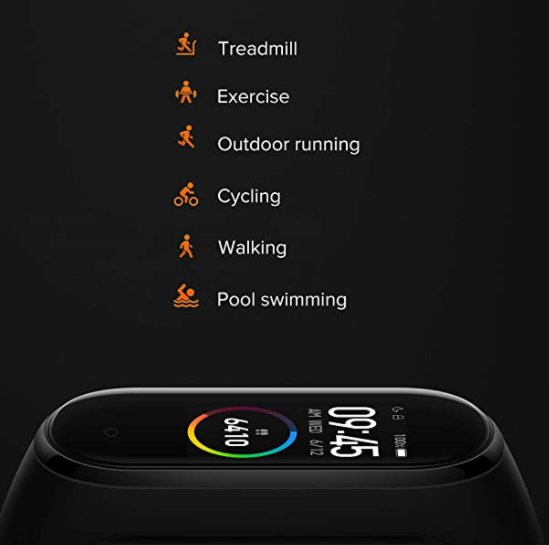
    The apps are great for tracking and providing feedback. You can choose to do it manually as well. But even this is a habit you have to build. A lot of the times I’ve forgotten to make a note of the habit that I have completed. I’ve seen this happen with my diet and workouts. For the latter, a wearable tracker automatically logging it is a good way to automate it. 

    fitness tracker

    Maybe setting up a trigger before or after one of these habits to log the activity might help. [Habit Stacking from Atomic Habits]

    Productivity for a parent.

    This is a tough one. We survived the lockdown, for the most part, thanks to the help at home. But with the nanny going away recently, we’re struggling to manage a 3-year-old while also juggling work and other responsibilities. Waking up early and creating a morning routine before the little one wakes up has given me an anchor. Even if the entire day is unexpectedly lost due to unavoidable circumstances at home, I don’t feel so bad.

    Working in bursts is the only practical way of getting things done when you have a child at home. But this is hard as it breaks your rhythm. I find it hard to go in and out of the work cycle. A big to-do list just makes this worse since you’re worried about completing those tasks all the time.

    Mothers have it worse. A full-time working mom with a young child is a superhero. Many hopefully are now discovering the work stay at home moms do as well. The physical and mental exertion is enormous. And in this work from home situation, they’ve been working the hardest. I wish companies acknowledge this and cut them some slack. 

    You can make the perfect plans, read books and watch videos, but your circumstances and nature of work are unique to you. The choice is between resigning to how things are or make small improvements through trial-and-error and constant tweaking.

  • How Analogies Can Simplify Your Message and Paint a Picture in the Readers’ Minds

    How Analogies Can Simplify Your Message and Paint a Picture in the Readers’ Minds

    A good orator makes us see with our ears

    Arab proverb

    How do you explain something unusual, foreign and complex to people? We often hear the phrase “explain it to a 5-year-old” in a pitch deck questionnaire or an interview. 

    We explain it with terms and language they are comfortable with. Analogies help you do just that by communicating a new concept in familiar terms.

    Watch Steve Jobs explain why he called the computer as the “bicycle for our minds”


    How do you process new information? We use mental models to think, solve problems and inform our decisions. Daniel Kahneman in ‘Thinking, Fast and Slow‘ talks of System 1 and System 2. System 1 is quick, intuitive and emotional. System 2 is slow, logical and deliberate. We think we operate in System 2 most of the time, but 95% of all human thought is sub-conscious.

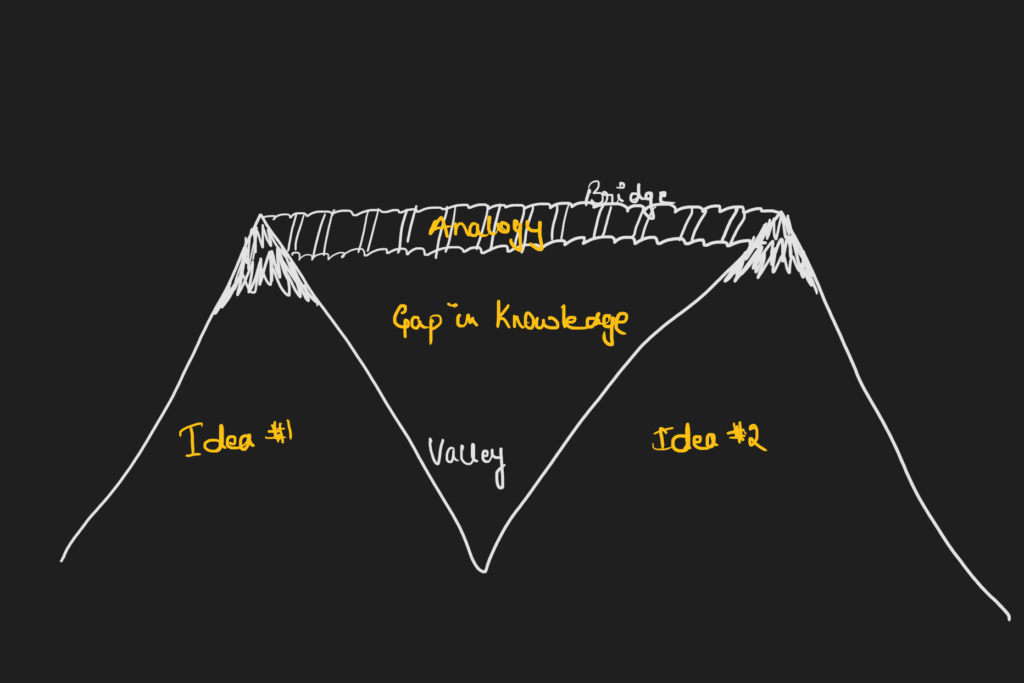
    Analogies, when used well, can provide quick, intuitive and an emotional bridge between two disparate ideas otherwise separated by a deep valley.

    What is an Analogy? 

    An analogy highlights the similarities and connects two disparate ideas together. It maps the understanding of one idea onto another while preserving relevant details and discarding the rest.

    A metaphor is a direct and creative comparison. It is a type of analogy. A simile is a comparison of two things using words ‘like’ or ‘as’.

    Metaphor, Analogy, Simile / Fun with language

    Why analogies are useful?

    Our brains are wired for taking shortcuts – the law of least effort. This is one reason why habits are formed which I wrote about previously. Analogies provide the shortcut to understanding a new concept.

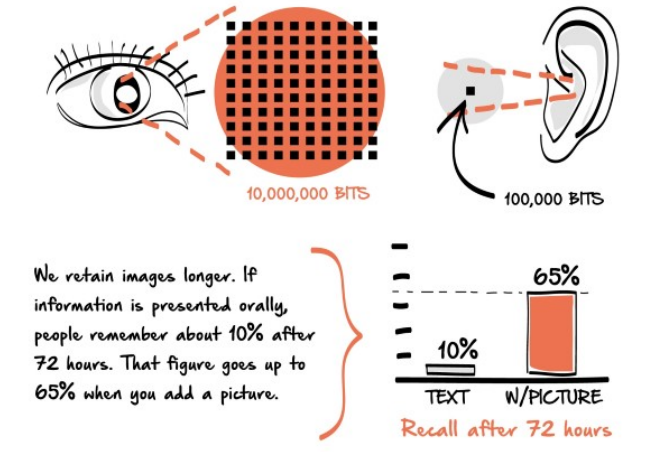
    Analogies paint a picture in the minds of people. And since we process information through memories and visuals, the message in the form of an analogy has a better chance of striking a chord with the reader or customer.

    Images do speak louder than words. See the entire infographic on metaphors here.

    We use analogical thinking for problem-solving and arguments to further our point of view. A lot of the times, we use analogies without even realizing it. Analogies can influence outcomes in ways we may not realize at first. The “three strikes” law in the US comes from baseball, but since it blindly applies this baseball concept to a complex environment, many petty crimes lead to jail time which otherwise would have been avoidable. 

    A well-crafted analogy can be persuasive in framing situations and arguments in your favour. Here are five criteria for creating effective analogies according to Pollock:

    • use the familiar and explain something unfamiliar
    • highlight similarities & obscure differences
    • identify useful abstractions
    • tell a coherent story
    • resonate emotionally

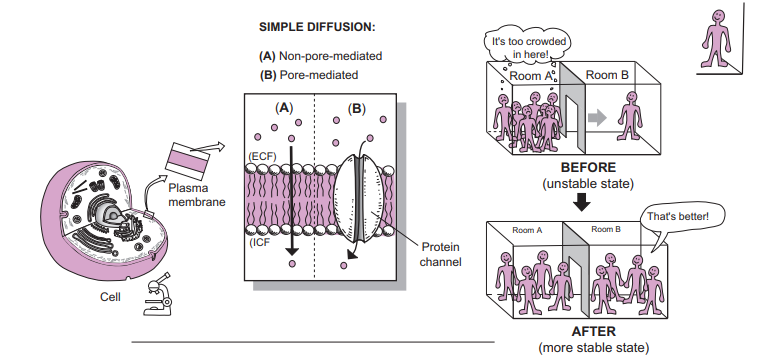
    Here’s a great example of using visual analogy to explain human anatomy and physiology:

    A Visual Analogy Guide to Human Anatomy and Physiology – Paul A. Krieger

    One of the reasons why they’re powerful is due to the Analogical Insertion Effect where a listener mistakes their own conclusions from arguments as presented facts, even when they don’t fit their prior beliefs. The ‘Resistance is futile’ hypothesis states that the analogical insertion effect can shift people’s thinking against their own will, even when those changes are emotionally uncomfortable.

    This could explain why stories are powerful. They are analogies of our own lives, dramatized and blown up on a big screen. We connect with the hero’s story because we find similarities with it while ignoring all that is different and immersing ourselves in the hero’s journey.

    Storytelling in a marketing and business context can use the effectiveness of analogies and the impressiveness of a story to deliver a compelling message that influences behaviour.

    Connect the dots

    I wrote about the practice of deliberate and mindful note-taking before. If note-taking is collecting the dots, then analogies can help us connect the dots. They bridge two different ideas by highlighting the similarities and helping us discover new insights. Many discoveries and inventions owe their genesis to analogies. Here are some examples:

    • Gutenberg – pressing liquid onto paper + standardized letters like coins
    • Darwin – plant/animal breeding vs natural selection
    • Human flight – not birds flapping wings, more like a cycle
    • Ford assembly line – conveyor belt at a slaughterhouse

    Analogies are strategic thinking tools

    It makes efficient use of information and mental processing power. You don’t need to understand every aspect of the problem. Apply models framed from areas you already know off to the current problem.

    This Harvard Business Review article called ‘How strategists really think.Tapping the power of analogy’ talks about how business schools teach strategy using case studies. Case studies provide a database of analogies the students can use in their management careers to solve problems. The best strategy consultants are adept at drawing lessons from one industry and applying it to another. The article goes on to say that leaders and managers who are unaware of how they are already using analogies in their thinking and decision making end up making mistakes; pitfalls that psychologists have researched and written about.

    The article prescribes four steps that can improve a management team’s odds of using an analogy well:

    • recognize the analogy and identify its purpose;
    • thoroughly understand its source;
    • determine whether the resemblance is more than superficial;
    • and decide whether the original strategy, properly translated, will work in the target industry.

    More examples of how analogies have helped in inventions and discoveries:

    • Kanban method was created when Taiichi Ohno observed the shelf-stocking procedures in US markets.
    • The desktop user interface designed by Xerox and popularized by Apple was based on familiar objects – files, folders, documents etc
    • Antoine Lavoisier, considered the father of modern chemistry, was an accountant, who used ideas from one field to then quantify measurements of chemical substances, creating the chemical balance equation.
    • Rutherford’s atomic model was based on the solar system

    Compound interest is like a snowball that grows bigger as it rolls

    Analogies help us create mental models by connecting ideas and concepts. 

    How can analogies help find a niche and position a product

    Analogical thinking can help identify and discover niches. A matchmaking app for founders to find co-founders. A uber for mental health. Amazon for construction material.

    If you’ve identified a new niche, the audience is generally unfamiliar and uneducated about it. Analogies can help place the new category of service in a context they can understand and relate to, thereby reducing the friction to adopting a new product or service.

    Choosing better analogies

    • Learn to spot analogies in disguise and analogical thinking
    • Deconstruct analogy – strengths & weaknesses
    • Don’t make snap judgements
    • Beware of hyperbole & don’t get framed
    • Remember analogies are models
    • Explore multiple analogies
      • “Analogies should enhance thinking, not substitute for it”
    • Zoom in and out for a closer look and a bigger picture

    Buying insurance is like “bubblewrapping” your life

    When analogies fail

    Enron’s rapid expansion and diversification into new markets based on loose analogies contributed to its collapse.

    Here are some reasons why analogies fail:

    • Relying on superficial similarities instead of deep traits
    • Anchoring – A cognitive bias where an analogy or other idea anchors itself and is hard to dislodge, even in the face of contradictory evidence
    • Confirmation bias – The anchoring effect is reinforced by another problem when we tend to seek out information that confirms our existing beliefs and to ignore contradictory data.
    • You start with a source problem and a candidate solution, then use analogies to find a target problem where the solution would work well.
      Eg: Building a product first and then trying to find a market for it.
    • Using cliched metaphors
      • “A low hanging fruit”
      • “we’re the Mercedes of X”
      • “save for a rainy day”
      • “blanket of snow”
      • “putting all your eggs in one basket”
    • Using superficial analogies. This approach can also be used to find niches in your target market based on what you observe in other industries.

    Analogies, therefore, can offer an impactful way to sell, market and pitch your product or service to an audience who is either unaware or is expected to raise lots of questions.

    Additional Reading/Watching:

    The art of the metaphor
    The hidden power of analogy 
    Thinking in time – The uses of history for decision-makers
    The Tall Lady With the Iceberg: The Power of Metaphor to Sell, Persuade & Explain Anything to Anyone
    Thinking as a science 
    Analogy Quotes
    Analogy Examples

    [emailoctopus form_id=1]

  • Book Highlights: Atomic Habits

    Book Highlights: Atomic Habits

    power of atomic habits

    Forming new habits and breaking old ones are hard.

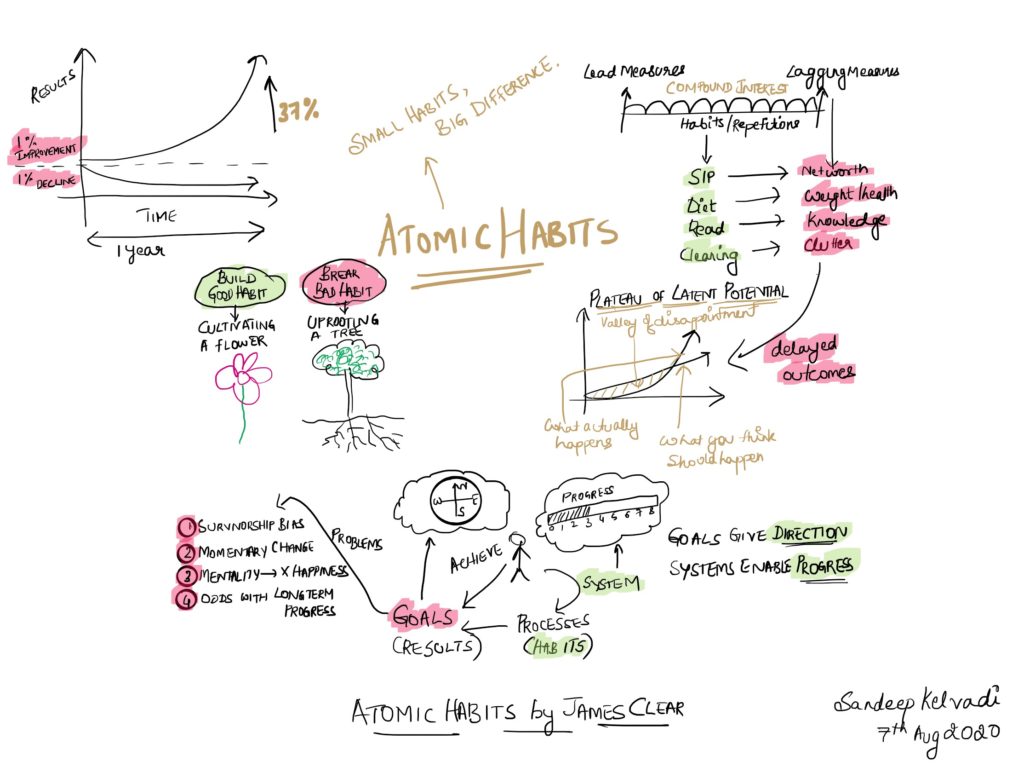
    Delayed Outcomes is one of the main reasons why we start a new habit and give up early. The new year weight loss goals, your financial goals and learning something new don’t happen quickly enough. When we rely solely on motivation, a limited resource, we run out of steam of quickly – the valley of disappointment.

    Building a good habit is like cultivating a flower, it takes time. Breaking a bad habit is hard like uprooting a tree.

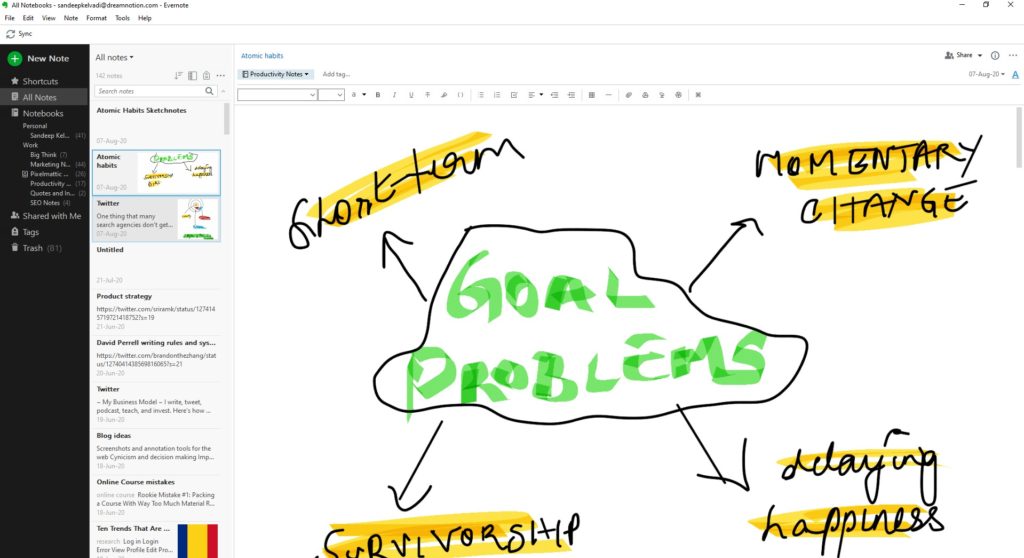
    Goals oriented thinking is quite pervasive. SMART goals or not, setting goals, being excited in the beginning, losing momentum and giving up halfway is something a lot of us are familiar with.

    Goals give direction. Systems (habits) enable progress.

    habits and identity in atomic habits

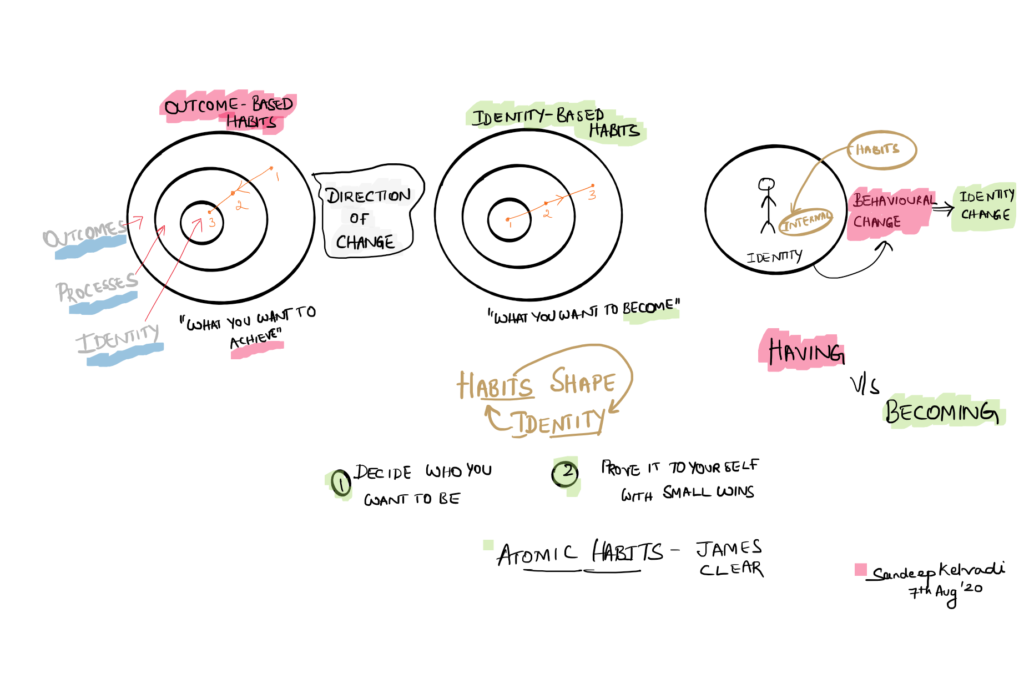
    When the focus is on outcomes, success or failure impacts your identity. When you instead start with setting out to change who you to become, you focus on the identity that will lead to good outcomes.

    Atomic Habits approaches this desire for change through incremental and tiny improvements. A 1% improvement every day compounds to a 37% increase improvement in a year’s time. Acquiring new habits or breaking bad ones is no longer a mountain to climb, but a series of small steps taken every day.

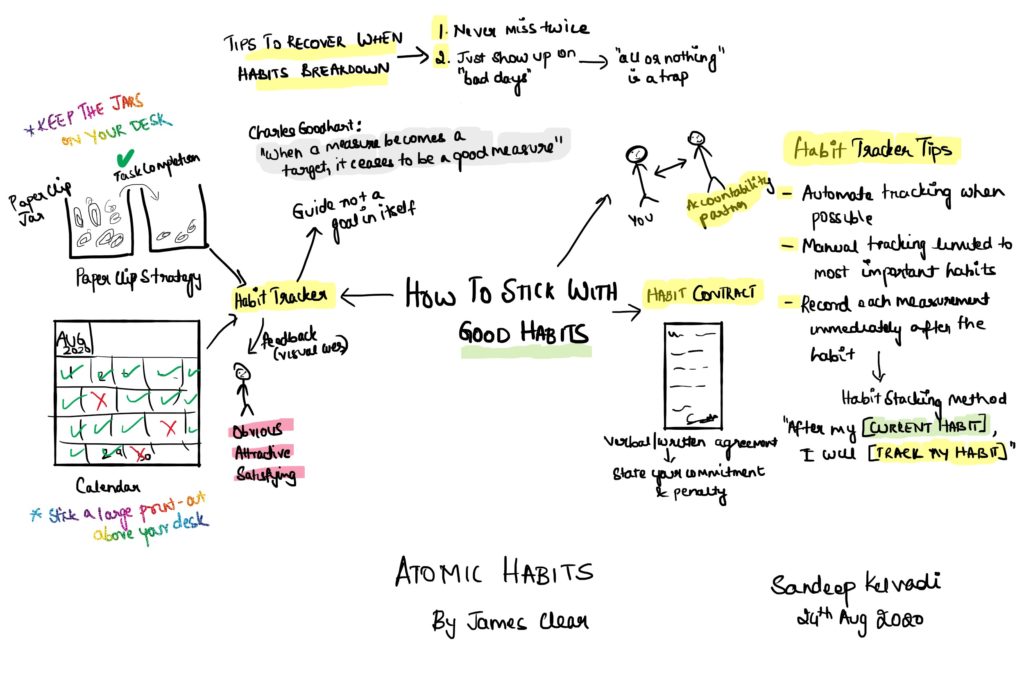
    4 stages of a habit, a sketch note

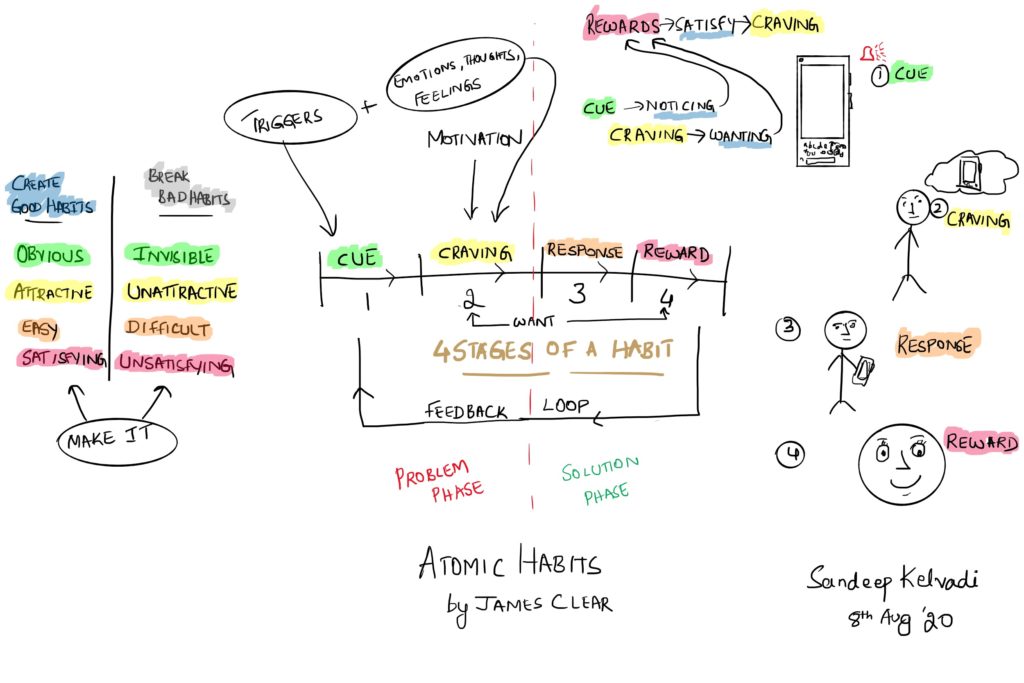
    Habits are how the brain automates our actions and responses to cues. A cue triggers a response and when there is a reward at the end of it, the brain starts to crave for it, and this leads to what is called the Habit Loop.

    Recognizing how a habit is formed is critical to forming new ones or breaking old ones. If creating a good habit, make the cues obvious, the craving attractive, the action easy and a satisfying reward. You can break a bad habit by making the triggers invisible, the craving unattractive, the action difficult and the rewards unsatisfying.

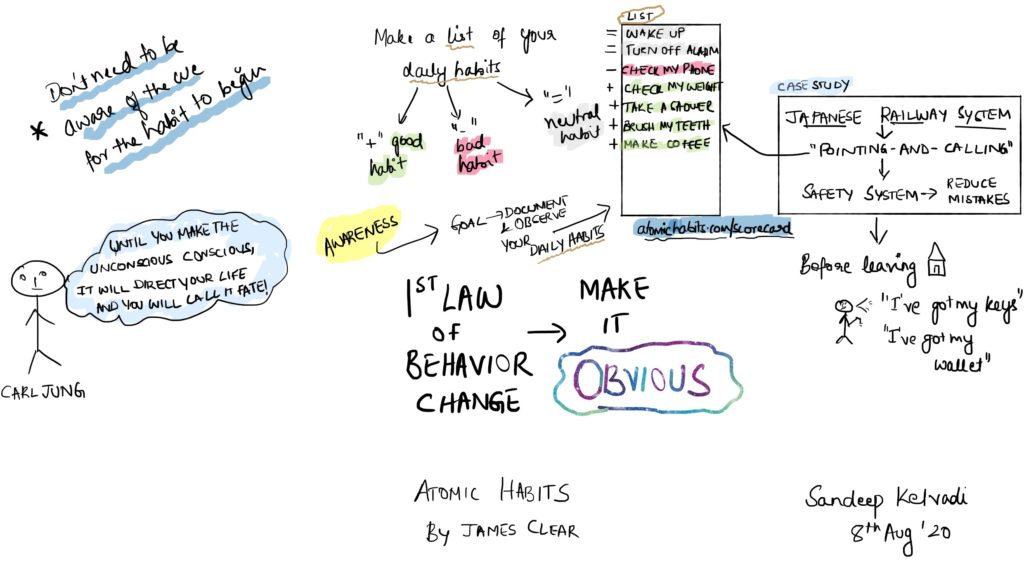
    Atomic Habits’ 1st Law of Behaviour Change: Make it obvious

    make habits obvious

    When you understand how habits work, focusing on the starting point, the cue can help you stick to new habits or break the old ones. Self-awareness is the goal here. Make a list of all your current habits, mark them as good, bad and neutral. Now for each of the habits you’ve listed, identify your cues. You don’t always have to be aware of the cue for the habit to be triggered. So the first step is to spot and highlight all your current habits.

    start a habit

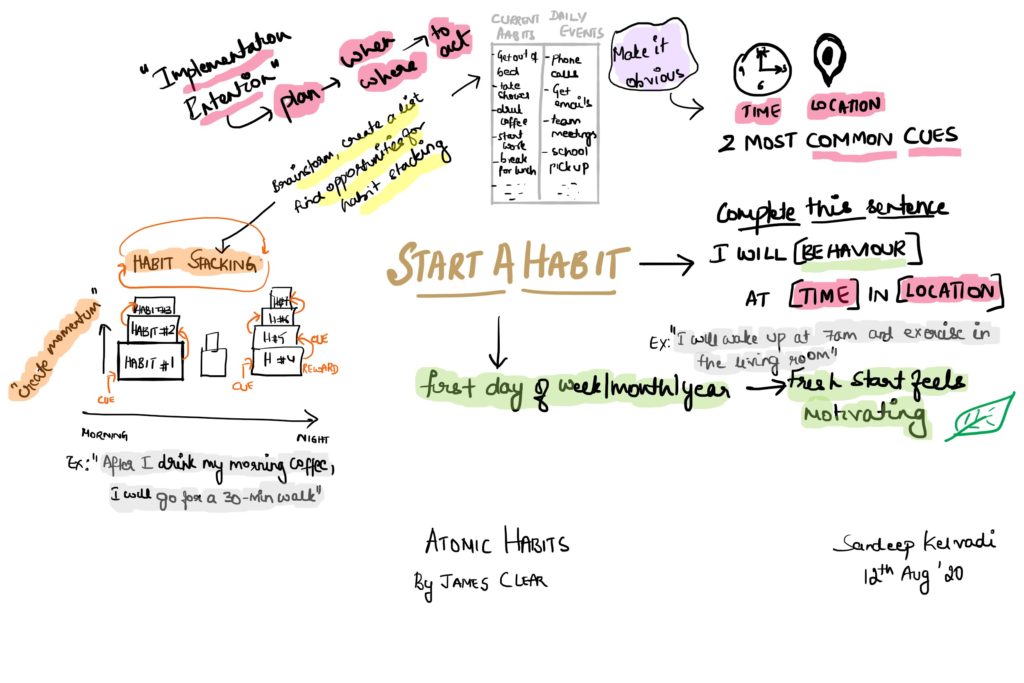
    When you want to start a new habit, a fresh start and a clean slate feel good. Time and location are powerful cues that you can take advantage to design a new habit for your self. Research shows that when you write down a plan that involves time and location for when and where you will act on your intention, the success rate is higher. This plan is also referred to as the Implementation Intention.

    Every night I write down my implementation intention for the following morning’s routine, I’ve noticed that I stick to it, compared to those days when I forget to write it down in my journal.

    Habit Stacking allows you to piggyback habits. You can use a habit that is already established to trigger a new one you’re trying to establish.

    design your habits

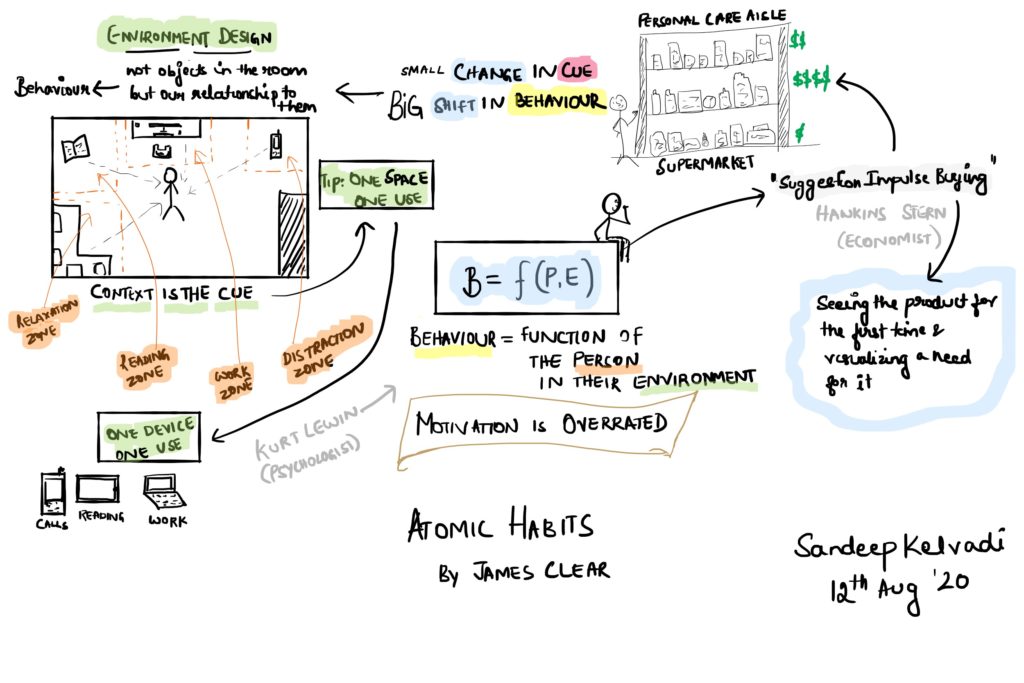
    Behaviour is the function of the person in their environment

    Your environment is a cue for a lot of your behaviours, so why not make a conscious decision to design it a certain way. Supermarkets and large retail stores are masters at this, to trick you into buying products you don’t want by placing them strategically in the aisles.

    Why waste your energy on motivation if you can design the environment around you to subconsciously trigger you to perform an action.

    One space, one use. One device, one use.

    Since a lot of us are working from home these days, creating separate zones in the house can help separate work from other activities like reading and relaxing.

    habits and self-control

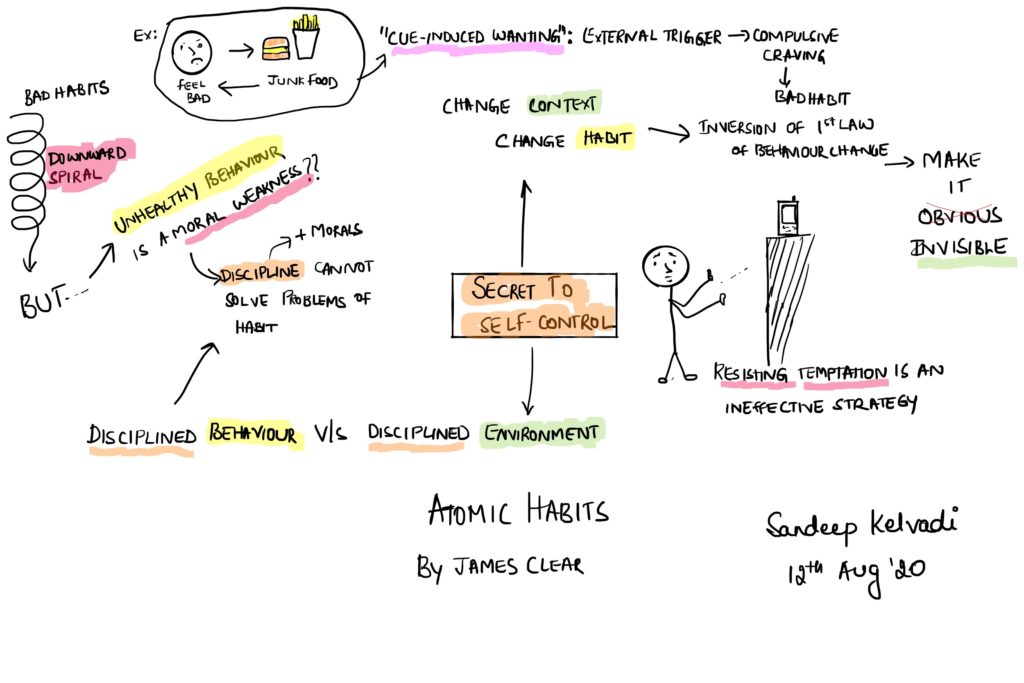
    Willpower is a limited resource. Relying on that to break bad habits is ineffective. Remember the “uprooting a tree” analogy for breaking a bad habit. Now imagine trying to uproot it with a small knife.

    Willpower is at its weakest at the end of a long workday since you’ve used it up. Any surprise why so much of the binge eating happens at night? You see a jar of cookies on the kitchen counter as you’re walking by and before you realize, your hands already are in it.

    When you realize that habits are automatic and do not run solely on motivation, you start to realize the importance of the cues and the environment in which your current habits operate. “Discipline” is the application of morals to solve problems of habit that results in judgements of your personality and character. It’s a downward spiral from thereon.

    The solution: make the cue invisible. Leave your phone in the next room. Move the cookie jar from the kitchen counter to a place where you can’t see it.

    habits and temptation

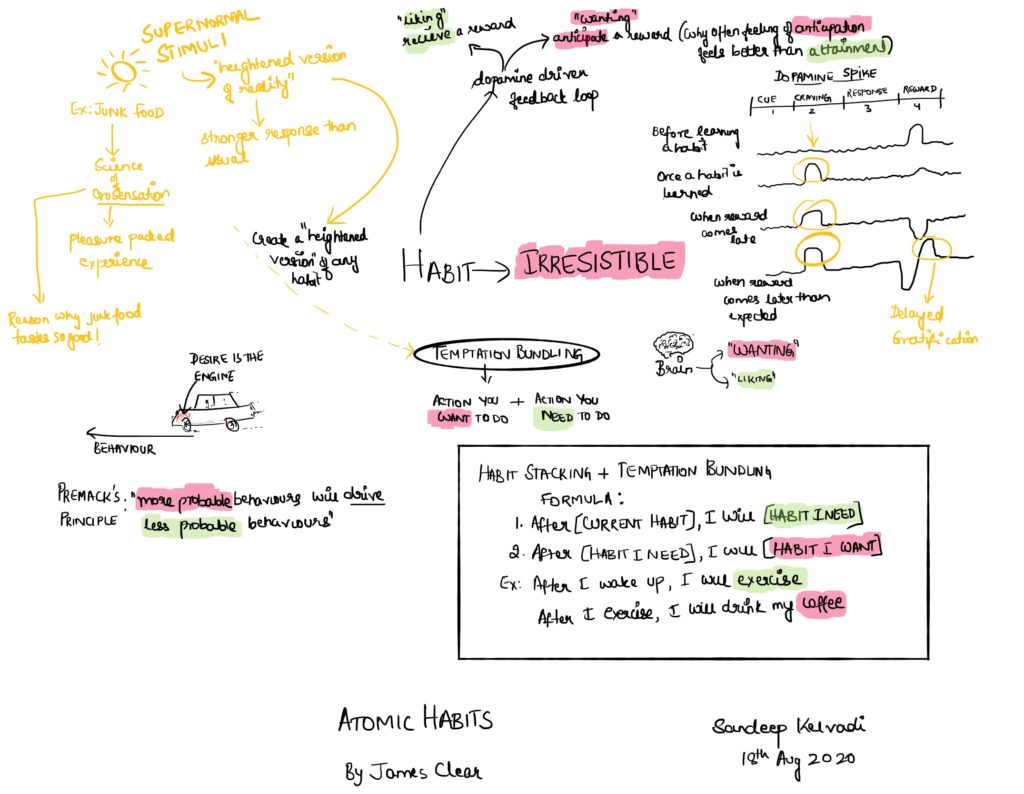
    If cues can be made obvious or invisible, the craving element can also be designed to work in our favour. The craving is the thoughts, emotions and feelings we experience that creates the “want” for the reward. It is the craving and desire that gets us to act.

    Often, the feeling of anticipation feels better than the actual completion of a task.

    The brain is geared towards “wanting” more than “liking”. That’s why desire is such a powerful emotion. Fast food has perfected the science of packaging and selling a craving.

    If there’s something you already like doing, a natural want, bundle it with something you need to do. James Clear, the author of Atomic Habits, calls this Temptation Bundling. This is similar to the idea of habit stacking, but in this case, you’re piggybacking on something you really want to do, but before you that you need to complete a task that you need to do. It uses your existing craving, but in your favour towards making a new behaviour into a habit.

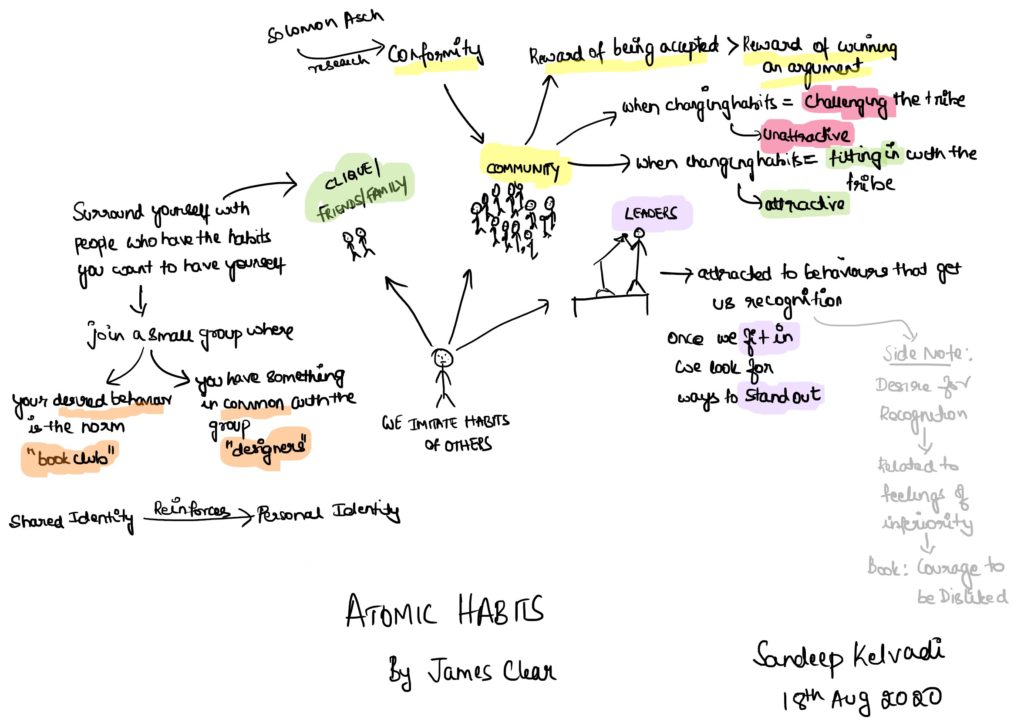
    habits and imitation

    We start learning by imitation right from the time we were toddlers. It does stop even as we grow older. So surround yourself with people you can learn from. This shared identity will reinforce the personal identity you wish to create for yourself. But this can also be a slippery slope as the desire for recognition can lead to feelings of inferiority and Imposter Syndrome.

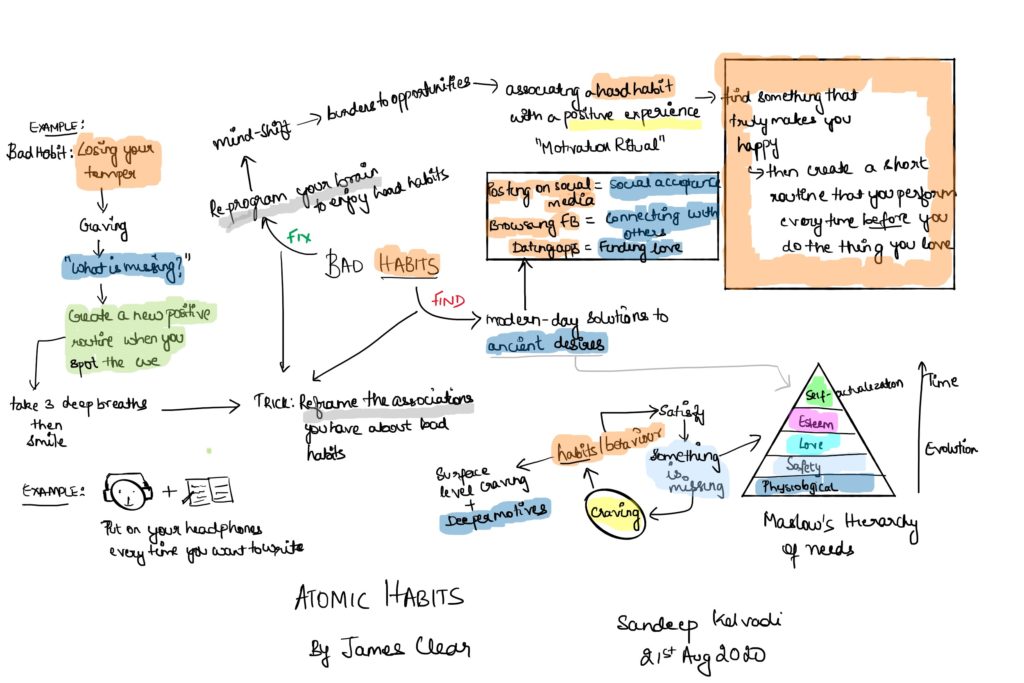
    habits and desires

    Stop judging yourself for the bad habits you may have acquired. A moral view of it only exacerbates your situation. Our reptilian brain is active and takes over in more ways than we like to admit.

    Our desires are ancient, habits are new.

    So to find the root cause of our bad habits, we need to the primal needs driving them, which is not always obvious. Once we understand the root cause of our craving, we can find ways to fix our habits by reprograming our brain. One way to do this is by associating a hard habit with a positive experience through what is knows as a Motivation Ritual. Sportspeople are good at this when they have to get through training on “bad days”.

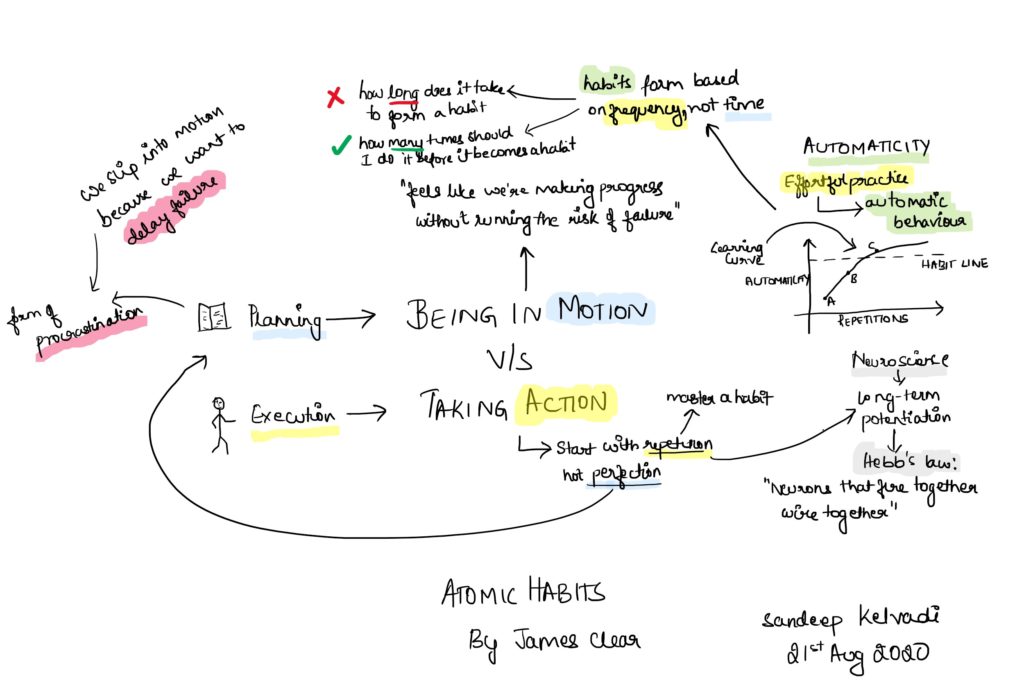
    habits and procrastination

    Mistaking planning for actual work is a form of procrastination. And procrastination is linked to failure and possible feelings of inferiority.

    I’ve written about how perfection is a favourite ruse of procrastinators.

    Habits form based on frequency, not time

    Focus on the daily repetitions and not how long it takes to create a habit. Focus on who you want to become and not just the goals you want to achieve. Automaticity is the effortful practice that leads to automatic behaviour.

    habits and friction

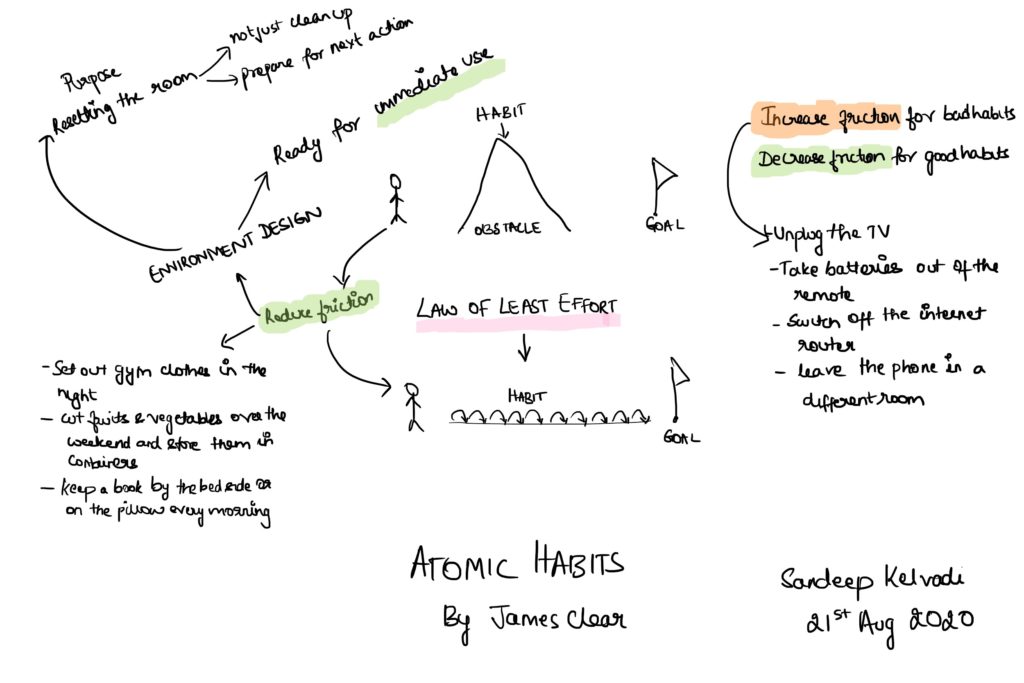
    Once you have decided to take action, make it easy. Reduce the friction through changes in your environment so that it is ready for “immediate use”. You can increase or decrease the friction depending on the habit.

    Make good habits easy and bad habits hard

    two minute rule of habits

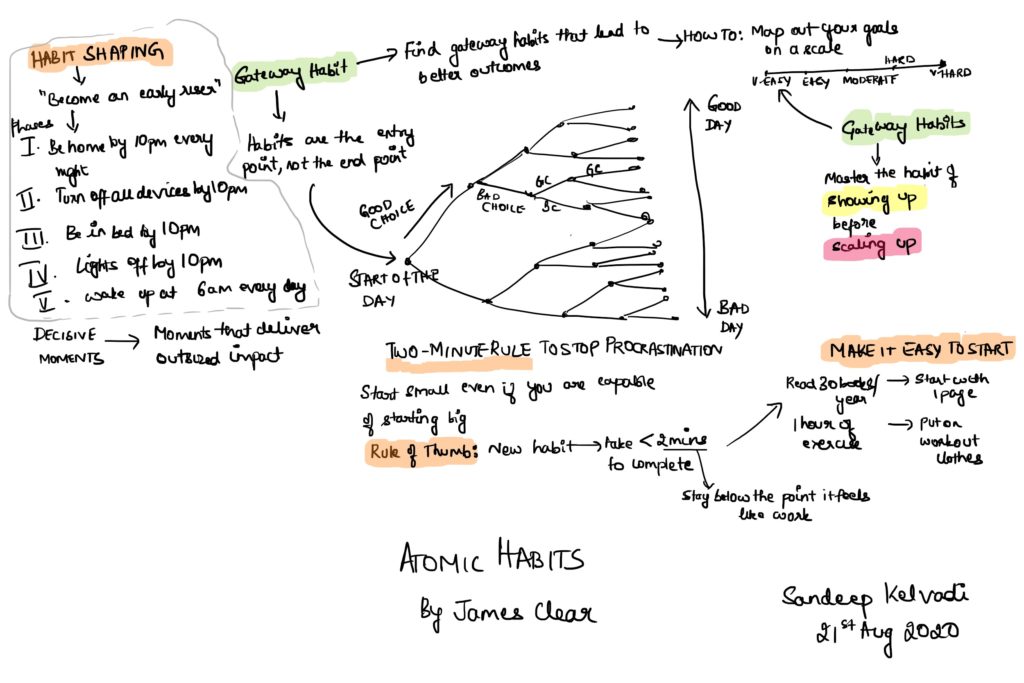
    There are decisive moments each day that influence your behaviours leading to a productive day or an unproductive one. Changing our behaviour at key moments can alter how the day pans out. Finding these gateway habits can be crucial in implementing behaviour changes.

    One way to make a good habit easy is to use the two-minute rule. Scale down the habit to actions that can be completed in two minutes or less. And then stop. Once you reach the point of automaticity, you can scale up. Often driven by the initial novelty of starting a new task, we aim for doing too much. And this often leads to failure because we’ve made it difficult for ourselves to sustain once the motivation and willpower run dry.

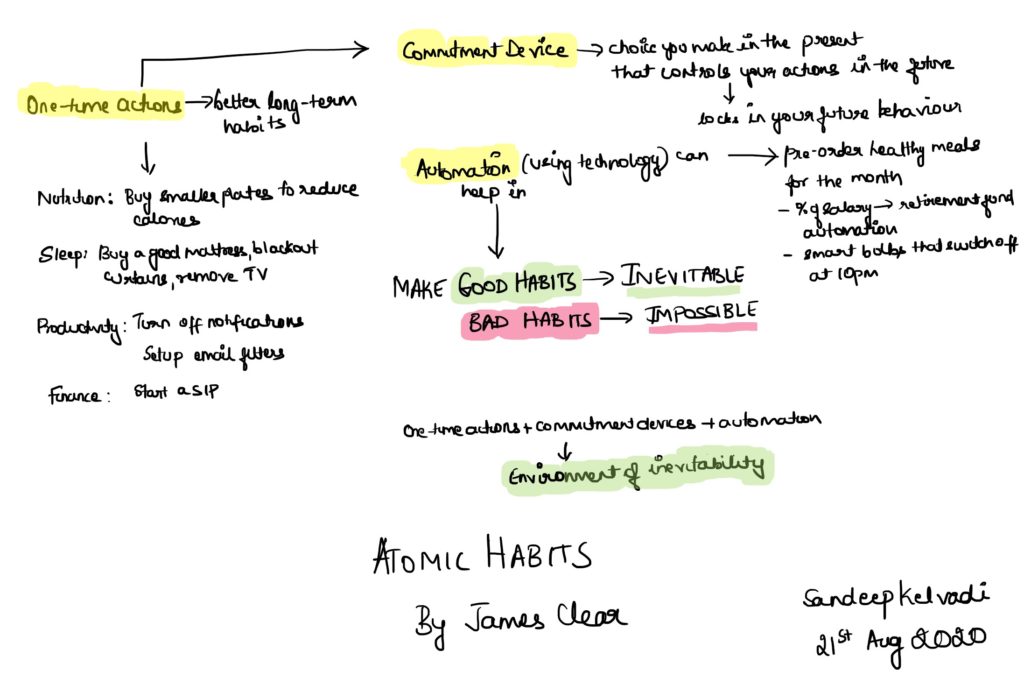
    What if good habits were inevitable? Wouldn’t that be great! We could take one-time decisions that locks our future behaviour in. Technology can come to our help in this case, whether it is automatic subscriptions, smart devices etc. Simple things like using smaller plates, betters mattresses and SIP mutual funds can also automate good habits or make them inevitable.

    Environment of inevitability = One-time actions + Commitment devices + Automation

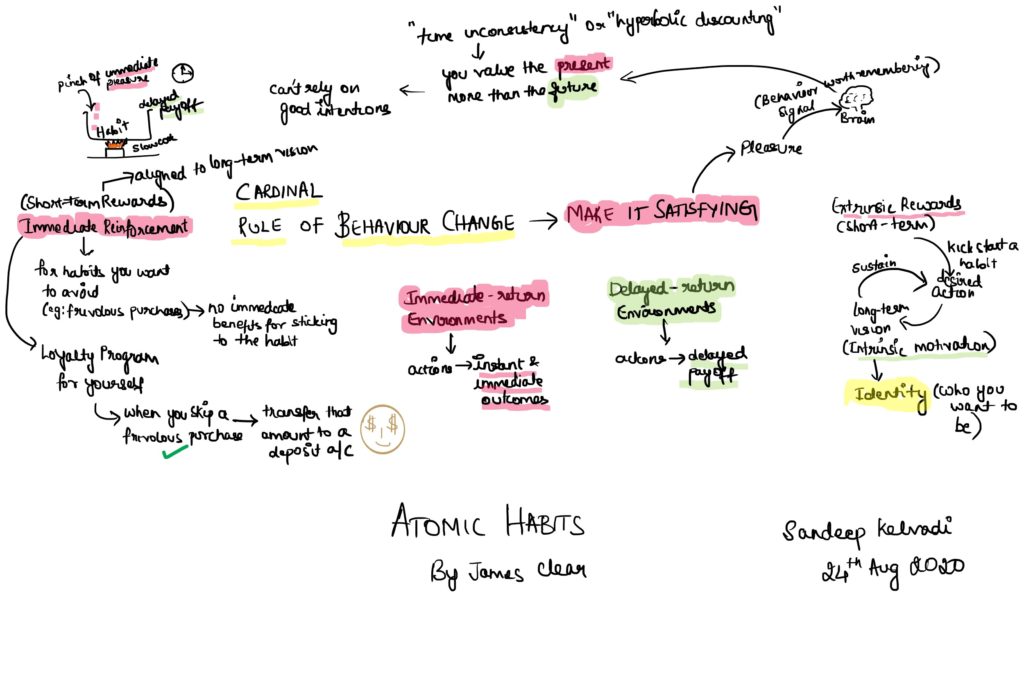
    Rewards give us the feedback for the actions performed. But short term and immediate rewards tend to be harmful. Practicing delayed gratification is known to have positive impacts on how we lead our lives.

    Gamification and game design uses a combination of extrinsic rewards to tap into your intrinsic motivation to deliver engagement. Jane McGonigal in her book called Reality Is Broken describes how games can be deployed in a social context for positive impact.

    Here’s a video about the famous Marshmallow test where kids that exhibited behaviours of delayed gratification led happier and successful lives.

    This is another idea that games have perfected – the levels and the progress bar to give you feedback. Creating a habit tracker does the same thing. I’ve tried software habit trackers, but a physical tracker performs better. If it’s software based, it’s better to choose one that is automatic.

    A habit tracker makes your habit obvious, attractive and satisfying.

    Another idea to keep you honest about your habits and the progress is to have an accountability partner. If you are part of a team, group or community, you can find someone there to review your progress on a weekly basis.

    I find the idea of a Habit Contract a bit strange, but it apparently works according to the examples shared in this book. A habit contract is a verbal or written commitment to yourself that states your commitment and a penalty for not following through.

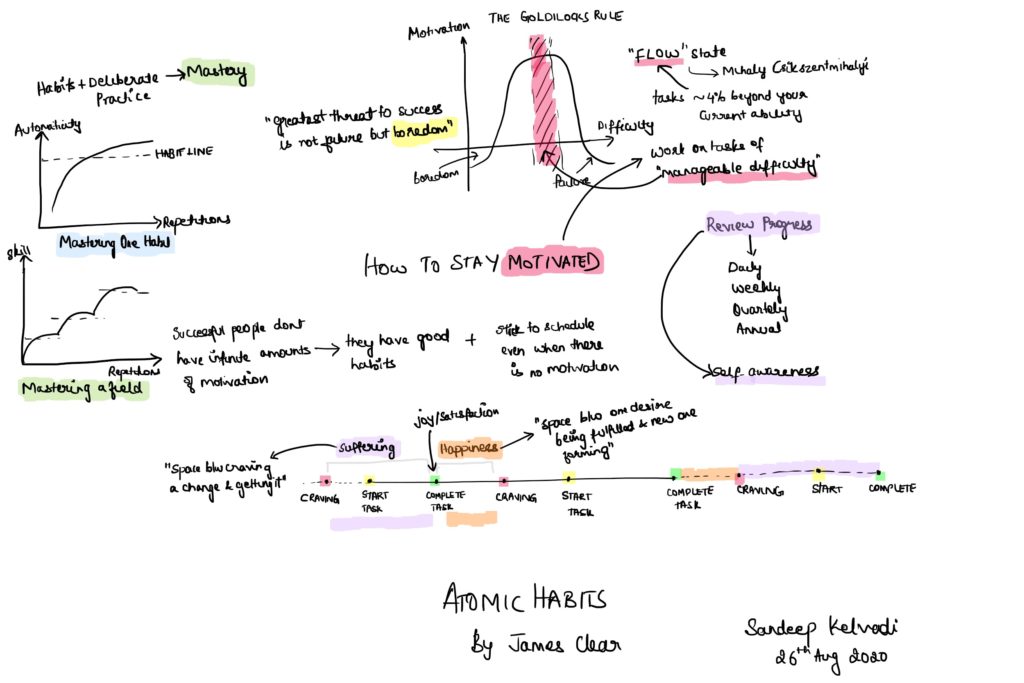
    Habits can automate behaviour, but when we get to the point of automaticity, and it becomes easier and easier, we stop progressing in terms of skill level. To level up and learn something new, we need to increase the difficulty of the tasks each time. This is how we achieve mastery. Again, games have implemented this for decades.

    To achieve a “flow state“, we need to work with tasks of manageable difficulty – tasks that are not too easy or too difficult.

    The fundamental idea in this book is that tiny changes and small improvements in your daily life by breaking down habits into smaller chunks can compound over a period of time to produce desired results. It’s not just about achieving our goals but changing mindsets and lifestyles for the better.

    Here’s my rating of the book on Goodreads.

  • What’s holding you back from achieving your true potential

    What’s holding you back from achieving your true potential

    “I just look at all these people, and I think, what the heck am I doing here? They’ve made amazing things. I just went where I was sent.” – Neil Armstrong

    When Karan and I began discussing the direction of our agency business triggered by the pandemic and the lockdowns, it led us down the path of introspection. A part of that was to look at our own selves and see what we needed to do as individuals to take the company to the next level. We realized that Imposter Syndrome was affecting us and we had undervalued ourselves on numerous occasions. 

    We needed a mindset change about how we looked at what we do, how we evaluated potential new clients and what this meant for us going forward. More about mindsets in an upcoming post.

    You need to suffer a little bit of Imposter Syndrome, but too much of it and you will not accomplish your goals

    What is Imposter Syndrome and what it is not?

    You’ve heard the word, maybe casually read about it, but have you looked deeper and seen how it is affecting you? I hadn’t.

    This term was coined by Pauline Clance and Suzanne Imes in 1978 in their study titled Imposter Syndrome phenomenon in high performing women. 

    Imposter Syndrome is a phenomenon you experience under certain conditions. It’s not a personality trait or a mental disorder. Imposter syndrome is not just another symptom of low self-confidence or extreme humility. It is a constant fear of being found out.

    Have you ever felt like a fraud? That you don’t deserve your success, it is down to luck or hard work?

    Clance and Imes described it as to “designate an internal experience of intellectual phonies”

    Imposter Syndrome is also referred to as “confidence gremlins”, impostorism, impostor phenomenon or fraud syndrome.

    What does Imposter Syndrome feel like?

    Symptoms might include:

    • Low self-confidence stopping you from exploring new areas
    • Feelings of inadequacy
    • Comparing yourself with other people
    • Anxiety before a presentation or a talk
    • Self-doubt creeping in when you take on a new task
    • Distrust in one’s capabilities – “Am I good enough?”
    • Negative self-talk
    • Dwelling on the past – “I wish I could have done it differently”
    • Irrational fears of the future 
    • Taking on extra work to make sure you’re “doing it all”
    • Shrugging off accolades – “Oh,  it’s nothing”
    • Not exploring a new job opportunity because you don’t feel you meet every requirement (“The expert” Imposter Syndrome type)
    • You fear judgment and discovery

    Have you experienced any of this? I certainly have. Share your experiences with Imposter Syndrome in the comments below.

    You’re not alone.

    70% of the people most likely experience. It was initially thought to have affected high performing women more when Clanes and Imes first researched this phenomenon. But recent studies show it affects men too. 

    It’s inconclusive as to who it affects more, but where it’s different is the circumstances. For women, it’s about proving their ability in a male-dominated environment and for men, it’s about living up to societal norms and to be seen as successful.

    One study claims that it affects men more. The paper suggests that this could be due to traditional gender norms placing greater expectation from men to be competent and successful. Harsh and negative feedback triggered higher anxiety and lower effort in men.

    “Sometimes I’m afraid others will discover how much knowledge or ability I really lack”. –

    Personality and Individual Differences, Rebecca Badawy

    Women, on the other hand, fared better and responded positively to the feedback.

    Imposter Syndrome affects everybody, even the rich, the famous and the successful.

    Michelle Obama had this to say at an event “I still have a little impostor syndrome, it never goes away, that you’re actually listening to me,”

    “Every time I was called on in class, I was sure that I was about to embarrass myself. Every time I took a test, I was sure that it had gone badly. And every time I didn’t embarrass myself — or even excelled — I believed that I had fooled everyone yet again.” – Sheryl Sandberg

    Maya Angelou “I have written 11 books, but each time I think, ‘Uh oh, they’re going to find out now. I’ve run a game on everybody, and they’re going to find me out.’” — Maya Angelou

    Neil Gaiman
    “Some years ago, I was lucky enough invited to a gathering of great and good people: artists and scientists, writers and discoverers of things. And I felt that at any moment they would realise that I didn’t qualify to be there, among these people who had really done things.”

    What triggers it?

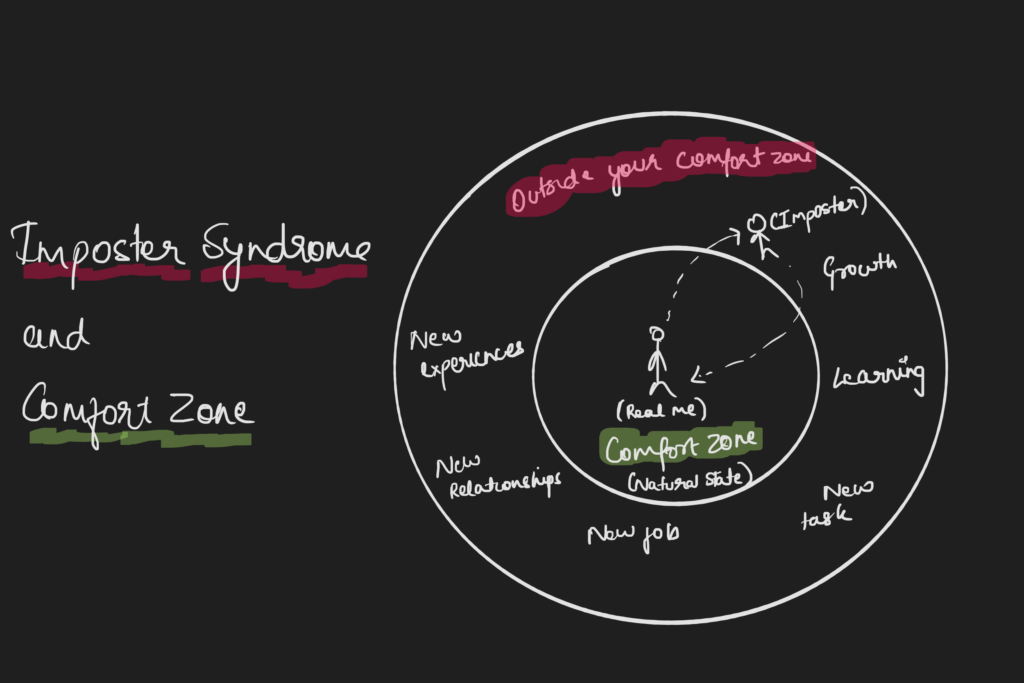
    the imposter syndrome and comfort zone
    • A new environment 
    • Workplace
      • Starting a new job
      • Starting your own business
      • Receiving a promotion
    • Academic settings
      • When you have to teach others (peers)
      • Receiving an award
    • Social interactions
      • Social gatherings
      • Networking events
    • Relationships
      • Business meetings with clients
      • Becoming a first-time parent.
      • Dating

    Ironically, spikes in learning and growth happen when you’re outside your comfort zone.

    Get a digest of my readings and learnings in your inbox a couple of times a month.

    [emailoctopus form_id=1]

    Are you actually an imposter?

    One way to find out is to measure yourself on the Clance impostor phenomenon scale (CIP). Here’s the test best on Pauline Clance’s work:

    Take the Imposter Syndrome Test

    “After taking the Impostor Test, add together the numbers of the responses to each statement. If the total score is 40 or less, the respondent has few Impostor characteristics; if the score is between 41 and 60, the respondent has moderate IP experiences; a score between 61 and 80 means the respondent frequently has Impostor feelings; and a score higher than 80 means the respondent often has intense IP experiences. The higher the score, the more frequently and seriously the Impostor Phenomenon interferes in a person’s life.”

    CIP scale helps determine if characteristics of fear are present. Aspects of fear include: “ fear of evaluation, fear of not continuing success and fear of not being as capable as others”

    There are six dimensions to the Imposter Syndrome:

    • The impostor cycle (more on this below)
    • The need to be special or the best (There is a universal desire in the pursuit of superiority since we are born as helpless beings)
    • Characteristics of Superman/Superwoman
    • Fear of failure
    • Denial of ability and discounting praise
    • Feeling fear and guilt about success also known as the Jonah complex 

    If you have any two of the above aspects, you’re considered to have the Imposter Syndrome.

    Valerie Young suggested 5 types of imposter syndromes in her book: The Secret Thoughts of Successful Women: Why Capable People Suffer From the Impostor Syndrome and How to Thrive in Spite of It

    • The perfectionist – celebrating success is difficult because you always feel you could have done better, you have a hard delegating and managing people
    • The superwoman/man – you’re a workaholic addicted to the validation that comes from working long hours
    • The natural genius – you judge yourself based on how easy and quick you learn new things the first time
    • The soloist – you are so independent that you don’t believe in asking for help and must do everything on your own
    • The expert – you measure yourself based on what and how much you know, constantly seeking certifications and trainings for validation

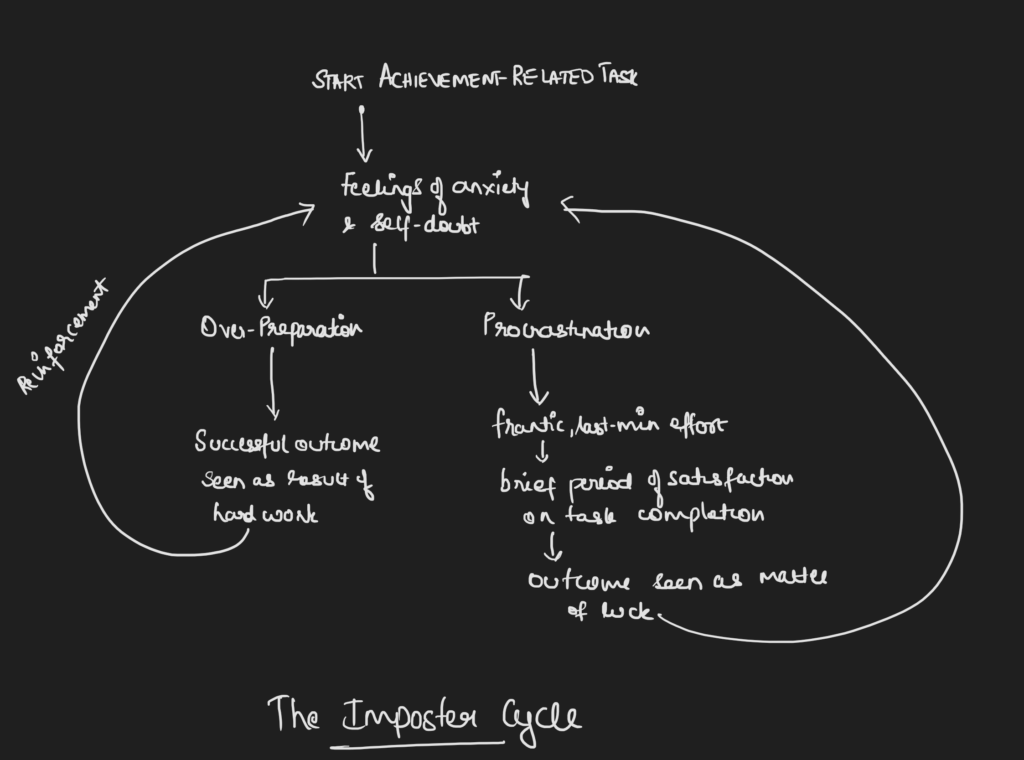
    Here’s how the Imposter cycle works.

    the imposter syndrome cycle
    • Starts with an achievement-related task
    • Feelings of anxiety, self-doubt and worry follow
    • Two possible reactions to these feelings
      • Over-preparation
        • successful outcome is seen as a result of hard work
      • Procrastination
        • frantic, last-minute effort
        • brief period of satisfaction from task completion
        • outcome seen as a matter of luck
      • In either case, hard work or luck, the outcome is not seen as a reflection of one’s true ability
        • Positive feedback received is discounted
    • Cycle leads to accumulation of self-doubt, depression and anxiety
      • Fear of being exposed keep the cycle going

    One of the ways we procrastinate is by delaying the action through excessive planning.

    Dealing with it and overcoming it

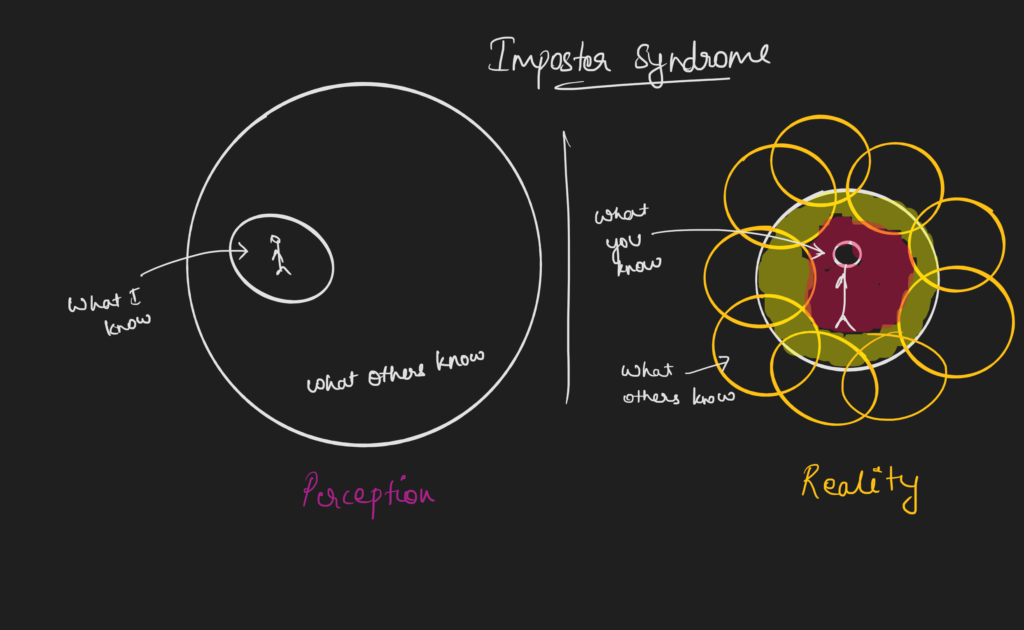
    the imposter syndrome perception and reality

    If this phenomenon is so pervasive, how do people deal with it? Studies show that joining a support group of like-minded people who also experience the same thing can be beneficial.

    Reframing your mindset to look at failures as opportunities can flip how you process these feelings.

    “I want to receive that degree. I won’t give up and have too much pride to walk away.”

    “If I can do this, I will be able to help others in the future and work with people as motivated as I am.”

    “I can be the voice of other People of Color who do not have the opportunities like I do.”

    “I know I can do this.”

    James Clear in his book, Atomic Habits, talks of how you can build good habits and break bad habits by making tiny changes to your life and routine. If you have identified the cues that trigger your Imposter Syndrome symptoms, then you can recognize it before or as it happens and have a pre-defined response, a routine.

    Self-acceptance is also critical in dealing with this phenomenon. We are born as unique individuals, with strengths and weaknesses. Acknowledging and being self-aware can help us manage and overcome Imposter Syndrome effectively. A simple SWOT analysis of personal skills and capabilities can provide you with that information.

    Owning your successes and documenting it can be useful as you can go back to them when you are experiencing self-doubt.

    It affects companies too

    Imposter Syndrome doesn’t just affect individuals, it can negatively impact companies too. If the team experiences, it can become part of the culture, which then seeps into everything that you do. This can manifest in how you value the company, try too hard to please the wrong customers, lower ambitions for the company and stagnate.

    From a marketing point of view, this could reflect in the weak messaging that lacks confidence. Or you mask it with jargons and complexity. On the flip side, marketers exploit your self-doubt and feelings of inadequacy to sell you products and services.

    Final Thoughts

    If progress is you getting better every day, imposter syndrome is like a chain tied to your back, pulling you or stopping you from moving forward. Or worse, sinking you downwards.

    It’s a fine balance between self-confidence and over-confidence. The Imposter Syndrome prevents us from tipping over to the side of over-confidence. When kept in check, it can drive you towards excellence. 

    But chronic feelings of self-doubt can severely hamper our progress and mental well-being. So being self-aware of our triggers and symptoms can help in managing and overcoming this phenomenon.

    My short notes from The Courage To Be Disliked addresses the topic of inferiority complex and how our universal desire for superiority can put us on a path to crave recognition which in turn can cause feelings of inferiority. 

    “FOI is feeling of something that is missing in oneself. To compensate for the lack of courage in making progress, we fall into the trap of superiority complex. Must detach from the desire for recognition. Healthy FOI = compare to oneself”. Read more here.


    This blog post is a part of my #100DaysOfWriting challenge.

  • Can the practice of note-taking make you smarter?

    Can the practice of note-taking make you smarter?

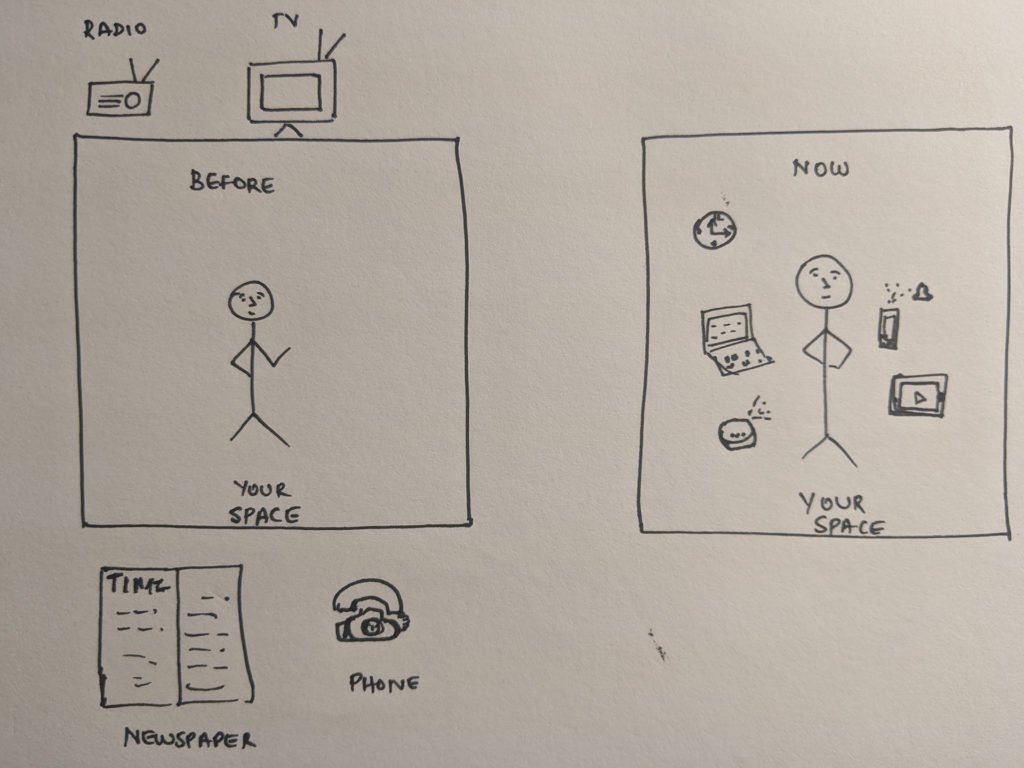
    The earth’s atmosphere is full of waves and signals transmitting bits of information from one device to another. This did not exist 100 years ago. 

    Radio and TV signals have been replaced by Wi-Fi and 4G. The devices of yesteryear existed outside of our personal space. We had control over them. The remote control was in our hands. Not anymore. 

    We welcomed these smart connected devices into our lives, but have they made us smarter? If yes, at what cost?

    Devices and personal space

    We’re creating more information and content than we ever have in our entire history. Access to information has enormous benefits and it has helped us progress as a society, but at an individual level, the information overload has turned into a burden.

    We don’t need more information. We need someone to help us make sense of it. Online gurus are filling in that need wherever you look.

    productivity and oganization

    What if we can take back the remote control and also have a better way of filtering, tagging, sorting and categorizing the information we receive from multiple places. Can we be mindful of the information we consume so that it actually benefits us in our personal and professional lives?

    Note-taking apps on the rise

    We have always documented our lives throughout our existence as a species. The earliest form of human documentation dates back to 4th millennium BC. Note-taking or journaling is a habit that has now become necessary for anyone who wants to make the best use of their time and energy.

    Software and apps have existed for more than a decade that could technically help you take notes digitally if you wanted. The apps of today though have become smarter, helping you capture information as you’re consuming it, storing it and categorizing it for future retrieval. Some of them use smart linking methods to help you build a powerful and personal wiki.

    There are simple note capturing apps like Apple Notes and Google Keep. And there are apps like Evernote and Microsoft OneNote, which have been around for a decade almost, that help you capture and organize information. I’ve used the latter extensively when I was in Grad school. Google Docs has enabled us to document our processes and projects at Pixelmattic over the last 6 years.

    But there is something different about the new generation of note-taking and journaling apps.

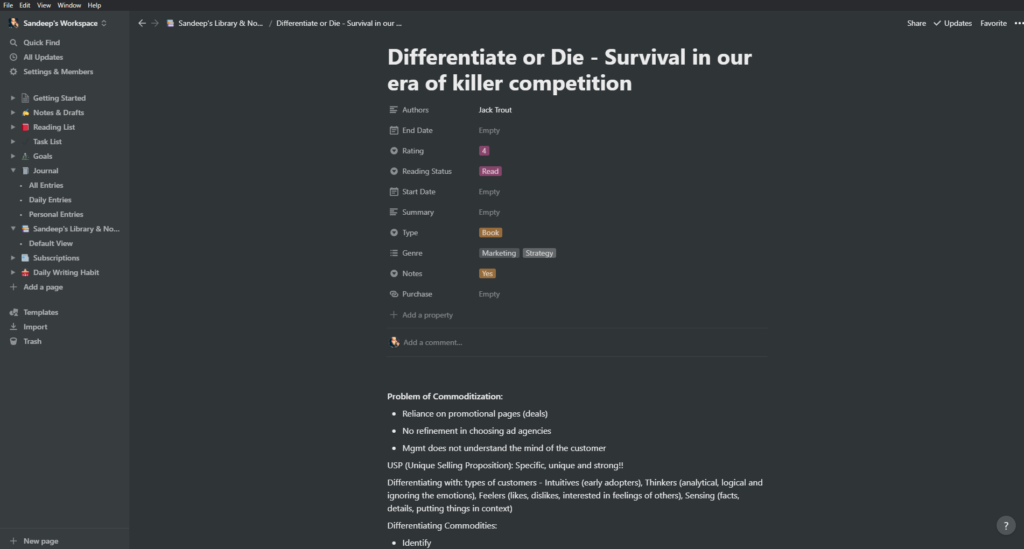
    Notion is a popular multi-purpose personal database app. It combines aspects of lists, documents, spreadsheets and more in the same interface. Think of Google Docs, Trello, Google Keep and Google Sheets combined in one app. You can create a document that has your notes, a spreadsheet, URL embeds, a Kanban board and a To-Do list all in one place. This kind of flexibility however can be overwhelming for new users, but there seems to be an active user base making plenty of tutorials that you can watch to get started.

    Evernote is a great multi-platform app that has evolved over the years and currently has more than 200 million users. It has many features, but what I like is the ecosystem of extensions and frictionless capturing of information from any device you’re on. I’ve used this app over the years to primarily store my book notes. I used it earlier this year to capture information on the go. While that part of the app experience was good, I felt the tags and category features to sort and filter content was not advanced.

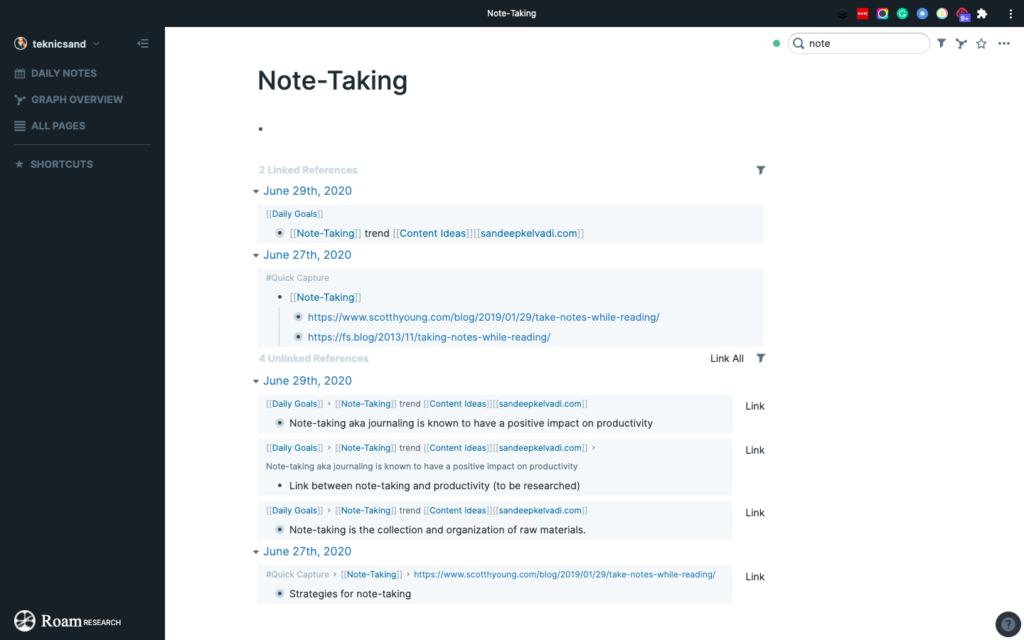
    Roam is probably the most interesting tool I’ve tried in recent times. It looks spartan compared to some of the modern and slick apps, has many points of friction and lacks a true multi-platform app ecosystem. And yet, I find myself investing more and more time into this. Roam has now become my primary note-taking, journaling and To-Do list tool. Roam takes quite the opposite approach when it comes to the UI, offering a basic and functional interface and powerful shortcuts. This simplicity combined with its most useful feature, bi-directional linking, makes it a great tool to build your own personal knowledge base.

    Roam GraphRoam graph
    Graph Overview of my connected notes in Roam

    “Note-taking is the collection and organization of raw materials for stuff you are building”

    Ideas for better note-taking

    1. Quality of input affects the quality of output
      Apply a discerning eye to the notes and information you capture. If the quality of raw materials you are sourcing and storing is poor, it will affect the outcomes. Whenever possible, let the notes reflect the idea you have just read about or watched, in your own words.
    2. Categorize and tag information
      Maybe in the future you could have your own personal Google that will index, process natural language and give you relevant results instantly. The note-taking tools of today are not there yet. So what you can do is categorize and tag them carefully every time you capture notes that makes it easy for you to retrieve them in the future
    3. Review and reflect
      Reviewing the notes periodically and reflecting on them is a great way to not only refresh your memory but also bring back some ideas and thoughts to the top of your mind.
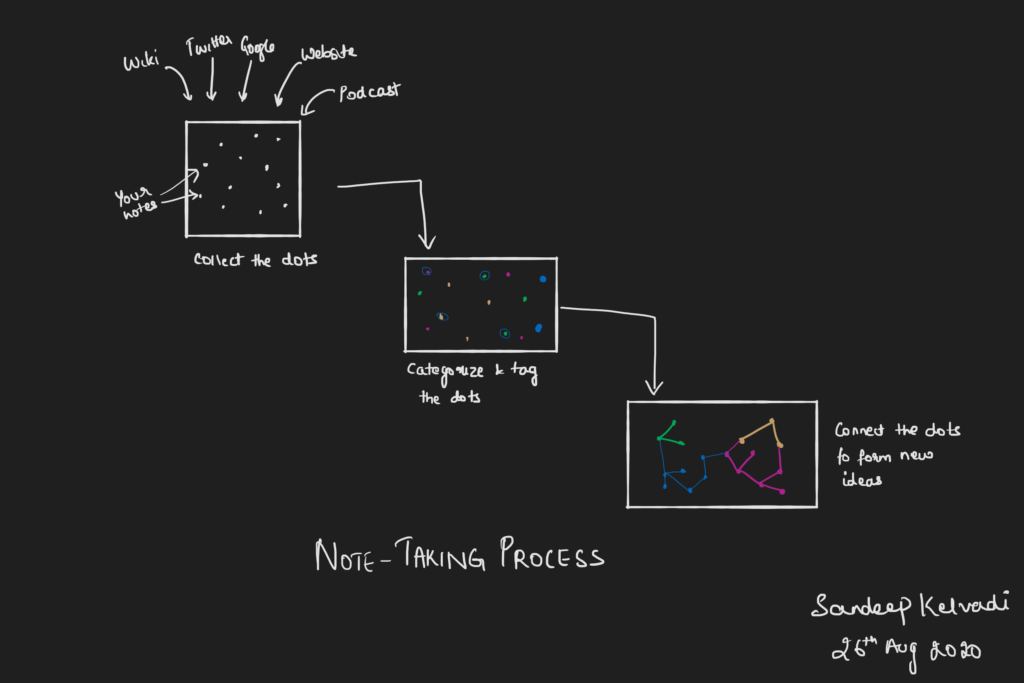
    4. Connect the dots
      The ultimate goal of note-taking should be to connect the dots. Collect the dots on the go, tag and store them. When you review and reflect, you should connect the dots for building a bigger picture. Great ideas come about when you bring two disparate thoughts/notes together to create something new.
    note-taking process
    Collect the dots and connect the dots

    “Note-taking is an investment for your future self”

    Additional Reading:

    The Bullet Journal

    Zettelkasten Method

    Bi-directional Linking

    Drop your email below and be the first to know as I explore new tools and methods of note-taking.

    [emailoctopus form_id=1]

  • Support Indian brands, but not mediocrity

    Support Indian brands, but not mediocrity

    The market doesn’t recognise or support jingoism.

    There is a strong sentiment in the country to support local products over imported ones, particularly those imported from China. Keeping all the political considerations aside, this is a good cause to get behind. But it shouldn’t surface-level commitment. It needs the strong backing of the establishment, the government and bureaucracy, financially and policy-wise.

    In a globalized world with complex supply chains that cross many boundaries before resulting in the final product, such a move should not come at the expense of collaborations. Vocal for local should not be a slippery slope towards isolation. Nor should it come at the cost of the consumer – a lack of choice or promotion of mediocre products and companies as alternatives.

    How do we balance the need for encouraging local businesses while also promoting high standards of design, manufacturing and business values?

    One way to identify companies like that is to focus on those that have a unique and strong point of view. Companies like this tend to believe strongly in how a product or service should be created or delivered. Often this is one of their stronger differentiating factors.. Such companies build what we call Brands. A company associated with a strong and singular message.

    Brands matter. And it’s hard to build them, but once you do they last long.

    Examples of Indian brands:

    Royal Enfield has a cult-like following and continues to dominate the segment based on a strong story. A British legacy but now a completely Indian brand, that rides more on emotion than innovation.

    TATA is another brand built over decades that Indians trust and respect. Corporate values and ethics are what differentiate this conglomerate from others.

    Indigo Airlines has succeeded where most of the others have struggled or failed. In doing so, they’ve also built a strong brand, a brand focused on efficiency, a concept still rare in the Indian business world.

    IT services led TCS and Infosys put the entire industry on the world map. Many others have benefitted from this as India is seen as a reliable IT service provider for global corporations. 

    On the other hand, India is not known for its manufacturing or engineering capabilities. Can we build a brand around ingenuity, low-cost innovation and craft? Germany is associated with incredible precision engineering skills and China for its scale of manufacturing. If we are going to promote the Indian manufacturing sector and want the world to notice, we need to create a unique space to differentiate ourselves. You can’t compete with Germany or China on qualities they own and are associated with.

    Crafted in India vs Make in India

    We need to encourage Indian brands, particularly the young ones. But support them for the right reasons – great products and good business ethics.

    India has been historically known for its handicrafts and other traditional craftwork. Can we build on that legacy and carry that over to large scale manufacturing? Crafted in India vs Make in India could be a better way to market our capabilities.

    Of course, a brand needs to be built on substance. If we are encouraging Indian brands, then let’s set a higher bar for us to aim for, and not settle for mediocrity. 

    The first wave of the IT revolution in India was led by services companies with cost as their biggest differentiating factor. The second wave led by the likes of Flipkart rode the wave of new internet consumers, but essentially copying a tried and tested business model. The third wave of companies we’re currently witnessing is SaaS companies, the likes of Freshworks and Zoho, which are building products for the world out of India. 

    The success of every wave is built on the lessons learned from those who paved the way in the previous generations. So what can the current generation of manufacturing companies and the ones we hope to encourage in the future learn from the previous generations?  

    A community can build a brand today. 

    In today’s age, it only takes a few hundred passionate customers to kickstart a successful business.

    A 1000 loyal fans can make a small business successful. Scale that to 100,000 dedicated brand lovers and the network effect takes over leading to massive growth. Supporting Indian brands by buying from them and advocating for them can contribute to building new and successful businesses.

    Indianness should not be the only reason you buy from a company though. How do they treat their employees, for example, do they go above and beyond to make customers happy and are their products truly world-class?

    Put your money where your mouth is?

    Can you invest 10L+ in an Indian brand when there are international competitors?

    I bought a TATA Nexon after plenty of research which included popular foreign competitors. A ‘value for money’ product from a company making a genuine effort to rebuild its image and of course backed by a strong legacy brand. I will probably do a review of the car in a future post, but I’ve noticed something peculiar while following the Nexon brand pre and post-purchase.

    If you look up online forums and YouTube review/comments of the car, it is overwhelmingly positive. And yet, it is the 3rd of 4th best in the segment in terms of sales. Here are the latest sales numbers of the Indian auto industry.

    What this tells me is that there is still a wide gap between feeling proud of an Indian brand and actually spending money on one. Let’s hope that changes going forward.


    This blog post is a part #100DaysOfWriting challenge.

  • Procrastinator’s favourite ruse is perfection

    Procrastinator’s favourite ruse is perfection

    One of the reasons we procrastinate is because we are afraid of failure. On the surface, it seems like boredom. The idea of creating something that does not live up to an imaginary view of perfection stops us from starting the task. And if you dig deeper, this stems from a feeling of inferiority and the need for recognition. We, therefore, come up with excuses to stop ourselves from creating things and putting it out there for the fear of being judged.

    Procrastination is often attributed to feeling a lack of motivation among other things. But deep down are we just afraid to go out of our comfort zone, take a risk and do something? The risk of failure, the risk of being judged and the risk of the end product not being good enough. 

    Alfred Adler, who coined the term Inferiority Complex, talks of the relationship between the feeling of inferiority and the pursuit of superiority. Read more about Adlerian Psychology in my book highlights on The Courage To Be Disliked.

    If we create, whether that is writing, art or any form of expression, without thinking about other people’s judgement, it takes away the excuses. To put your work out there and continue to build on it and learn publicly without fear requires courage. Courage to think and break the false premise that everything we put in public must be perfect.

    I attended a workshop on lettering recently. Check out https://www.lettersandallthat.in/

    The goal of publishing your work for all to see is not to get validation but to just give!

    Focusing on the process and not the end result of building an audience, a personal brand or any such goal, allows us to progress meaningfully. This detachment from validation and immediate rewards is necessary for real growth. It’s hard to do it because the world around us is programmed to do just that. We are lab rats in a social media network lab being fed dopamine hits, craving for the likes, comments and follows.

    What if we created our work in isolation from these? Use social media for one way distribution and let people discover your body of work, not the one single post which you spent days, weeks or months procrastinating about and working on to make it perfect hoping it would go viral. And even if no one discovers your work, the act of consistently working on your craft will at least make you better at your job.

    This is one reason why I haven’t been able to write on this blog consistently even though I wanted to. Does every blog post need to be a 10,000-word masterpiece? No. The conundrum is to find the balance between creating something valuable every day and not work with goal of creating something perfect every time. 

    Yes, making it into a habit and not relying on moments of inspiration or motivation is equally important. Anne-Laure from Ness Labs writes about the idea of creativity and how it doesn’t have to rely on fleeting moments of inspiration.

    Seth Godin says the fear never goes away, you simply have to dance with it. Once you get comfortable with this idea, the next challenge is to put this into practice. And to do it consistently, we need to master the act of just showing up. Atomic Habits provides easy and practical approaches to building habits. The two-minute rule is one useful tactic. Break down any new habit you want to inculcate into the easiest possible first step that can be completed in two minutes or less. Practice this and make the two-minute action a daily habit before you scale up.

    I remember an incident from high school drama competition in which I took part. Since I was a Prefect for the house, I was involved in planning and recruiting people from our house for the play. We found people for all the major characters but there was one role which required walking into a scene early on in the play, uttering a line, turning back, getting shot and lying down for the entire duration of the play. I volunteered but didn’t really have to rehearse much. But I showed up the drama practice every single day and played my part to the perfection of course on the day of the competition. So well, that I may have gone to sleep on the stage in front of the school and woken up after the curtains closed. 

    To my surprise, the school drama teacher called out my name after all the awards were given for a special mention. He noticed that I showed up every day for practice even though I had no major role to play and I could have easily skipped it. That memory has stayed with me. Just showing up everyday to something you have committed to improving is a big first step.

    I seemed to have forgotten that lesson or have not applied that when it comes to blogging. So today I’m making a public commitment to myself to write every day for the next 100 days and put my work out there publicly, firstly for my own selfish needs but also in the hope it benefits the few who will read it.

    Read Next: Two-Minute Rule To Stop Procrastination

  • What no one tells you about building websites on WordPress

    What no one tells you about building websites on WordPress

    Building websites on WordPress is not easy

    A non-tech business owner starting out with WordPress DIY approach will realize the many different steps involved in setting up a WordPress website. Domain, hosting, pointing the domain to the hosting, installing WordPress (this is usually automated), installing and configuring the theme and choosing the right plugins can all add up to a significant amount of time.

    The paradox of choice is a real problem in WordPress. There are 10’s of thousands of themes and more than 50,000 plugins on the official repository. How do you pick the right one for your specific needs?

    When you get all of this figured out, you need to spend the time to actually build a website. If it’s a resume one-pager, then using a template with a few modifications will do the job. However, if you plan to build a fully functioning business website or an online store with customizations, you reach a point where your lack of coding language becomes too much of an obstacle to climb.

    It is at this point that you reach out for professional help. We get a lot of such email on a weekly basis from entrepreneurs struggling to complete their half-built websites because the theme they purchased isn’t playing nice with the plugins they are using.

    WordPress websites are not always cheap to build

    WordPress software is free, but not the website building costs. There is a common misconception that because WordPress is open-source and that there are many free themes and plugins available, it must be cheap to build a website even if you hire someone to do it.

    There is some truth to that. The barrier to entry in WordPress for freelancers and developers is low, and hence the large WordPress community. You will find a wide spectrum of pricing with WordPress service providers with freelancers on platforms like Fiverr promising to develop websites for as low as $100.

    At the same time, you have WordPress VIP agencies charging $100,000 for WordPress based solutions.

    At Pixelmattic, our average project ticket size starts at $10,000 and goes upwards of that. So why does it cost so much to build a WordPress website? This is a question we often get asked by new businesses who don’t have the budget.

    You’re not just building a website. If a website is all you need, you would do-it-yourself or hire a freelancer and complete it. On the other hand, if you are looking to build a brand asset that generates leads for your business, then many aspects of planning needs to go into it.

    For example, at Pixelmattic, we start with Brand Strategy, which involves Positioning exercises, creating Brand Stories and building a unique Brand Voice & Tone. This is followed by a Digital Marketing Strategy, in which the website plays a critical role.

    A project of this scope involves digital strategists, designers, copywriters and a WordPress developer of course. As you can imagine, WordPress development is not the only work involved here, in fact, it probably adds up to no more than 30-35% of the project cost.

    So what you are really paying for is guidance and advice on digital strategy, execution of the strategy. The website happens to be a part of this exercise.

    It’s a one-time investment. It’s not!

    Build and forget is the mantra most website owners follow. Treating the website project as a one-time investment is a recipe for disaster.

    It could be argued that an incremental approach to building a website is far more effective for a website than a 3-4 month project or even longer in some cases.

    A lot ends up changing by the end of a long project and you are left with a website which may not reflect your current business priorities. Rework and scrapping the entire website is not unheard off in such scenarios.

    Buying a car or building a house doesn’t end with your investment. There are running and operational costs involved. The same applies to a website. Hosting and domain are the obvious ones that you pay monthly or annually.

    A website once developed doesn’t operate in a vacuum. There is constant change – hosting server gets updated, newer versions of PHP are released. WordPress has a major update every quarter, themes and plugins are updated frequently. A website is like a living organism or a machine with many moving parts. If you don’t service it or do regular checkups, it can break down.

    One update for any of the components can make it incompatible with the rest. This can have either a minor impact like a button or page not displaying as it should. But in the worst case scenario, which happens more often than you expect, the website crashes or does not load at all.

    This worst case scenario is acceptable if yours is a personal blog or a resume website with not much traffic. But if you’re relying on the website for growing your business, it can be catastrophic.

    WordPress websites are not SEO-friendly by default

    The way content is structured and URLs are created by default in WordPress goes some distance in helping create a search engine friendly website. You add some excellent SEO plugins into the mix and set it up correctly, a lot can be done without ever having to dig into code to optimize your website.

    However, to expect a WordPress website to automatically rank well because “WordPress is SEO friendly” is like buying a treadmill and expecting to automatically lose weight. You need to do the work. WordPress makes it easy though and better than most content platforms out there.

    WordPress is slow

    WordPress runs on PHP. PHP is no longer fancied by developers today. Devs always like to work on the latest programming languages and the many Javascript based options today are the flavour of the town. And they happen to be faster and better than PHP in many ways. That’s just the nature of technology and evolution.

    However, PHP still powers 80% of the internet and remains a popular option. With the latest versions of PHP, the issues of performance have been addressed significantly. This has greatly benefited WordPress too.

    WordPress still remains slow when compared to the newer javascript based frameworks because of how it is architected. But does this mean you should not use WordPress at all? While it is fashionable in some circles to diss on WordPress as an outdated, legacy platform that performs poorly when it comes to website speed, this is a lopsided view.

    For a large set of use cases, WordPress still remains the goto option for the flexibility it offers.

    A WordPress website can load fast, but it requires some effort to optimize it. And this is where an experienced professional or a WordPress service provider can help. It also helps if you’re on a reliable and fast hosting provider.

    The ease of getting started with WordPress and adding plugins to build a website to your liking quickly also acts to the detriment of WordPress when it comes to performance. A bloated theme and a large number of plugins added to the website can quickly add up to high load times.

    At Pixelmattic, we start lean and build or add only what is necessary for a clients’ websites. Striking a balance between quickly adding features via plugins and performance is something that needs WordPress experience and web expertise.

    You will get hacked

    A Windows PC from the early 2000’s or before had a higher chance of getting hacked than a Mac. It wasn’t necessarily because Windows had more flaws. It was the result of its popularity. From a hackers point of view, it made better sense to target Windows PCs because there were so many of them.

    WordPress gets bad press for security issues for the same reason. WordPress core, the main CMS software very rarely has vulnerabilities that are exploited, and these are usually patched immediately. Poor user choices with plugins and hosting introduce vulnerabilities in the system that make them sitting ducks for hackers.

    WordPress can and should do a better job of monitoring plugins and themes that have security vulnerabilities. It is a challenging problem since there are so many. WordPress’ biggest advantage is also its disadvantage.

    As a website owner, you can save yourself the pain of cleaning up a hacked website by getting a reputed website host who specializes in WordPress. And then follow some best practices like adding only the best plugins or keeping your website always updated.

    Should you use WordPress?

    websites on WordPress

    The answer is it depends.

    If you want a website with just static content that acts as a resume or billboard for your business, go with Wix, Weebly or Squarespace.

    If you want to build a large and complex website that gets millions of views in a day with as many transactions, go custom and build with the latest tech.

    If the content is an important element of your digital strategy and business, WordPress CMS is still the king by a distance.

  • Book Highlights: Courage to be Disliked

    Book Highlights: Courage to be Disliked

    • Authors: Fumitake Koga and Ichiro Kishimi

    • Alderian [[Psychology]] (Alfred Adler)
      • Aetiology – the study of causation
      • Teleology – the study of the purpose of a given phenomenon, rather than its cause
      • Psychology of use vs psychology of possession (Freud)
      • We’re at the mercy of our past lives vs we choose our lives and lifestyles

    • Alderian Psychology denies trauma
      • Don’t think about past causes, but present goals
      • “No experience is in itself a cause of our success or failure. We do not suffer from the shock of our experiences – the so-called trauma – but instead, we make out of them whatever suits our purposes. We are not determined by our experiences, but the meaning we give them is self-determining.’ [[Quotes]]
      • Your life is not something that someone gives you, but something you choose yourself, and you are the one who decides how you live

    • People fabricate anger
      • You use anger as a tool to get the other to submit to you.
      • Anger is not an impulsive emotion. It is a means to achieve a goal

    • Don’t let the past control you
      • The past and our emotions don’t control us
      • It’s not about what happened in the past, but how it was resolved. The meaning we attribute to determines the way our present will be.
      • People are not driven by past cause, but move toward goals that they themselves set

    • People are afraid to change
      • The first step to change is knowing.
      • The important thing is not what one is born with, but what use one makes use of that equipment – Adler [[Quotes]]
      • Unhappiness is a choice you make. People decide that unhappiness is good (beneficial) for them.
      • Personality, disposition -> lifestyle -> tendencies of thought and action in life -> [[Worldviews]]
      • You choose your lifestyle even if there were many subconscious and external factors that influenced it
      • People don’t want to change because even in the current state of unhappiness they are comfortable. The thought of change brings uncertainty. There is anxiety generated by changing and disappointment attached to not changing.
      • The unhappiness can’t be blamed on the past or the environment. It isn’t a lack of competence either, but the lack of courage. Courage to be happy.
      • Trauma and environment are excuses’No matter what has occurred in your life up to this point, it should have no bearing at all on how you live from now on’ – Adler [[Quotes]]

    • All problems are interpersonal problems
      • Encouragement – Self-acceptance + courage to fail/rejected/disliked
      • To feel lonely, you need people around in the social world.
      • People avoid interpersonal relationships by disliking themselves

    • Feelings of inferiority (FOI)
      • FOI are subjective assumptions
        • FOI = value judgement of oneself – > one has no worth or one is only worth so much
        • Minderwertigkeitsgefuhl (German)=Minder + wert (worth) + gefuhl (feeling)
        • FOI – > value judgement only happens in a social context -> interpersonal relationships

    • Inferiority complex is an excuse
      • There is a universal desire in the pursuit of superiority since we are born as helpless beings ->
      • FOI and POS are two sides of the same coin (even successful people don’t escape the FOI)
      • FOI and POS can be a stimulant for personal growth
      • Inferiority complex (IC) is an abnormal mental state
      • FOI != IC
      • IC -> a mental state where you give up even before trying to take the first step to progress
      • A is the situation, so B cannot be done

    • Braggarts have FOI
      • No one is capable of dealing with FOI for a long period
      • FOI is feeling of something that is missing in oneself. To compensate for the lack of courage in making progress, we fall into the trap of superiority complex
      • Fabricated feeling of superiority is driven by an intense feeling of inferiority
      • Strongest person in our world is a baby. A baby rules over adults with his weakness

    • Life is not a competition
      • Pursuit of superiority is not like climbing a ladder and kicking others down
        • People are moving forward on the same level playing field with people moving behind and ahead of them
        • Distance covered might be different but everyone is moving forward on the same plane
        • POS = moving forward on one’s own feet, not competition
      • Healthy FOI = compare to oneself
      • Acknowledge that people are different from us (gender, age) but equal (same plane)
      • Get out of places that are preoccupied with winning and losing
      • If you look at life as a competition, then interpersonal relationships are bound to get strained.
      • Even successful people who are winning would not be happy since they are comparing themselves with people who are more successful than them.

    “You’re the only one who’s worried how you look”

    • Power struggle and revenge
      • Personal anger (grudge) based on ’emotions’ dissipates quickly X righteous indignation for society’s contradictions and injustices (based on logic) lasts longer
      • Personal grudges is about yourself. Righteous indignation goes beyond your own interests
      • Anger, arguments and fight are indications of a power struggle, of trying to get the other party to submit to you – There is a universal desire in the pursuit of superiority since we are born as helpless beings ->
      • Even if you win the battle in a power struggle, it doesn’t end there. It enters the next stage – > Revenge
        • A child oppressed by parents will stop going to school, indulge in acts of self-harm etc. The goal of the child is revenge and the actions are a means to achieve that goal, the goal of ensuring parents feel upset, sad and worry about their child. It is this subconscious or conscious understanding that drives the problematic behaviour [[Parenting]]

    • Never get into a power struggle
      • “controlling anger” and bearing insults and personal attacks” are also signs that you’re in a power struggle.
      • Anger is a form of communication. There is no need to rely on it as a tool for communication.
        • Irascible people do not have short tempers – it is only that they do not know how to use other tools for communication other than anger

    • Criticising others on the basis that you are right about something is an interpersonal relationship trap. The conviction that ‘I am right’ and the other person is wrong eventually becomes a contest that you want to win -> Power struggle and revenge
      • In a power struggle (argument), admitting a mistake is admitting defeat
      • If you think you are right, regardless of what other people’s opinions might be, end the discussion and walk away
      • If you don’t have the power struggle mindset, admitting mistakes, apologies and stepping away from power battles is not a defeat

    • POS != competition
    • Power struggle clouds judgement and decision making

    • Life tasks
      • Objectives of Adlerian psychology for
        • Human behaviour
          • to be self-reliant
          • to live in harmony with society
        • Psychology that supports these human behaviours are the consciousness that
          • I have the ability
          • People are my friends (comrades)
      • Life tasks – > help you achieve these Objectives of Adlerian psychology for
      • 3 categories of interpersonal relationships (IR)
        • Tasks of work
        • Tasks of friendship
        • Tasks of love
      • Life tasks = tasks of (work + friendship + love)
      • Life tasks are IR that you cannot avoid as an individual when attempting to live as a social being

    • Tasks of work as a IR are easy to understand as they have a common objective of obtaining good results, so people cooperate even if they don’t get along
      • People who have trouble at this stage are NEETs (Not in education, employment or training) or ‘shut-ins’ -> they don’t try to work because they want to avoid IR that are associated with work
      • Getting rejected in an interview or being rebuked for a mistake for being incompetent leads to IR issues

    • Tasks of love – If the IR is such that people restrict each other, it eventually falls apart
      • “Whenever I am with this person, I can behave very freely, one can really feel love. One can be in a calm and quite natural state, without having feelings of inferiority or being beset with the need to flaunt one’s superiority”
      • Restriction is a manifestation of the mindset of attempting to control one’s partner
      • Red string vs rigid chains
        • Red string – romantic love – can be snapped
        • Rigid chain – parent-child relationship – cannot be snapped

    • Life-Lie
      • state of coming up with all manner of pretexts in order to avoid the life tasks
      • shifting one’s responsibility of the situation to someone else
      • Life-tasks and life-lies are not discussed in terms of good or evil, but in terms of courage

    • Desire for recognition
    • Adlerian psychology (AP) denies the need to seek recognition from others
    • Do not live to satisfy the expectations of others
    • Separation of tasks – ‘whose task is it?’
      • Ask the Q and separate one’s own tasks from other people’s tasks
        • Answer to the Q lies in understanding who is going to receive the end result brought about by the choice that is made
      • Separate them by not intruding on other people’s tasks
      • Problems in IRs arise when you intrude on other people’s tasks or allow someone to intrude on yours
      • In AP counselling, client changing or not changing is not the task of the counsellor
      • Discard other people’s tasks
      • E.g: A child not studying should not cause you to intervene. It is ultimately the responsibility of the child. You can assist, but can’t take the responsibility for his/her studying
        • “It’s for your own good” sounds hollow and the children see through it because it is in your self-interest that the child studies
      • Separation of tasks -> ‘freedom’
      • Separation of tasks is a way to unravel the threads of the complex entanglement of one’s IR

    • Gordian Knot
      • “Destiny is not something brought about by legend, but by clearing away with one’s own sword” – Alexander the Great [[Quotes]]
      • Forming a good IR requires a certain degree of distance. Not too close or too far.
      • (Goodwill = reward) – > desire for recognition
        • If another person does something for you, you feel obliged to do something in return (Robert Cialdini – Reciprocity). Instead, you should decide what you need to do.
      • Reward should not be the base for a IR

    • Making one’s choices can be scary because of the unknown consequences. It is this fear that causes most to live a life that satisfies someone else’s expectations. This leads to a desire for recognition. In other words, not to be disliked by anyone.
      • To not be disliked by others, we must constantly gauge other people’s feelings and swearing loyalty to all of them
    • Separating one’s own tasks is not egocentric. Intervening in other people’s task is.
    • Courage to be disliked != Desire to want to be disliked
    • Not wanting to be disliked is a instinctive human desire. Kant, the philosopher, calls it inclination
      • To live a life driven by these desires is not freedom, but being a slave to one’s desires and impulses
      • If you want freedom, freedom to live on your terms, you need to accept the fact that you will be disliked by someone
    • Can you endure the weight of freedom? Of being disliked by your parents and loved ones?
      • One neither prepares to be self-righteous or defiant. One just separates tasks. Separate them by not intruding on other people’s tasks
    • Courage to be happy = courage to be disliked

    • Individual Psychology and Holism
      • AP is a psychology of the individual, but not individualism that leads to isolation
      • AP doesn’t treat the mind as separate from the body; reason as separate from emotion
        • Life-Lie
          • “I don’t know what got into me”
          • “I flew into a fit of rage”
          • “The emotion got the best of me”
          • “I couldn’t help it”

    • Goal of Interpersonal Relationships (IR) is a feeling of community
      • Community feeling (CF) = awareness of having one’s own refuge among friends
      • Community in AP goes beyond household, society and humanity. It includes all of time, plants, animals and inanimate objects.
        • Adler’s views on community drove many of his contemporaries to part with him
      • CF is also referred to as having ‘interest in society’
      • Smallest unit of a community is an IR between two people
        • Switch from attachment to self to interest in society
        • Self-centered people are incapable of carrying out the separation of tasks and are obsessed with the desire for recognition
      • You are not the centre of the world
      • Be aware of multiple and larger communities, not just the small local community (home, school, company, etc) you are a part of

    • Horizontal relationship
      • No praise or rebuke
      • Praise = passing judgement from a person of ability on a person with no ability
      • Praising leads to a hierarchical relationship
      • Intervention v/s assistance
      • Assistance in a horizontal relationship = Encouragement
      • Gratitude vs praise
      • One cannot choose a mix of horizontal relationships with some and vertical relationship with others.
      • Self-worth comes from the feeling of being beneficial to the community

    “People can be of use to someone else simply by being alive”

    • Not self-affirmation, self-acceptance
      • Switching from self-interest to social interest requires
        • self-acceptance
          • Self-affirmation is making suggestions to oneself such as “I can do it” “i am strong” even when something is beyond one’s ability.
          • Self-affirmation leads to superiority complex
          • Accepting who you are as you are
            • Eg; if one accepts himself as sixty percent and thinking about how one can get closer to 100 percent
          • Affirmative resignation – ascertain what one can change and what one can’t change
            • Focus on the things one can change – > self-acceptance
        • confidence in others
          • Difference between trust and confidence
            • Trust comes with set conditions – > credit
              • ‘we will lend you on the condition that you will pay it back’
            • Confidence = trust – conditions
              • Believing unconditionally
              • Doubt in relationships cannot lead to deep relationships
            • You are not the one who decides whether or not to take advantage in a relationship. That is the other person’s task
              • Separate them by not intruding on other people’s tasks
            • Unconditional confidence -> Horizontal relationship
              • If no desire to make the relationship better, severe the ties
        • contribution to others
          • Self-sacrifice != contribution to others
          • contribution to others serves to satisfy the “I”
          • eg: joining the workforce

    • sense of belonging = self acceptance + confidence in others (seeing people as friends and not enemies) + contribution to society

    Happiness = Feeling of contribution (without a desire for recognition) = “I am of use to someone”

    • Normal vs Special
      • When the endeavour to be especially good fails, one takes the opposite approach of especially bad
      • Wanting to feel special is driven by a desire for recognition and a lack of self-acceptance
        • Pursuit of easy superiority = problem behaviour that seeks attention
          • It doesn’t matter even if the attention is in the form of rebuke
        • Pursuit of easy superiority <-> Power struggle and revenge
        • Side note: Pursuit of excellence without POS != competition and Deny the desire for recognition

    • Courage to be normal
      • You want to be special because you can’t accept your normal self
      • When being especially good becomes a lost cause, one makes the leap to being especially bad
      • We tend to think normal = incapable/mediocre

    • Life is a series of moments
      • Life goals can be imagined as climbing to the mountain top
        • A powerful analogy littered across pop culture
        • What if you don’t make it to the mountain top
        • Life as a line that weaves its way across the mountain until it reaches the top and life as a story is Freudian in nature, attributing a greater part of life to causes
      • AP treats life as a series of dots.
        • Dots are moments, A series of moments called ‘now’
        • Our lives exist only in moments and not a linear line that leads to a destination
        • There is no such thing as a well-planned life, as it is impossible

    • Forget the goals. Live in the moment
      • “A goal is not your destination. It’s your compass”
      • Living in the moment and appreciating how far you have come.
      • Find fulfilment in the here and now
      • The goal is to the enjoy the moment to the fullest
      • Kinetic (dynamic) life vs energial (actual-active-state) life
      • With a goal as your destination, every point on the journey is a life with goal incomplete or unfulfilled
      • The journey is the goal.
      • But is this akin to living life blindfolded?
        • Don’t see behind you or ahead. Just shine the light on your spot like a bright spot light on you when you’re on a theatre stage where you can’t see anything else
        • With a dim spotlight, you can see things behind and ahead of you
      • Life is complete at every moment if you’re living in the here and now. And doing it earnestly.
      • The greatest life-lie is to look at the past and the future and cast a dim light on one’s entire life

    • Life is meaningless
      • Whatever meaning life has must be assigned to it by the individual
      • contribution to others is the life’s guiding star
      • If ‘I’ change, the world will change. No one else can change it for me.
        • You should just start right here and now, without regard to whether others are cooperative or not, with an intention to contribute to others

    • Children who have not been taught to confront challenges will try to avoid all challenges
      • Challenges != competition (Life is not a competition)
      • We compare children to others with the image of an ideal child. And then treat the ideal child as 100 points and gradually subtract from that whenever your child doesn’t meet your expectations. Instead, start from zero.

    Adlerian psychology is a psychology for changing oneself, not a psychology for changing others