Blog

  • Book Highlights: Play Bigger

    Book Highlights: Play Bigger

    Play Bigger: How Pirates, Dreamers, and Innovators Create and Dominate Markets by Al Ramadan, Dave Peterson, Christopher Lochhead, Kevin Maney

    My rating: 3 of 5 stars


    Builds on the concept of Positioning for the current business landscape. The authors refer to it as Category Design, a process of finding a niche and establishing the company as a “category king” through a series of well planned and executed steps.

    Book Highlights

    Category design as a strategy and discipline

    • Disruption is a by-product, not a goal
    • When a category king appears on the scene, money competes to invest in it leading to high valuations
    • Grow fast or die slow – McKinsey
    • Category design = great product (UX) + great company (culture) + great category (positioning)
    • The fist inventor is an innovator to be thanked. The first to define and develop a category is a leader to be followed
    • A company that first frames the problem is the one that often defines the category and wins it (if executed well)
      • Market the problem, not just the solution
    • [[Psychology]] that works in favor of Category Design
      • [[Anchoring Effect]] – is a cognitive bias where a human tends to rely heavily on an initial piece of information that was received to make decisions later
      • [[Choice Supportive Bias]] or post-purchase rationalization that retroactively ascribes positive attributes to decisions already made. A tendency to remember our choices as better than they actually are
      • [[Groupthink Bias]] is a tendency to believe things because others do
    • The Evolution of new markets
      • Early phase: Lots of companies competing for attention in a new category
      • Middle phase: Category king emerges
      • Last phase: Other companies fall way and the winner continues to dominate
    • 6-10 law
      • The time taken for a company that define and dominate a category to go public
      • This corresponds to the “sweet spot” in the evolution of markets graph
      • The 6-10 year time period it takes for the audience to shift their thinking and then change their buying behaviour
      • This could also correspond to the “Crossing the Chasm” defined by Geoffrey Moore when the product gets mass adoption
    • The no 1 job of a CEO is to change the way people think. [Side note: Not sure if people change. We are simply redefining their worldviews.]
      • Expensive to change
      • When do people change or alter their worldviews
    • Category design about making a powerful and provocative [[Story]] that causes users to make a choice. It takes people on a journey
      • 4. Buyer’s Journey
      • Story (Focus) = P’s (internal) issue + theme (human nature) + plot (events)
    • If you’re using a model you’ve seen elsewhere, you’re following
    • CEO or someone equivalent should drive this exercise

    Category Discovery

    • 3 Q’s
      • Can you explain like a 5 year old what problem you’re trying to solve
      • If you solve this problem perfectly, what category are you in
      • If you win 85% of the category, what’s the size of your potential category
    • Process of category designs starts with looking for critical insights – conversations and whiteboarding sessions and interviews
    • An insight by itself isn’t worth much. It has to lead to discovering a category that fits with the company and product you can build
    • Best insights come from observing something that is “missing” in the world
    • Look up Floodgate early stage investment firm for thinking about new insights in the tech space
    • Two types of insights
      • Market insights – something “missing” in the world at large that technology (?) can solve
      • Tech insights – come from a scientist or a engineer about technology
    • Questions to start the insights discovery
      • Vision/mission – original market or technology insight that led you to start the company
      • Customers – who do you envision buying this product or service
      • Problem statement – what’s the problem you think can solve
      • Use cases – What are the specific ways people will use this product or service to solve their problem
      • Product/Solution – detailed explanation of the solution, what does it do now and what else is it capable of doing
      • Ecosystem – Other companies involved in solving the problem or adding additional value
      • Competition – Who else is trying to solve the problem
      • Business model – How will your service change business for your customers
      • Sales and go-to market – How is the solution sold and marketed
      • Organization structure
      • Funding strategy
    • Look outside the company also for insights
      • What categories exist already
        • Who is good and who sucks
      • Who are the thought leaders, bloggers, investors in this space
    • A category name should describe the nature of the problem being solved. And for companies selling to enterprise, the category name should relate to the business function where the problem lies. For consumers companies, the name should be direct and descriptive like “social network” “on-demand transportation”
    • Evangelism of the problem and the category matters
    • Company should internalize and debate the category. It should also map out what the category means to every part of the company
    • Steps
      • Decide who will lead the work to discover and name a category within the company
        • Hand it to someone who can come in from a fresh perspective
      • Fact-finding – Explore Questions to start the insights discovery
        • Don’t ask customers. They don’t know what they want yet
      • Keep a full-day to do this as a workshop to unplug and focus on this discussion
      • Identify the kinds of people you’re addressing now and the kind of people you really want to address
        • Identify the persona – the person inside companies that actually cares about this solution
          • What’s the problem they don’t know they have or don’t know they can solve
          • What would their world look like if they had a solution
      • What are the From and To of the Customer – the journey a customer needs to take to reject the old way of doing things and adopt the new way
        • Category design about making a powerful and provocative [[Story]] that causes users to make a choice. It takes people on a journey
        • What’s the “new” thing that never existed before that your customers will feel they must have
      • Name the category
        • Talk about words that would describe the category and the impact it would have on the minds of the customer
        • Words shouldn’t describe your product or solution, but the category
        • play with combinations of 2-3 words, not more
        • the final phrase should seem obvious
      • Create a category design document with the following topics
        • Category Landscape
        • C Ecosystem
        • Customer journey
        • Category Name and description
        • Make a case for why the new category should exist
        • Draft plan – outline of how the company can create and dominate the category
    • Once the document is prepared for internal consumption, work starts on crafting a point of view (POV) – the category’s story which will act as the guiding principle for the company’s strategy

    Point of view

    • POV frames the new problem that your category identifies and sets you up as the answer
      • Frames are the words and images and interactions that reinforce a bias someone is already feeling
    • POV conditions the market to accept your solution to their problem
    • When a company has a strong POV, actions inevitably follow
    • POV has to take into account the state of technology and the mindset of society [[Worldviews]]
    • POV = trailer for the story of your category and your role in it
    • Story must be written down [[Story Brand]]
    • POV = Problem + implications + category vision + blueprint to build category + visualize outcomes
    • Iterate POV many times before sharing
    • POV can help align hiring, employees, investors, product development, brand
    • Steps for creating a POV
      • Who – someone outside the company that you trust
      • Fact-finding by interviewing the team
        • how the company is different and not better
        • how will the solution be created that solves the problem
        • how will the world look like when implemented
        • nature and values of the company
      • Agree on the problem and frame it clearly
      • Craft a story and iterate
        • set up the problem with a dramatic flourish, then describe the solution
        • Add FOMO. Make it emotional, not factual
        • Inject the story with the company’s personality
      • Distribute, evangelize and mobilize

    Mobilization of resources

    • Lightning strike is a publicity event meant to grab attention of the customers, investors, analysts and media
    • Lightning strike is opposite to peanut butter marketing
    • Ground wars + air wars needed
      • Ground wars = lead gen, sales calls, closing deals
      • air wars = lightning strike
    • Lightning strike is a company event, not a marketing event. It must happen within a short timeline given the pace of development – 3 to 6 months
    • 4 documents you can create to plan for a lightning strike
      • category blueprint (category vision from a market perspective) -> thought leadership
      • product taxonomy
        • take product or solution apart and look at it from the lens of the category blueprint
        • label the pieces that sync with the blueprint (name of products and features can change the way people value them)
        • put it all back in a way that makes sense
      • customer use cases
      • category ecosystem
        • All ecosystems have control points which a company can use to exert control.
          • Eg: iTunes, Bloomberg for information on stocks
    • The POV is ambitious enough if you feel the stress on the company as it tries to get to the lightning strike
    • Steps to put lightning strike in motion
      • Who will manage it
      • Plot a timeline
      • Look for an event to hijack
      • Decide what the strike will deliver
      • Who will be targeted
      • From and to journey of each target
      • What will be unveiled and how
      • What offerings need to be ready
      • How will they deliver on the category and company POV
      • Question the ambition of the vision – too much to achieve or too little, tweak accordingly
      • Mobilize the team and the entire company behind it
      • Watch out for potential trouble

    Conditioning the market

    • Evaluate where your audience will be in the next 3 to 6 months (trade shows and industry events)
    • Content has to big and bold. It has to evangelize the category problem. The event is the message
    • 3 to 6 strikes needed to firmly establish a category with a 6 month time interval

    The Flywheel

    • After you define and develop a category as described above, you then enter a stage where you can dominate a category for decades to come
    • Flywheel has 3 elements -> company design, product design and category design
    • A regular cadence of lightning strikes will provide the force to put the flywheel in motion
    • category expansion = category flywheel
    • Category harvesting is about evolutionary improvement seen in the 3rd phase of the evolution of markets

    Designing your personal category

    • identify a skill you have and find a need
    • Be the go-to person to solve a particular problem
    • your value = potential market for what you do + your position in that market + proof that you can deliver on your promises
    • Create a POV and live it
    • Develop an ecosystem of partners, supporters and colleagues
    • Find an opportunity to do a lightning strike

    Other highlights

    • Market cap of category kings is driven by potential and not market cap
    • Before you condition the market, you need to condition the company
    • Focus on future economics, not today’s revenue
    • Category Design Examples [[Positioning]] [[Niche]]
      • Frozen foods business by Clarence Birdseye
      • Salesforce with the “no software” and “the end of software” campaign
      • Business technology optimization
      • social network
      • on-demand transportation
      • community-driven hospitality – Airbnb
      • visual analytics – Tableau
      • Personal digital assistant – Palm
    • Book Recommendations [[Reading List]]
  • Worldviews: How we see the world

    Worldviews: How we see the world

    What are Worldviews

    Worldview is a colored lens through which we see the world. It’s our perspective formed as a result of the environment, people around us, and the biases we hold.

    It’s our truth.

    Using this framework of ideas and filters, we interpret everything that happens in the world and around us

    The word “worldview” comes from the German word Weltanschauung.

    Worldviews can be:

    1. Attitudinal – Is the glass half full or half-empty?
    2. Idealogical – your beliefs and values
    3. Philosophical – your views on the fundamental questions of existence, values, and knowledge
    4. Religious – practices and behaviors determined by the religion you follow

    Cultural Theory of Worldviews

    According to the Cultural Theory, put forth by anthropologist Mary Douglas, worldview is made up of cultural bias, social relations, and the ‘myth of nature’.

    • Cultural bias is shared beliefs and values
    • Social relations are social organizational forms
    • Myth of nature is a perspective of the natural world

    Societies and individuals can be classified into 4 worldviews across the two dimensions of social relations – group and grid.

    The group dimension indicates how strong the individuals’ behaviour is constrained by the group or how strong the group boundaries are.

    Grid dimension indicates how strong or binding is the individual’s behaviour based on their status or role in the “system”.

    A person who believes in a hierarchical world think his/her role is defined by the position in the hierarchy and has to act within the boundaries defined by the group. An individualistic person would be the exact opposite not constrained by the hierarchy or be a part of any group.

    A person with an egalitarianism worldview believes in the community and the need to look out for other, while retaining a strong sense of personal freedom.

    Each worldview represents how people organize, perceive, rationalize social relations, and constructing a bias about the interaction between society and the natural world. This guides their thoughts and actions with regard to nature.

    People of distinct worldviews have a different ranking of risks and preferences.

    The impact of worldviews on sustainable mobility – this paper uses the Cultural Theory to explain why it is important to consider worldviews and how we need to adapt the messaging to different worldviews to spread the idea of sustainable mobility. This paper suggested the adoption of “clumsy solutions” that takes into account all the different worldviews and their impact on individual behaviours and choices. As opposed to “elegant solutions” which take the single problem-single solution approach which optimizes for only one worldview.

    clumsy solutions based on different worldviews
    Source: https://www.pnas.org/content/117/8/4034

    You can read more about how this understanding of worldviews impacts policy and governance of sustainable mobility.

    While reading about worldviews, I came across Annick De Witt, a Dutch researcher, who has done some interesting work in this space. There is a short test you can take on her site to find out your worldview. (Mine was post-modern and negative on the traditional worldview).

    Worldviews and marketing

    Understanding worldviews might be the first step to influencing and bringing about change. The subject could be an individual, a group, an industry or the government.

    If worldviews influence how we see the world, interact with it and the decisions we make as a result, then understanding it is the first step.

    As a marketer, you are always digging for information and insights on the customer. The worldviews of customers matter.

    In fact, as Seth Godin advocates in his book ‘All Marketers are storytellers“, marketing only succeeds when you find enough people with similar worldviews that come together which allows marketers to reach them cost-effectively.

    You can now frame a story that matches the worldview of your audience.

    Frames are elements of a story painted to leverage a worldview a consumer already has.

    George Lakoff on political discourse

    Fox news is a great example of this. They took the conservative audience, an underserved market at that point, created a frame and narrative and told stories that fit it. They consistently rank as #1 channel on cable in the US today.

    Here are my notes on the topic of worldviews and frames from Seth Godin’s book:

    All Marketers tell Stories - Seth Godin

    No amount of advertising or growth hacking without addressing the worldviews of the target audience is going to achieve results

    You might generate leads with marketing tactics and using clever hacks, but growth comes from engagement. With the wrong audience, you may never achieve the true potential of the business.

    Can you change worldviews

    Once our views are formed, we rarely change them. Instead, we like to build a moat around it and protect ourselves from being attacked by opposing worldviews. (Self-affirmation)

    There are numerous studies that show how confirmation bias and groupthink make it hard for us to change opinions once they’re e formed.

    It seems that we reevaluate our worldviews only when we have a traumatic experience. Charles Duhigg in The Power of Habit also talks of how habits are interrupted by traumatic events. It would be interesting to explore the intersection of worldviews and habits.

    Given our stubbornness to change, it would be foolish for marketers to think we can change the worldviews of customers. It is an expensive proposition.

    Politicians are great at using existing worldviews and building narratives to align with those worldviews.

    Self-affirmation and Cultural Cognition are two areas of study that give us some insights into how we can influence people to change their views. Studies show that before you attempt to change someone’s mind if you make them feel good about themselves first, they are more open to changing their views. So the less threatened we feel, the more likely we are to change our opinions.

    A political party builds a narrative, digging into a mythical past, boosts your self-image, and makes you feel good. They then follow it up with messaging that changes your worldview and you start to agree with everything they are proposing, even if it is detrimental to society. To insulate you further from opposing points of view, they create a story around victimhood and make you feel threatened. Sounds familiar?

    How do you find people with similar worldviews

    Talking to people? Exploring the different subcultures that exist in the world will open a window into the many worldviews that exist. Online forums, subreddits, and discussions between a group of people in a community are perfect places to study the worldviews.

    Not everyone in a community share the worldview and that’s an important nuance to understand.

    If you’ve narrowed down on a group and want to investigate their worldviews, interviewing 3-5 people and creating buyer personas might be a useful approach.

    Create your brand positioning that aligns with the worldviews and messaging that uses the language of these worldviews.

    Why we failed to sell an education product to schools

    We built a social learning platform for schools way back in 2011-12. It failed to take off. There were many mistakes we made as first-time entrepreneurs. But looking back, I realize we failed to understand the worldview of the school administration and the teachers adequately.

    The worldview of the school management is based around academics. There are a few exceptions, but thanks to the examination driven system, most schools optimize the running of the school for getting the best results in exams.

    Our product was trying to sell the idea of making learning a social and engaging experience. And for the product to have worked we needed the teachers on board. The worldview of most teachers is that of completing the syllabus, sticking to the schedule and helping students ace the exams.

    So when they saw the demo of our product, they wondered how much extra work this was going to be and if they would have to stay after class hours to use it.

    Not many education startups have succeeded in the formal education sector since then. The ones that have in some cases have done so through addressing the school’s desire to sell itself as a modern, technology-driven elite school. Who cares if the technology is just a projector in a classroom.

    Moving up the value chain

    Since we transitioned from a product to a services over the years and launched Pixelmattic in 2015, we’ve always wondered how we can move up the value chain.

    You can read more about why we created Pixelmattic and the lessons behind positioning it as a niche brand here:

    https://medium.com/@teknicsand/what-i-learned-from-creating-a-new-brand-repositioning-our-company-6f26a846fe47

    Applying the worldview framework to the kind of inquiries we have received for websites over the years, it’s clear that there are essentially two kinds:

    • A worldview that looks at a website as a billboard to add some basic information which is hygiene for the business. The client doesn’t really expect the website to generate any business for them.
    • A worldview in which the website is a crucial and integral part of their business. The website, therefore, needs to be aesthetically good looking, load fast, rank in Google, and generate leads.

    The scope for doing creative and interesting work with the second worldview is far higher. So instead of trying to change the minds of clients who don’t believe the website can be an integral part of their digital strategy, we’ve instead focused on the latter.

    We’re currently in the process of refining our approach to focus on selling collaboration and growth. Not commodities like websites and SEO.

    And this time around, unlike our mistakes with the product, we are going to carefully study and align our marketing to the worldviews of our target audience.

    Politics and worldviews

    Doodle on worldviews politics and marketing

    We live in a polarized world today. Politicians have used a deadly combination of data, marketing and psychology to create vote banks at the expense of social harmony.

    The media has helped define the Overton window around a range of issues which were previously considered extreme. We’ve normalized hate in our public discourse.

    Here’s George Lakoff dissecting Trump’s communication strategy:

    The mistake, George Lakoff says, that the progressives in the US make is to rely on logic to counter the narratives. You can see the same issues in the Indian political landscape as well.

    https://www.berkeleyside.com/2017/05/02/berkeley-author-george-lakoff-says-dont-underestimate-trump

    Annick DeWitt analyses the political landscape through the prism of worldviews. She classifies worldviews as follows: traditional, modern, post-modern, and integrative.

    With western civilization, you can trace the evolution from a traditional worldview dominated by religion to a modern worldview after the scientific revolution, and the Enlightenment, driven by mostly scientific and rational beliefs.

    In the last century, we’ve seen the formation of postmodern worldviews with rise of feminism and the fight for gender rights, originating predominantly from the cultural elites in academic circles, and advocating for more than just rational beliefs that include creativity and self-expression among other things.

    “one reason that stands out is the ways in which the more traditional (bridging to modern) oriented segments of society have been feeling encroached upon, and threatened by, the emergence of more postmodern views and values”.

    Annick De Witt

    A newly emerging work seeks to bring the polarized world together by creating an integrative worldview.

    Climate change is a hotly debated and polarizing topic because it is mainly presented in scientific terms and since a large section of society process information through different beliefs, the message seems jarring giving rise to conflicts.

    Bernie Sanders built a large, passionate following during his campaign by appealing to people with postmodern worldviews. The postmodern arose because of some of the shortcomings of the modern worldview with its supposed focus on money, materialism and wealth creation. This critical view puts postmodern worldview on a conflict path with the other worldviews.

    Trump on the other hand primarily appeals to a mix of traditional and modern worldviews. The BJP in India does the same.

    The success of Trump and Sanders political campaigns show that politicians appeal to the extremes and then hope to carry that message across those in the middle and bring enough of them onto their side.

    In India, the right is made up of people with traditional (the conservative hindu) and modern worldviews (the business folk). The decline of Congress, among many other factors, can also be attributed to their lack of clarity on which worldview they espouse.

    https://blogs.scientificamerican.com/guest-blog/understanding-our-polarized-political-landscape-requires-a-long-deep-look-at-our-worldviews/

    Challenge your own worldviews.

    A polarized world is not a sustainable one. Looking at the world through the prism of worldviews can help make sense of the diverse opinions and one’s own biases.

    An integrative worldview where we acknowledge the concerns and beliefs of everyone while building an equitable and just world might be the way forward. One can only hope.

    Whatever worldview you currently hold, it’s always good to question some of the beliefs, develop more empathy for the other, and resolve our cognitive dissonance constructively.

  • Book Highlights: All Marketers Tell Stories

    Book Highlights: All Marketers Tell Stories

    • Remarkable, consistent and authentic stories, not facts, to people who are inclined to believe.
    • Needs are practical and objective. Wants are irrational and subjective. (How to understand your audience)
      • Path to profitable growth is in satisfying the wants, not needs

    • Characteristics of a great story
      • It’s true. Not because it is factual, but it is authentic and consistent
        • Consumers are very good at detecting inconsistencies
      • They make a promise – bold and audacious
      • They are trusted. A marketer needs to earn the credibility to tell the story
      • They are subtle, allowing the consumers to draw their own conclusions
      • They happen fast
      • They don’t appeal to logic, but to our senses
      • They are not aimed at “everyone”. Average people have many different points of view about life and are by and large satisfied
      • They don’t contradict themselves
      • They agree with our worldview
    • Consumers are complicit in marketing. They believe the stories. Without this belief, there is no marketing.
      • Successful marketers are just the providers of stories that consumers choose to believe
    • Marketing is about spreading ideas.

    • How Marketing Works
      • Consumer’s worldview is already formed
      • People only notice the new and make a guess
      • First impressions start the story
      • Great marketers tell stories we believe
      • Marketers with authenticity thrive
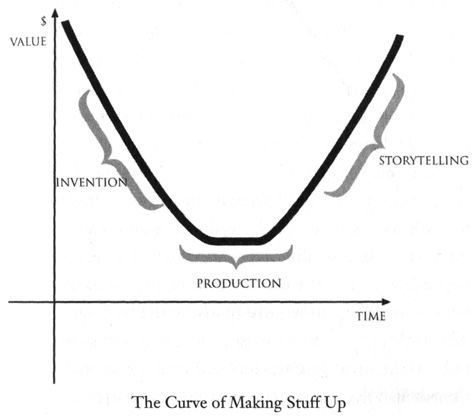
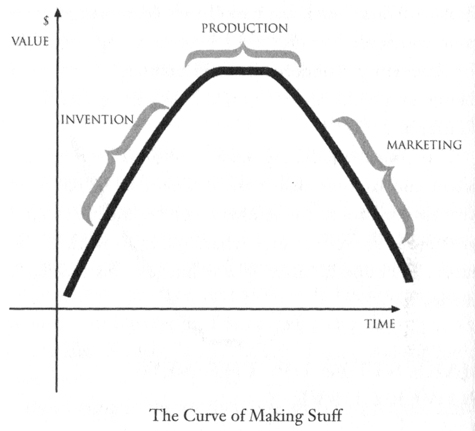
    • The curve of making stuff vs the curve of making stuff up
      • The value in creating and producing something new has dropped. Mass production and advertisements can’t generate profits
      • Creating something remarkable and then marketing it through storytelling generates profit. Product and service life cycles are much shorter now
    • Most people selling services/products struggle because they focus on production – making stuff cheaper,better
      • Remarkable product + storytelling has a better chance of succeeding

    Step 1: Worldviews and Frames

    • Each person has a different worldview
        • WV = biases + values + assumptions
        • WV influenced by people, places and life experiences
      • WV is not about world-sized issues, it more often than not affects how we think about small day-to-day issues
      • WV = lens for decision making
      • Frames are elements of a story painted to leverage a worldview a consumer already has. – George Lakoff on political discourse
        • Frames is the way you hang a story on a consumer’s existing worldview
        • Frames are the words and images and interactions that reinforce a bias someone is already feeling
      • Different WVs, different frames
      • Don’t change WVs. Instead, identify a group with a certain wv, frame your story in terms of that worldview and you win.
        • Changing WVs is expensive and glamorous work, but doesn’t lead to a lot of profits
        • People don’t want to change their WVs. They like it, embrace it and want it to be reinforced.
      • Marketing succeeds when enough people with similar WVs come together in a way that allows marketers to reach them cost-effectively.
        • Be a big fish in a small pond. Then move to adjacent ponds. – Geoffrey Moore – Crossing the Chasm
      • Opportunity = find a neglected WV and frame your story for them
        • People group together into common worldviews and your job is to find a previously undiscovered group and frame a story for those people
        • Find overlooked big markets by clumping together people with complementary worldviews
      • WV is not who you are, but what you believe and your biases.
      • WV is not forever. It’s what the consumer believes right now.
      • WV affects three things
        • Attention – whether we pay attention to something new
          • As a marketer, you cannot force people to pay attention
          • Push marketing like ads are random interruptions which are not predictable or scalable for marketers
        • Bias – new information received is coloured with our biases
          • Euphemisms help you frame a story to get past people’s biases
        • Vernacular – choice of media, tone of voice, words that are used and even smell
          • Copywriting
          • Photography
          • web design
          • branding
      • Examples of marketing to a previously ignored community with a worldview
        • Examples of new tea brands challenging old brands like Tetley and Lipton
          • Republic of Tea
          • Tazo
        • Selling wine and alcohol through stories
      • Not all ignored worldviews are markets in waiting. They’re either too small or too much on the fringe
      • Conventional wisdom has ignored many small communities for long. Such small groups along with other groups that have complementary WVs can turn into a cult -> movement -> trend -> mass market. Leap from the “none-of-the-above” group to the general population.
        • Unlike Moore’s simple curve, it is a multi-dimensional mess that occurs across populations and WVs and markets
        • Difference between early adopters and the mass market is one of worldview
        • It’s a mistake to assume that there’s only one product adoption lifecycle curve and that the only WV that matters is where people are more likely to adopt new tech
        • Edges of the curve are where there are people with an unfulfilled worldview
      • Speaking respectfully to a person’s worldview is the price of entry to get their attention
      • Best marketing stories are told with frames but ultimately spread to people who are open to being convinced of something brand new
        • It’s not enough to find a niche that shares a WV. That niche has to be ready and able to influence a large group of their friends
          • [[ToResearch]] How to influence a group to spread the word
        • A shared WV doesn’t make a community. They just share a bias, but don’t talk to each other because they’re not interested in why others have the same negative view (like hating car dealers)
          • Best marketing happens when you talk to a group that shares a WV but also talks about it which makes it a community
      • The desire to do what other people we admire are doing is what helps successful marketing efforts
        • People buy art at an auction because of their friends. They’re not interested in something that no else is looking for.

    • Step 2: People notice only the new and make a guess
      • How the brain processes new information
        • Look for a difference
        • Look for causation (coincidence) Three rules for the road between setup and payoff
        • Use our prediction machine Setup triggers anticipation – what happens next. This leads us to an adrenaline-fuelled insight from making connections ourselves which results in engagement
        • Rely on cognitive dissonance
      • In the face of random behaviour, people make up their own lies
      • We drink the can, not the beverage
      • People only notice stuff that’s new and different. Once they do, they start making guesses about what to expect next.

    • Step 3: First Impressions Start the Story
      • You don’t get much time to tell your story.
        • Short attention spans
        • The animal brain inside us and things we do instinctively. The subconscious mind.
      • To avoid the onslaught of choices, we make snap judgements.
      • If the story is compelling and addresses basic human desires like fear or power or acceptance, it might be embraced
        • Acceptance, the need for approval
        • Curiosity, the need to learn
        • Eating, the need for food
        • Family, the need to raise children
        • Honor, the need to be loyal to the traditional values of one’s clan/ethnic group
        • Idealism, the need for social justice
        • Independence, the need for individuality
        • Order, the need for organized, stable, predictable environments
        • Physical activity, the need for exercise
        • Power, the need for influence of the will
        • Romance, the need for sex
        • Saving, the need to collect
        • Social contact, the need for friends (peer relationships)
        • Status, the need for social standing/importance
        • Tranquillity, the need to be safe
        • Vengeance, the need to strike back/to win
      • We have no control over when the first impression happens.
      • Superstitions are incorrect theories based on snap judgements
        • Facts are not the most powerful antidote to superstitions. Authentic, personal interaction is.

    • Step 4: Great marketers tell stories we believe
      • Marketing = advertising (pre-internet world)
      • Marketing = storytelling
      • Tell a story worth sharing and a lie worth remembering
      • The only way to change minds is to get past the filters and safeguards people erect to insulate themselves from opposing points of view and then to tell a story that spreads
      • Stories only work because consumers buy what they don’t need
      • The reason people buy stuff is because of the way it makes them feel

    • Step 5: Marketers with authenticity thrive
      • Before we are able to share a story with our friends and family, we should be able to tell it to ourselves
      • How to start your authentic marketing story
        • Copy someone from a different industry who is telling a similar story
        • Discover the cues and signals used
        • Do them all, not just a few. (Story is a symphony, not a note)
      • Stories promise to fulfil the wishes of the customer. They offer:
        • a shortcut
        • a miracle
        • money
        • social success
        • safety
        • ego
        • fun
        • pleasure
        • belonging
    • Competition
      • You can’t tell a better version of your competitor’s story. Once the customer has bought someone else’s story and believes that lie, persuading the customer to switch is the same thing as persuading the customer to admit that he was wrong. People don’t like to admit they’re wrong
    • 4 reasons why a new product launch failed
      • No one noticed it – because they were not looking. People only notice something that is remarkable or exceptional.
      • People noticed it but didn’t want to try it – because they don’t share the worldview as they’re not interested
      • People used it but didn’t return to it – no sticky enough or lack of habit loops
      • People liked it but didn’t tell their friends – worldview
    • The stories that work are the ones that spread.
    • You succeed by being an extremist in your storytelling, then gracefully moving your product or service to the middle so it becomes more palatable to audiences that are persuaded by their friends, not by the storyteller.
    • Examples of stories framed around worldviews
      • “I believe home-cooked meals are better for my family” – Crockpot
      • “Organic food is better”
    • You can’t just sit down and make up a story and expect people to believe it. You have to tell a story, not give a lecture
    • You cannot prove anything to the customer. You gain a customer when she proves to herself that you’re a good choice. The process of discovery is more powerful than being told the right answer.
    • Expectations are the engine of our perceptions
    • Storytelling works when the story actually makes the product or service better
    • Fibs are lies that make the story come true. It’s a way of describing your offering (in human terms) that makes the thing itself more enjoyable or more effective
    • Fraud is a marketing pitch that once revealed as a story makes the customer angry. Fraud is a story told solely for the selfish benefit of the marketer
    • Just because people might believe your story doesn’t give you a right to tell it!
    • Marketing is the art of making promises using non-verbal techniques
    • Successful stories don’t offer better quality or a good price
    • Don’t rely on marketing as a crutch. If it requires to change your story or your offering, then that is what you need to do.
    • Oxymorons – framing a statement around a worldview and then deliberately confounding expectations
      • compassionate conservatism
      • socially conscious investing
      • OMs might help you address a small but previously unaddressed group that actually wants both
    • Questions to ask
      • Which worldview are you addressing?
      • which frame are you using?
      • what’s the story that’s worth noticing
      • how will you live your story
      • what hard decisions are you willing to make in order to keep your story real and pure and authentic?
      • what are the shortcuts your fans can use to tell the story to their friends? how can you help them frame that story?
      • how can you radically change your product or service so that the story is natural and obvious and easy to tell?
      • what is the value of the permission the customer gives you to tell them something
  • Book Highlights: Differentiate or Die

    Book Highlights: Differentiate or Die

    Problem of Commoditization:

    • Reliance on promotional pages (deals)
    • No refinement in choosing ad agencies
    • Mgmt does not understand the mind of the customer

    USP (Unique Selling Proposition): Specific, unique and strong!!

    Differentiating with: types of customers – Intuitives (early adopters), Thinkers (analytical, logical and ignoring the emotions), Feelers (likes, dislikes, interested in feelings of others), Sensing (facts, details, putting things in context)

    Differentiating Commodities:

    • Identify
    • Personify
    • Create a new generic
    • Change the name
    • Reposition the category

    “Where there’s a will there’s a way to differentiate“

    1. Quality & Customer Orientation are not always differentiating ideas
      • Quality is a given; not a differentiator [Gillette model of differentiation: Improve, Upgrade and Innovate]
      • Knowing your customer is not a differentiator
      • Customer Orientation does not necessarily mean value for customers and company
      • Watch for undesirable and unexpected outcomes from customer loyalty programs
      • Customer Satisfaction does not mean customer commitment to your brand
      • Operational effectiveness v/s strategic positioning
    2. Creativity is not a differentiating idea
      • By getting into the trap of being creative, you miss the point of conveying the actual message. (Clever and funny ads that actually do not say anything about the product itself)
      • Emotion depends on intelligence and reason. Emotion being irrational is a myth
      • Ads must promote the product benefits and product differences and not purely be creative an emotional
      • Present product information as news to customers, then it makes a bigger impact on their minds
    3. Price is not a differentiating idea
      • You can start with price, but have to move up the value chain
      • Ways to do it:
        • Do something special
        • Cause confusion among the minds of the consumers as to what value others are providing
        • Shift the argument (eg Total cost of ownership)
      • Price promotions only work in the short term to give a spike in sales
      • short term price promotions can:
        • shift stock/move your stocks
        • achieve sales target for the quarter
        • postpone losing shelf space
        • keep up with competition for the time being
      • Differentiating with high price
        • high quality products can be expensive
        • high quality products offer prestige
    4. Breadth of line is a difficult way to differentiate
      • Preference is better than breadth of line. (You should be the preferred product in a category instead of having a presence in all categories)
      • Large breadth of product offerings can also dilute your differentiation
    5. Steps to differentiation:
      • Make sense in a context. (provide context to your message. what is the perception people have after listening to your competitor’s messages? What do customers think when they hear about Educomp for example?), (see if the timing is right)
      • Find the differentiating idea (Need not be product related)
      • Have the credentials (Back up your claims)
      • Communicate your difference
    6. Differentiation takes place in the minds of the customers
      • Minds are limited
      • Minds hate confusion. Need simplicity
      • Minds are insecure. They will go by what others are doing
      • Minds don’t change
      • Minds can lose focus
    7. Being first is a differentiating idea
    8. Attribute ownership is a way to differentiate. (Products have attributes)
      • Owning an attribute. (BMW owns driving pleasure. Merc owns luxury, Volvo-safety,Jaguar-styling,toyota-reliability,ferrari-speed))
      • Having an attribute that is the opposite of what your competition has. (Coke was the original cola. Pepsi targeted the younger generation. Coke for the older people, and pepsi for the youngsters)
      • Attribute must be simple and benefit oriented
      • Attributes are not created equal. Some have a stronger impact, value and benefit. Ownership of such an attribute could give you a significant share of the market
      • Use of negative attributes to show your better than the competition. (BMW vs Merc: The ultimate driving machine vs the ultimate sitting machine. McD’s is for kids!!)
    9. Leadership is way to differentiate
      • Owning a category shows leadership. Xerox-copiers, Heinz-ketchup
      • If your the leader, dont be afraid to brag and let everyone know. Customers like leaders. [People love underdogs, but buy from overdogs]
      • Different forms of leadership:
        • Sales Leadership
        • Technology
        • Science
      • Leadership is a platform
    10. Heritage is a differentiating idea
      • heritage can be a substitute for leadership
      • locational heritage ( Scotch whisky, Italian designer wear, french wine etc)
      • Anti competitor heritage ( Most American vodkas look Russian. Stolichnaya is different. It is Russian.) (Absolut Sweden versus Absolute Russian.)
      • Use characters (Col Sanders)
    11. Market specialty is a differentiating idea
      • One stop shop for everything is a bad idea [Gap-casaual clothing, benetton -wool &clothing for youngstrs,victoria secret, banana republic-upmarket casual wear)
      • Announce your specialty
      • Become the expert for that specialty
    12. Preference is a differentiating idea
      • Customers like to follow the herd
      • They look for “social proof” before the make their decisions
      • If you can’t get everyone to prefer you, find a smaller group that will
      • If you have a brand ambassador, they need to be a good fit for the company/product [social proof]
    13. How a product is made if a differentiating idea
      • Magic ingredient [KFC crispy chicken, Sony Trinitron technology, General Motors NorthStar technology etc]
      • Dramatize the difference [Customers dont need to understand how it works.]
      • Product innovation [Dove is made from moisturizing lotion, DiGiorno pizza is cooked twice without having the problems that occur with reheating ]
      • System innovation. Innovate the system that connects your product and the customer
      • Making it the right way by not cutting costs. Absorb the costs and produce a better product
    14. Being the latest can be a differentiating idea
      • When it may not work:
        • do not solve a non-existent problem
        • do not mess with tradition
        • It must be better
    15. Hotness can be a differentiating idea
      • If your product generates buzz use that to your advantage. A rapid initial sales growth can be one of them
      • Strategy implementation to explain why your hot through
        • Sales [compare your sales vs competitor sales for any time period favorable to you]
        • Industry ratings [JD Power)
        • Industry experts
      • Publicize the problem your trying to solve
    16. Growth can destroy differentiation
      • growth can be distracting
      • line extension problem [Chevrolet was a good family car. They entered all categories and increase their line of breadth. Now no one knows what they stand for]
      • Discern between nice to have and the need to have, when adding features/products to your list of offering
    17. Differentiation requires sacrifice
      • Product sacrifice [Eveready made all kinds of batteries. Duracell focused on alkaline batteries to become the leaders]
      • Attribute sacrifice – focus on one kind of product attribute. Volvo focused on safety for all their cars. Dell focused on direct delivery of PCs.
      • Target market sacrifice [Burger king sacrificed the kids meal market to target the older crowd to differentiate from McD’s]
      • BUT, What you advertise, what you sell and what you make money from can be three different things.
      • Sacrifice is only in the minds of the customers. [Fedex overtook the leaders by promoting overnight deliver of small packages. But that doesn’t mean they don’t ship larger or 2-day deliveries]
    18. Being different in different places
      • Maybelline is a low end cosmetic range in the US. It is aspirational in the south east asian markets.
      • things to keep in mind if you go into other countries or markets:
        • current idea may be the wrong idea
        • attributes can change when you cross borders [beer is macho in Australia, considered feminine and sophisticated in south east asia)
        • your market leadership elsewhere may not translate
        • your heritage may not be respected
        • your specialty may get blurred [lux is a soap in indonesia, shampoo in china, and everything in Japan)
    19. Maintaining your difference
      • Stay contrary (to general thinking or your competitors)
      • be consistent (ad guys, sales guys, customer support guys – all need to speak the same message)
      • make the tough calls (convince investors, stock markets etc that to differentiate you need to sacrifice)
      • consistency in operations(if you promote yourself as a customer friendly company, it should reflect in the operations. sales staff, customer support etc need to friednly)
      • evolve your difference – your differentiator may not remain the same over a long period. It could be copied or become irrelevant.
      • evolving vs tinkering – silly cosmetic changes done because of a trend will not help in maintaining your differentiation
    20. You can differentiate anything
      • study the trends
      • shift the battlefield (top down – “bad for you” educational approach will not work. Telling cigarette users that smoking is injurious to health will not stop them or new people from trying it]
      • Strategy is executing your differentiation
      • “Slaughtering tomorrow’s opportunity on the altar of yesterday”
    21. Who is in charge of differentiation?
      • The role of the CEO or Chief Marketing Officer is very crucial. To ensure everyone in the organization buys into it, and follows it, and not veer of that path because of distractions
  • How to understand your audience better

    How to understand your audience better

    Everyone needs an audience, whether you are a freelancer, a blogger, a business owner or even a politician.

    Not having a target audience is like throwing a bowl of pasta on the wall and hoping it sticks.

    https://giphy.com/gifs/studiosoriginals-l3UcjBJUov1gCRGbS

    From my past experience, the process of identifying and defining your audience takes the following steps:

    Get a good understanding of what business you really are in

    You sell online communication courses, but you are in the business of personal development

    You sell website development service, but you are in the digital transformation business

    Coca Cola doesn’t sell coke, they sell a feeling.

    Who is most likely to buy from you and why?

    Explore by talking to people in your network of friends and business contacts. Research online, ask questions and expand your thinking.

    Collect the dots and organize them so that you can connect them later to make sense.

    Deep dive into your market segment

    Once you settle on an industry and market segment that feels like a good fit for your business, deep dive into that segment to understand who the buyers really are and what do they want.

    Researching customers can be categorized into:

    1. Exploratory and specific
    2. Quantitative and qualitative

    Research methods will also depend on the type of business

    If you’re a B2C business, selling a low-price product, you will have to rely on demographic data, personality attributes and psychographics.

    Here’s how Hubspot explains the difference between demographics and psychographics”

    Demographics: Age, Gender, Occupation, Ethnicity, Geolocation, Education level, Religion

    Psychographics: Personality characteristics, Lifestyle, Social class, Attitudes, Principles & beliefs, Activities & Interests

    The two popular research methods in B2C are:

    1. Surveys
    2. Focus groups

    For a B2B situation with a high-consideration decision product or service, relying on demographic data may not give you the full picture.

    Low-consideration decisions are impulsive and in the realm of our sub-conscious. It is hard to identify and narrow down the specific set of influencing factors for a wide audience.

    You don’t think twice about buying a toothpaste. You stick to your favorite brand or pick one that catches your attention. And it is hard to explain why a lot of the times, so imagine trying to interview a buyer about why they chose a particular toothpaste. You will get a wide variation in answers and no meaningful patterns out of it.

    In the case of high-consideration decisions, the buyer thinks, researches, consider options and then finally takes the decision. In such a scenario, finding what triggers the buyer to look for a solution, what motivates him or her to search for options and on what criteria does the buyer finally make a decision can be gathered through a structured process of talking to potential buyers.

    Before that, here are some great resources for you to find macro-level data about the economy and your specific industry.

    Study the market

    Data + Insights = Knowledge

    Analyze the competition to understand your audience

    Look for insights in the following places:

    1. Competitor websites
    2. Blog (Competitor and Industry influencers)
    3. Customer testimonials and review – find common patterns as to why they like your competitor’s service
    4. Competitor’s audience on social media – who are they and what are their profiles
    5. Digital tools for research
      • Google Search – use advanced search operators to narrow down your results
      • Google Trends
      • Google Alerts
      • Google Keyword Planner – free tools available within your Google Ads account (not Adsense)
      • Google Surveys
      • SEO tools
        • Ahrefs – SEO Keyword research tool
        • Moz
        • SEMRush
        • Ubersuggest.com
        • ranksignals.com
      • Buzzsumo – A content research tool
      • Alexa Site info tool
      • Spyfu
      • ispionage.com for checking your competitor’s Google PPC spends
      • mailcharts.com – track big brand’s email marketing activities
      • owletter.com – capture and analyze your competitor’s marketing emails
      • Owler – track news about companies
      • mention.com – social media tracking of competitors

    Gather data from the above tools, but for insights, you will have to speak to people – experts and potential customers, particularly the buyers.

    The structured approach to talking and interviewing buyers in your market and building archetypes is called Buyer Personas.

    How to create Buyer Personas

    Buyer Profile: We’ve discussed this above. Demographic and psychographic data can be found through industry reports and places like LinkedIn.

    Buyer Insights: While focus groups and surveys can help with getting general information, it does not give us actionable insights on which you can build your marketing strategy.

    Adele Revella in her book ‘Buyer Personas’ talks about the 5 Rings of Buying Insights:

    • Priority Initiatives – What are the buyer’s triggers that starts them on a journey to look for solutions.
    • Success Factors – What do they hope to achieve as an outcome, operationally and personally.
    • Perceived Barriers – We all have our biases and worldviews. Understand what barriers might be preventing them from considering a solution like yours
    • Buyer’s Journey – A B2B sales process is usually similar for most businesses. It can be encapsulated into the following stages: Awareness, Consideration and Purchase. The steps taken during these different stages can help us trace the buyer’s decision-making journey.
    • Decision Criteria – What are the attributes of your solution that a buyer finally makes a decision on?

    Interviewing for Buying Insights

    1. Identify buyers
      • Who considered and chose you (clients)
      • Who considered but chose a competitor (this type of buyer can provide you with the most valuable data)
      • Who considered but maintained status quo
      • Who never considered you and chose another
    2. Contact only those who have considered or bought a similar solution in the last 6 months
    3. Ask good questions, listen and record (with permission)
    4. Organize this information gathered into the 5 rings of insights mentioned above. Retain the buyer’s words and vocabulary.
    5. Match these insights which reflect a buyer’s wants and needs to your features and capabilities.
    6. Hire a copywriter to craft your marketing message that highlights your capabilities in the context of your buyer’s wants using words and language that is familiar to them.

    Additional Reading & Resources:

    https://info.buyerpersona.com/buyer-persona-templates-free-download
    https://hbr.org/2018/05/the-surprising-power-of-questions

    Book Recommendations:

  • Book Highlights: Design of Everyday Things

    Book Highlights: Design of Everyday Things

    It’s not your fault.

    Design Principles – Conceptual models, feedback, constraints, affordances, mapping, visibility

    Power of observationDesign is communicationFalse causality

    Principles of design for understandability and usability – conceptual model & visibilityMental model, designer’s model, system image, users model

    The paradox of technology Naive physics and psychology might be wrong but are often sensible

    Learned helplessnessTaught helplessness

    7 stages of action – goal, intention, action sequence, execution, perception, interpretation, evaluationOpportunistic vs planned actions

    The gulf of executionThe gulf of evaluation

    Knowledge resides partly in the head, the world and the constraints of the world., cultural constraints Discrepancy in precision of behavior and imprecision of knowledgePrecise behavior from imprecise knowledgeDeclarative knowledge and procedural knowledge

    Memory usage – memory for arbitrary things, memory for meaningful relationships, memory through explanation

    Wherever labels are necessary, consider another design

    Tradeoff between knowledge in the world and head – retrievability, learning, efficiency of use, ease of first time use, aestheticsConstraints – physical, semantic, cultural, logical

    If a door handle needs a sign, then its design is probably faulty

    Switches – grouping problem, mapping problem

    Sounds must reflect the natural relationships when providing feedback

    Errors – Slips (mess up action sequence) & mistakes (form wrong goal)

    Types of slips – capture error, description error, data driven error, associative activation error, loss of activation error, mode error

    Detection of slips – need feedback, also need to know error level

    Design lessons from study of slips – Prevention., CorrectionIf you build an error tolerant system, people will rely on it, so it needs to be reliable.

    Mistakes:

    Models of human thought – files, schema theory, connectionism/neural models-common memory & a discrepant. Tend to remember the latter, former is bunched together to form an average

    Structure of tasks:Wide and deep structure (Chess)Shallow structure (food menu)Narrow structure (starting a car)

    Everyday activities must minimize planningGames, puzzles, novels use wide and deep structures to make it more engaging

    Conscious and subconscious behaviorConscious thought has limited short term memory. It can be overcome by providing it an organizational structure that makes use of our subconscious pattern matching memory

    It is a lot easier to determine the obvious after the mistake has happened. Mistakes happen often when we misinterpret a situation. We explain away errors with logical explanation once it has occurred.

    Social pressure & mistakesCannot discount the effect of social pressures on decisions that are mistakes.

    Designing for errorNormal behavior is not always accurate and therefore you must design for error. Do not punish people for.making error. Design the system to allow for errors. Nderstamd the caues of error and design to minimize it. Allow actions to be undone if error occurs or if not possible make those actions hard to do. Make error discovery and error correction easier.

    Warning signals that can’t distinguish between deliberate and erroneous actions is poor design. Forcing functions – physical constraints on actions – failure in one stage prevents next stage from happening. But it isn’t easy to force unwanted behavior on users. FF – specialized methods for preventing accidents – interlocks(forces action to take place in a proper sequence), lockin(keeps operation active, & stops anyone from prematurely stopping it) , lockout (prevents an event from occurring or someone from entering a place that is dangerous)

    Natural evolution of design – hill climbingForces working against evolutionary design:- new models are in the design process before the old ones are released- no feedback mechanisms- pressure to be distinctive- curse of the designers individuality

    Why designers go astray- putting aesthetics first- designers are not typical users (repeated use of product results in the knowledge in the head whereas first time users rely on knowledge in the world) – designer’s clients may not be users – designing for special people- selective attention (problem of focus)

    Design is the successive application of constraints until a unique product is left.

    Designer must balance different constraints – market, cost, aesthetics, usability etc

    Physical anthropometry – measurement of the human individual

    Two deadly temptations for the designer :- creeping featurism: tendency to add features beyond reason. Two ways to deal with it… avoidance /restraint and organization /modularization- worshipping of false images

    Explorable systems must have 3 requirements :- visibility of allowable actions- effect of action must be visible & easy to interpret- actions should be without cost

    Make the computer system invisible when doing a task

    User centered design:

    Design should make sure that (1) user can figure out what to do (2) user can tell what is going on

    7 principles for transforming difficult tasks to simple ones :

    1. Use knowledge in the world and in the head3 conceptual models – designer’s, user’s, system image.designer and user communicate through system.image.
    2. Simplify structure of tasksUsing tech – keep task the same but provide mental aids – to make invisible visible, improving feedback & ability to keep control (computer graphics) – automate but keep nature of task same. (Car auto transmission) – change nature of task if itnis complex (shoelace to Velcro for kids & elderly) – don’t take away control (over automation can be a problem – overreliance, system failure, takes away control)

    First 2 act as reminders keeping the task the same

    Technology can transform deep, wide structures into narrower and shallower ones.

    Task simplification by itself, is not necessarily a virtue.

    1. Make things visible : bridge gaps between execution and evaluation

    Enable user to determine relationships :- between intentions & possible actions- b/w actions and its effects- b/w actual system state & what is the perceived system state- b/w perc. state & intentions, needs, expectations

    1. Get the mappings right5. Exploit the power of constraints – natural & artificial6. Design for error7. If all else fails, standardize.Standardization is another aspect of cultural constraints

    Deliberately making things difficult through design for safety, security etc :- hide critical components (make things invisible) – unnatural mappings for execution and evaluation- make actions physically difficult to do- require precise timing & physical manipulation- no feedback

    Easy looking is not necessarily easy to use

    Complexity of appearance = no of controlsDifficulty of use = difficulty of finding controls + difficulty of executing functions

    For ease to use, match no of controls to no of functions and organize panel acc to function For looking easy to use, minimize no of controls. Hide controls not being used at the moment.

    We are surrounded by objects of desire, not objects of use.

  • Book Highlights: Creating Signature Stories

    Book Highlights: Creating Signature Stories

    Signature story is an intriguing, authentic, involving narrative that delivers/supports a strategic message clarifying/enhancing the brand vision, customer relationship, organizational values and/or business strategy.

    7 characteristics of an intriguing story: 

    Thought provoking,

    Novel

    Informative

    Inspiring

    Exceptionally relevant

    Humorous

    Awe creating

    Authenticity doesn’t mean the story has to be true. Signature story is not a set of facts. A set of facts might be easier and seemingly an efficient way of communicating compared to a story which does not cover all the facts. But it cannot engage and feel authentic because it seems no different from another company’s set of facts.

    Signature Stories need not replace facts.

    Presenting facts in the context of a story:

    1. Embed facts into a story

    2. Place facts after the story so that it completes it

    3. Place facts before the story – danger of facts undercutting the power of a story because of the analytical context it sets

    A signature story can be 

    short with details or length

    borrowed 

    owned by the customer, employee or others (addressing the philosophical problem of the customer)

    (1-1-1 program) 

    Challenge: how to get organisations on board

    1. Making them believe

    2. Find and leverage stories

    3. Create a storytelling culture

    SS come in sets.

    1. Companion stories add interest, energy, and visibility

    2. Story set can express the breath and depth of a strategic message

    Types of sets:

    1. Elaboration stories – a master story can be elaborated with other stories that add interest and depth by using a character or a location as the hero in the supporting story

    2. Varied applications: same story with different applications

    3. Different plots

    4. Different spokesperson

    5. Different perspectives

    Visibility helps makes a brand relevant. Relevance requires brand awareness and credibility. Visibility does both. 

    Visibility leads to perceptions of success and leadership. Most people lack the motivation and patience to understand what is causing high brand visibility.

    Energy

    Insufficient energy causes:

    – decrease in visibility 

    – Brand seem bland, tired and old fashioned 

    – Decline in perceived quality

    Attention has two levels:

    – short term attention

    – long term… engagement

    Characteristics of a SS that increases both levels of attention:

    – Be fresh and different in the first few seconds

    – create the expectation of meaningful rewards 

    – relevant info, entertainment, emotional experience, affirmation of an opinion or choice

    – create uncertainty and suspense

    – create emotional involvement with character and plot

    – have a brand story… A recognizable story type

    4 motivations why people share stories with others (word of mouth):

    – Offering involvement 

    – Compelling and involving offer (Nordstrom tire story)

    – self-involvement 

    – offers a way to gain attention, show connoisseurship, feel like a pioneer (like a girl story)

    – other involvement – you want to reach out and help, Express care and friendship (Skype story)

    – message involvement – message is humorous, exciting, disturbing or intriguing for it to be shared (red bull space jump story)

    Connecting the SS with the brand:

    – Brand as the hero

    – brand surrogate as the hero

    – reflect the passion of the customer base

    – supporting programs that carry the brand name

    – prominent display of the brand as the story sponsor

    – adjacent communication

    Facts can be ridiculed; you don’t ridicule a story, it’s just a story.

    SS are good at influencing associations and beliefs, behavior and intentions. Associations & beliefs drive consumer choice and Brand relationships. Positioning SS highlights multiple dimensions of the brand and ties it together.

    Affect transfer – the liking of one object is transferred to a linked object.

    Narrative transportation – the audience is transported from the existing reality into the story or narrative.

    Why stories are good at persuading:- 

    Self Discovery is more powerful than having people talking at you

    – inhibits counter argument by distracting and breaking down suspicion

    – generate an emotional response which can affect the liking of a brand and the behavior towards it

    – a story teller is more authentic, credible and liked than a person trying to persuade with facts

    – stories are remembered

    (POSITIONING)

    SS for framing a sub category – when a brand association becomes a must have for a worthwhile customer

    Higher purpose SS goes beyond just selling products and services to answer the question of why. They inspire employees and customers. 

    Ideas for generating a higher purpose:

    – employees interests

    – organisations skills and assets

    – self-expression or social benefits that can be provided from your products or services

    – what do your customers appreciate and value

    – long term program vs a seasonal promotion

    Creating SS:

    – know your strategic message

    – allow a spectrum of stories to emerge

    – test and learn with multiple stories

    Types of story heroes:

    – customer

    – offering

    – brand

    – brand endorsers

    – suppliers

    – employees

    – organisation programs

    – founders

    – growth strategies

    – revitalization strategies

    Creating a strong SS:

    Bring technology breakthroughs to life

    Get personal

    Connect to your heritage

    Play to your audience

    Offer user generated content

    Try off the wall creativity

    Employ vivid technologies

    Rely on humour

    An effective SS need not tick all the elements in the list. Aim for a few that can make the story engaging and interesting. An effective story is not the sum of its parts but based on its flow and impression.

  • Book Highlights: Buy-In

    Book Highlights: Buy-In

    Type of people you will encounter:

    1. Pompous Mean
    2. Avoid Risks
    3. Divert Attention
    4. Hidden Agenda
    5. Supporter

    Tactics used to attack you:

    1. Confusion
      • irrelevant facts, convoluted logic, too many alternatives provided
      • “What about, what about, what about” argument
      • gives an impression that idea has not been well thought out
      • people cannot follow conversation anymore
      • stats often used to confuse
    2. Death by delay
      • attention can be diverted to other issues while diverting from the current focus
      • seems to have a sound and reasonable logic
      • “we have too much on our plate argument or issues needs urgent attention. IT may not require 100% of the people’s attention
    3. Fear mongering
      • they push emotional buttons
      • look for words that trigger emotions like big government, fire, slippery slope, ruined etc
    4. Ridicule & character assassination
      • question your competence; – It has collateral damage; –

    How to respond:

    1. Dont be afraid of distractors, they can help you
    2. Response – simple, straight-forward and honest
    3. Show respect
    4. Watch everyone. Focus on majority, and ignore the minority if they are firm on their positions.
    5. Anticipate & prepare in advance

    Goal is to not try and convince all those who disagree with you, but win over the majority, not just 51% either.

    Do not portray your solution as a panacea to all problems. One product cannot solve all problems that an organization has.

    When someone points a finger at you indirectly, appreciate the compliments, but emphasize that it was the work of large team. Attack is now made to look like its being targeted at the entire group

    Stages of the meeting:

    1. We need no solution, because there is no problem
    2. There is a problem, but your solution is flawed or doesn’t deal with it
    3. There is a problem, solution is good, but will not work in this situation/organization

    Types of attacks: (R:Response)

    1. We’ve been successful; why change? R: Those who fail to adapt eventually become extinct or irrelevant
    2. Money (any other problem the product does’t address) R: Extra money is what rarely builds truly great companies or organizations or funds great inventions
    3. You exaggerate the problem and the problem you raise is trivial R: Bring discussion back to the merit of your idea. Use a real life example so that people can empathize
    4. You’re implying that we’re failing R: No, we’re suggesting you’re doing a remarkably good job without the needed tools.
    5. What’s the hidden agenda here? R: Well no, look at our track records and the team behind this proposal
    6. What about this, and that, and this…? R: All good ideas. if new. raise more questions that cannot be answered with certainty. Cannot about 100% certain about any new idea. Holding new ideas to such standard, will kill most ideas.
    7. Your proposal goes too far/doesn’t go far enough R: 1. Good, we agree there is a problem. 2. I’m glad we agree the direction proposed is in the right direction. 3. Let’s get started at least. 4. If it goes too far, we will slow down at that point. 5. If it doesn’t go far enough, we will use the successes we would have had until then to mobilize into meeting the shortage.
    8. You have a chicken & egg problem R: Start small instead of doing two activities at the same time.
    9. Sounds like [something most people dislike] to me! R: Dismiss the comparison, and replace it with a more compelling and attractive one
    10. You’re abandoning our traditional/core values R: Our plan in fact upholds these values. We do not seek to change your existing processes but instead add value to your institution.
    11. It’s too simplistic to work No, its the combination of the good work you do and some new ideas together, can create benefits for everyone
    12. No one else does this R: There is a first time for everything, and this presents an unique opportunity. (We have a few examples of schools & universities trying this out today)
    13. You can’t have it both ways R: We didn’t say X or Y, although it may have sounded that way. We said A and B, which are not incompatible.
    14. Put forth an issue that is worrisome at an opportune moment and something the proposer don’t know about R: No one can deny the significance of the issue raised. We may have not explored this issue, but so far far every potential problem has been solved and we’re confident of addressing this issue as well.
    15. Idea is flawed because it is causing so many questions & concerns R: Actually its good that there are many questions. It shows we are engaged, & an engaged group makes better decisions and also implements them more successfully.
    16. We tried it before – didn’t work R: Conditions have probably changed. What we propose isn’t exactly what was tried before.
    17. It’s too difficult to understand R: Not a problem. We will make the required effort to make everyone understand and convince them. We believe its worth the effort.
    18. Good idea, but not the right time R: So you like the idea. Can I know what is stopping you from using the product now?
    19. It’s just too much work to implement this R: Good ideas always need time and energy to implement them, but the end benefits are far-reaching. (This will benefit students and teachers tremendously and bring a new dimension to learning)
    20. It won’t work here, we’re different! R: True, we recognize that. But we all are humans and organizations however unique they might be in their setup, have remarkable similarities. (Give a real world example)
    21. It puts us on a slippery slope R: Good organizations or groups of people use common sense as guard rail to keep from sliding into disaster
    22. We can’t afford this. R: Most important changes without new sources of money
    23. You’ll never convince enough people R: That right, and is never possible, so that’s okay
    24. We’re simply not equipped to do this R: You have much of what is required, and we can work together and get the rest

    Process of getting the buy-in:

    1. Get people’s attention
    2. Then, win their minds
    3. And finally win their hearts
  • Book Highlights: 10 Days to Faster Reading

    Book Highlights: 10 Days to Faster Reading

    Bad habits of reading: passive daydreaming, regression (rereading) and subvocalizing

    Have a clear purpose, preview the book – intro paras, titles and sub titles, and finally speed reading techniques

    1. Focus only on imp keywords and skip the rest
    2. Another strategy is to stop your eyes on thought groups instead of separate words. Imagine phrases as being separated by slashes: By looking for/thought groups,/you force your eyes/to move forward faster/while maintaining/good comprehension.
    3. One way to overcome the habit of subvocalizing is to focus on the white space just above each line. This way, you can still see the top half of the letters and can thus easily understand them without becoming fixated on the words themselves.
    4. Another strategy called the indenting method involves using your peripheral vision. Instead of placing your eyes at the beginning of each line, try aiming them half an inch inside the left margin, and then stop reading half an inch before the right margin.
    5. Use your hand or a pen to lead your eyes and create fast reading habits
    6. When reading narrow columns like the kinds found in newspapers, you can place your index finger in the center of a paragraph just under the line you’re reading. Move it either straight down or in the shape of a snake as you read across a line in order to guide your eyes.
    7. Next, cover the text you’ve already read in order to avoid regression. One way to do this is by using the business card method; another requires only using your hand. Make a fist with your left hand, and sticking your thumb out to the side. Then, just place your hand horizontally or vertically over the text you have just read
    8. Give yourself a five-minute break every 20 to 30 minutes so your brain and eyes can rest. And don’t read for more than an hour before taking your break!
  • WordCamp Europe Experience From An Indian Perspective

    WordCamp Europe Experience From An Indian Perspective

    WordCamp is a culmination of monthly WordPress meetups into an annual event held across many cities in the world. WordCamp US and WordCamp Europe are special events that bring WordPress communities from various regions to one city to celebrate the spirit of WordPress.

    WordCamp Europe 2016 held this time in Vienna was the largest WordCamp ever held with 1900+ attendees from more than 30+ countries. It moved from Seville to Vienna this year and it’s going to be held in Paris next year.

    We haven’t had a WordCamp Bangalore yet, but I attended WordCamp Mumbai earlier this year. So I wasn’t entirely sure what to expect from a WordCamp abroad.

    As a first time attendee at an event like this, I had a few apprehensions and a tad anxious too.

    Given that Vienna was a long flight from Bangalore, I decided to use the opportunity to visit family in neighbouring Switzerland and then get to Vienna a few days before the event.

    Basel train station
    Basel SBB – Train station

    Took the chance to visit Art Basel as well when I was there https://goo.gl/photos/VAVkjMDRPiykeQFq6

    View of Zurich from Uetilberg, the highest point.

    While Switzerland was gloomy and sunny intermittently, Vienna was just hot. I met up with Akshat who also traveled from Bangalore at our Wombats hostel near Naschmarkt on 21st June.

    The beautiful open space outside the venue

    View from the hostel room window

    He’s a veteran of sorts with attending these events and having already built good relationships within the community, I heeded his advice and got there early. And thanks to him, I made some new friends.

    We walked around Stepehenplatz the first evening planning and setting up meetings with people. This was my 2nd visit to Vienna and so it wasn’t very difficult trying to navigate the city.

    Picking up a local sim card with data for €15 was well worth it. Made it very easy for us to communicate and coordinate with others we were planning to meet.

    Naschmarkt

    Meeting people from so many different nationalities with unique backgrounds and outlook towards life was an enriching experience. It reminded me of the diversity of my own country. It warrants a separate post on the people I met and what I learned from them.

    Leopold Museum was a great venue to interact with people.

    Numerous conversations I had involved talking about culture, history and languages. Many were surprised to hear that we have  100+ languages in India and many more dialects.

    I always take pleasure in explaining the subtleties and nuances of India. What you is generally get to read is an oversimplified and reductionist view. So, I hope every person I spoke to walked away feeling as enriched as I did, learning about another country and its people.

    Tribe meetups and unconference was a great idea

    The diversity of the attendees also meant you got to observe the different accents, cultural influences, language and interesting questions about India, although none as ignorant as these. 

    There were a few that got asked often though. When I spoke about the WordPress agency and Design Studio I run, I was asked where I got all our clients from. I’m wondering if that was a polite way of asking “are you an outsourcing agency?” ? Or am I reading too much between the lines?

    Many were surprised to know we worked mostly with local businesses and startups in Bangalore and how we transformed from a product to a WordPress agency.

    Indian agencies really do have a bad reputation of spamming people and in some cases doing sub standard work. However, branding all Indian companies with the same brush would be a foolish thing to do. The image of an Indian company doing outsourcing work for dirt cheap seemed to be common.

    So it was interesting to see some reactions when they heard our story and how we work. “Your English is very good”… I heard that a couple of times too. ?

    One of the things I was curious about before coming was what language would people be most comfortable with. And from what I noticed, most folks had a good grasp of English and it seemed to be the primary language of choice.

    This is intriguing because in India, with all our different languages, you notice something similar. At conferences, you will generally notice most talking in English, but observe more intently and you will hear Hindi, Bengali, Tamil, Kannada, Telugu and other regional languages being spoken among small groups.

    I never got to ask this question, but I’m wondering what language is used in local WordPress meetups across different European countries.

    India is like Europe in many ways and to me the diversity at this event symbolized what WordPress is all about. It was also great to see the numerous steps the organizers had taken to make this an inclusive event.

    Remote work is an interesting trend I see more and more across companies. The big agencies at WCEU seemed to have embraced it. I haven’t seen much of this in India yet, but I encourage it within our company. I had an interesting chat with Tom Wilmots from Human Made about this. Another topic that deserves a separate blog post.

    In the end, I must say that the volunteers and organizers of this event did a fabulous job.So, thank you for making my long trip a worthwhile one. It was a great learning experience.