“high but not the highest intelligence, combined with the greatest degree of persistence will achieve greater eminence than the highest degree of intelligence with somewhat less persistence.”
Stanford psychologist, Catharine Cox
The problem with goals is that they are either too far out or very short-term. And there’s nothing in between connecting them.
One of the things games do well is to show you a clear progression by providing feedback on your current level and where you need to ultimately go to finish your game.
In other words, Grit is about pursuing a long-term goal, for a long time and not giving up. But we get sidetracked by distractions and life events.
Would it help if we designed goals that connected our weekly goals, yearly goals and long-term goals together with visual progression feedback?
A high-level goal is your life’s mission. It’s an end in itself. Can you tattoo your high-level goal? Because it’s a goal you are not going to change.
A low-level goal is only a means to an end. If you fail, you can try again or change the low-level goal till you find the most efficient way of doing it. These are experiments you conduct in the short term. The cost of failure is minimal.
Mid-level goals can be set in a way to unify and give direction to your low-level goals. They connect what you do on a day to day basis to your long term vision.
In productivity terms, the goal hierarchy could be implemented in the following way:
A 10-year vision of where you want to be and who you want to become as your high-level goal
A yearly plan and a 12-Week Plan to give you direction in the medium term
A weekly Agenda to drive your day-to-day activities
Buzzwords are “strategically ambiguous, over-packed with information and deliberately fleeting in nature,” says Andre Spicer in his article “Shooting the Shit“
But why do we use them so often, knowingly or unknowingly?
What’s the psychology behind them? And is there any real advantage in using them?
There is a psychological incentive in using buzzwords.
A study of buzzwords on college campuses in China showed that students used them to feel like they belong to groups as they felt lonely and embarrassed in large cities.
Buzzwords when used in a closed and like-minded group where everyone “gets it” can be a shorthand or provide context during conversations.
David Graeber says the reason we do it at work is because of our insecurity from what he calls “bullshit jobs” doing meaningless work. And to compensate for that we tend to overcomplicate business speak with fancy words.
In some rare cases, you can piggyback on a common buzzword to get attention and make your point.
However, buzzwords often obfuscate the core message. And if you’re striving for clarity and ease of understanding, particularly in marketing, you’re better off avoiding them.
Buzzwords are a trap for entrepreneurs and marketers. They quickly tend to find their way into the product’s differentiating features list. And that should be avoided at all costs as it puts you in the same bucket as everyone else using that buzzword.
Buzzwords in a business communication context are ambiguous, inaccurate, often old wine in a new bottle, and definitely not a differentiator. So it’s best avoided.
Scan your recent emails, tweets, or LinkedIn posts for buzzwords you may have used and share them in the comment below.
A marketing system is a set of resources organized in a way to produce repeatable results.
????Strategy – Establishes the principles the marketing system needs to follow
Objectives – What actions do you want to take?
Goals – What results do you want to achieve?
Marketing Plan – How do you intend to market your brand and to whom?
????????People – Resources required to operate the marketing system
Technical – Proficient with the web and digital to build solutions
Creative – Design skills that can visualize the brand
Marketing – Skills to execute the marketing strategy
????Experiments – Repeatable workflows for the team to follow
Ideation – Clearly defined process of collecting, evaluating, and prioritizing ideas. (A simple 2X2 effort-impact grid might help to prioritize)
Implementation – Step by step descriptions where needed and general guidance in other cases on how the implementation for the landing pages, emails, ads, etc need to be done. (Organize them on Drive or Notion for easy access to the team)
Feedback Loop – Validate the ideas after implementation by measuring them and refining the idea for the next round of experimentation
????Tools
Research – Gather insights on web traffic, competitors, social media engagement, industry benchmarks, etc using tools like SimilarWeb, Ahrefs and Sparktoro
CMS/Publishing – You will require a platform for managing and publishing content. WordPress, Ghost, and Webflow are options for a CMS-based website. Medium, Substack, and Typeshare are alternatives.
Analytics – Google Analytics for your website, ShieldApp.Ai for LinkedIn, and Buffer for different social media channels
Automation – Zapier and Automate.io are two good options to automate workflows and integrate your tools into the marketing system
I built the Pixelmattic marketing flywheel and brand by identifying what worked, turning that into a process and delegating it. And here are my lessons for turning some of them into marketing habits for your brand:
Your customers don’t know what you know and they don’t think like you do. The best way to understand their mindset is to speak to them including those who chose your competitors.
Brand Building
A strong brand can be your biggest competitive advantage in a crowded market or against bigger competitor with deep pockets. And brands can’t be built overnight, so use repeatable actions that strengthens your brand. Start with establishing brand guidelines.
Content Creation
Everyone from a company to an individual is a media publisher today. Its your vehicle to create a voice, a point of view and a narrative about your brand. So whatever format and channel you choose, create content regularly.
Experimentation Mindset
Marketing is a process of discovering the best way to articulate your brand to the right audience at the right time. The best way to approach it is with a scientific mindset of experimentation till you find a formula that works. Small, measurable experiments are better than lengthy and expensive marketing campaigns.
Analytics Review
Like audits, regularly review your analytics. But don’t sweat over vanity metrics like number of views and likes. Look for engagement and conversion data. Optimize your marketing for that. Our agency site gets low traffic, but gives us enough leads that convert to run a profitable 15 member team.
Follow me on Twitter for more
5 Marketing habits you should build today
I built the Pixelmattic marketing flywheel and brand by identifying what worked, turning that into a process and delegating it. And here are my lessons for turning them into marketing habits:
If you don’t want to gamble your marketing budget away, then you must do this one thing – audience research.
Here are 3 things you can do to build a marketing persona
Talk to the customer
Find 3-5 people who are customers and leads that didn’t convert
Find out what their triggers, hesitations, influences and state of awareness levels are with regards to their buying process
Compile this into buying insights that you can use in your messaging
Secondary research to create the voice of the customer
Find out where your customers hang out and discuss their problems and solutions that relates to what you do
Go to your competitor sites and look up testimonials of customers
Compile a document of customer statements that describes pain points and solutions in their own words
Quantitative research
SEMRush, Ahrefs and other SEO tools like them gives you a ton of data on niche and competitors. Find out what the competition is ranking for and the opportunities you can capitalize on
Macro data for the industry or geographies can be found through Pew research, government websites, Mary Meeker reports
Combine all of the insights from above to create an image of who the potential customer is, how they think, what are they apprehensive about, how are they currently solving their problems and what influences them in their decision making.
Armed with the right insights, your marketing can now be aimed correctly instead of shooting in the dark.
I’ve relied Content marketing since 2015 to help generate leads consistently for my agency.
Content marketing is an investment into the future of your business.
But most give up early on in the journey before they’ve seen meaningful results. Or go about it the wrong way.
And I’ve made all of the mistakes below that I want you to avoid.
Getting tactical without a strategy to tie them all together
Marketing in general always has a shiny buzzword around the corner. It’s easy to get pulled into latest trend and forget about basic principles. While you experiment with the latest tactic, make sure you don’t go off track.
Document your content marketing strategy and make it accessible to your team. Use it in every monthly/quarterly meeting and update it as you go along.
Content creation without content distribution in mind
What’s the use of creating great content if no one reads it or sees it. And getting the audience’s attention is harder than before.
While there is no guaranteed formula for viral content, thinking of how the content will be distributed while you’re creating content can give you ideas.
Putting all eggs in one basket or too many baskets
What’s hot today is out of fashion tomorrow, so don’t rely only on one strategy or tactic.
Run marketing experiments frequently to find the right mix of tactics that works for your business.
Ultimately your aim should be to own the audience on your turf – website and email. Use social media channels to get the attention and engagement, but don’t depend on them entirely.
I run a remote agency and we successfully transitioned all our client communication from email to Slack.
In the early days, like most agencies, all our communication with clients was primarily via email and the project management tool.
The design review stages with new clients are tricky. The iterations also need a rapid exchange of information. Emails are not best suited for both these scenarios. We dealt with our fair share of communication overhead during those days.
We tried one project management tool after another, believing that a perfect project management tool would solve our communication related problems.
We’ve been using Slack internally since 2016, but made this transition of onboarding all our old and new clients in 2019-20.
If you’re an agency or a client, shifting your project communication from emails to Slack will have massive benefits .
#1. Saves you hours replying to a long chain of emails or trying to find the right email thread to respond to
Contextual and threaded conversations make it easy to pick up where you left off. Sharing files and hoping on quick calls versus sending email attachments and sending calendar invites. Take your pick.
#2. Avoids Whatsapp chat messages which are difficult to manage and monitor
Many clients will tend to message you on WhatsApp because it’s convenient. But as an agency this won’t scale. Slack is convenient and provides access to the entire project team.
#3. The client vendor dynamics on Slack is that of collaborators and colleagues.
A formal relationship over email transforms into a friendlier and collaborative relationship over Slack and this has huge benefits for the productivity of everyone involved.
Brand building has one thing in common with fitness and financial wealth creation – both need consistency over a long duration of time.
We solve this in our personal lives by building habits.
Habits form because the brain is constantly looking for ways to save effort.
Charles Duhigg, The Power of Habit
What if we used the same approach to create organizational habits?
Marketing and brand building is about consistency, so why not create good habits that you and the team can use to build your brand.
Instead of looking at short-term campaigns and sprints that are disjointed in their objectives, why not develop brand habits. Small, simple and consistent actions you can take as a brand that will add up to something significant in a few years time.
Building a brand is like going to the gym. It’s important, but not always urgent on our list of tasks.
“Individuals have habits, groups have routines. Routines are the organizational analogue of habits”.
Geoffrey Hodgson
Charles Duhigg describes keystone habits as those that over time transforms everything. A brand habit can be considered a keystone habit because of its power to transform a business, the work culture, customer experience and product quality.
What you can do to build a brand habit:
Take a stock of where your brand stands today, how you see it, how your customer sees it and how your employees see it? Are they all in alignment? Where do you want your brand to go in 5 or 10 years time?
Habits are reward loops that is triggered by a cue. A routine follows and there is a reward at the end of it. This reward creates the craving for the habit to become a loop.
Do you want to establish a clear brand identity and personality? Make a routine to infuse this identity and personality into every brand communication.
Your brand is targeting a specific audience and a specific need? Build a set of routines for different teams/members to continuously engage with them at different stages of the customer lifecycle.
Questions to ask yourself for creating brand habits:
What are the cues for your employees and teams that triggers a routine?
What are the sequence of steps you want codified and committed to muscle memory? How will you build the muscle memory for your teams?
What reward can you design at the end of it that turns them into habit loops?
The difference between great brands and the average ones is the consistency with which they articulate, reinforce and demonstrate their brand values.
Good brand habits are the secret to their consistency.
Brand habits can also be used outside of the company, in your marketing and advertising.
Habits to drive customer adoption and influence customer behaviour.
Habits are so strong that they cause our brains to cling to them at the exclusion of all else, including common sense
Case Study: How Pepsodent changed consumer behaviour to become one of the most sold products in the world
In the 1940s, only 7% of America brushed their teeth regularly. In a decade since the first Pepsodent ad, that number had changed to 65%.
Claude Hopkins was asked to take over the struggling Pepsodent brand. The first change he made after studying the market was to link brushing with the vanity of looking good.
While it wasn’t factually correct, he convinced people through the ads that a thin film, which naturally occurs and which toothpaste has no major effect on, is the cause for bad looking teeth. Pepsodent was then positioned as the solution to a beautiful smile.
The cue then became beautiful teeth every time someone looked in the mirror. That led to more people brushing their teeth. To make this a habit, Pepsodent then added a mint flavour which left a refreshing feeling in the mouth. The brains then started to crave that sensation.
Case Study: How changing the focus from bad smell to rewarding with a pleasant fragrance transformed Febreze
P&G almost killed this product before it went on to become a hit. They spent tons of money developing the cleaning product, but a lack of resonance in marketing almost cost them.
It was initially positioned as a product that removed bad smells for people who smoked or had pets at home. But it turned out that these people were so used to the smell, they didn’t feel the need to remove the bad odour.
When they tried this product with a new target audience, the ones who spent time cleaning and keeping the houses tidy, the initial response from them was lukewarm. But when they dug deeper into the habits of this persona, they found the insight they were looking for.
Febreze added fragrance to their cleaning product and the reward of a fresh smell at the end of a cleaning chore turned it into a habit. People were then using Febreze just for the smell, even when there was no cleaning needed.
Operant conditioning is the idea that a person’s behavior is modified by its consequence. People strive to do things that make them feel rewarded.
There are however dark sides to the use of such powerful psychological techniques. The fast food we eat today has been designed to keep to trigger cravings and that has led to unfortunate consequences of obesity and other health problems.
5 Brand Habits you should build
Create brand identity guidelines and follow them in all your communication
Establish a brand voice and tone and filter every message through it
Brand values don’t change often. Align your teams to it. Reinforce often.
Evaluate and refine your brand positioning. Let it influence your marketing and product decisions.
Weigh all strategic and tactical decisions you or the teams make against your brand values.
Full Title:: Finding the Right Message – How to turn voice of customer research into irresistible website copy
Source:: Kindle
My Rating: 4/5
Why::
Finding the Right Message is a concise and practical book on why you need to invest time and effort in understanding your customers better. There are useful tips on how to conduct surveys, how to ask open-ended questions to get illuminating answers, and most importantly actionable steps on how to translate the insights into good copy.
Short Summary::
Self-absorbed messaging focused on just selling things doesn’t strike a chord with the customers. With people having very little time and attention today, finding and using the right message in marketing is critical. And to find the right message we must start with developing a deeper understanding of the customers and their struggles in finding the right solution.
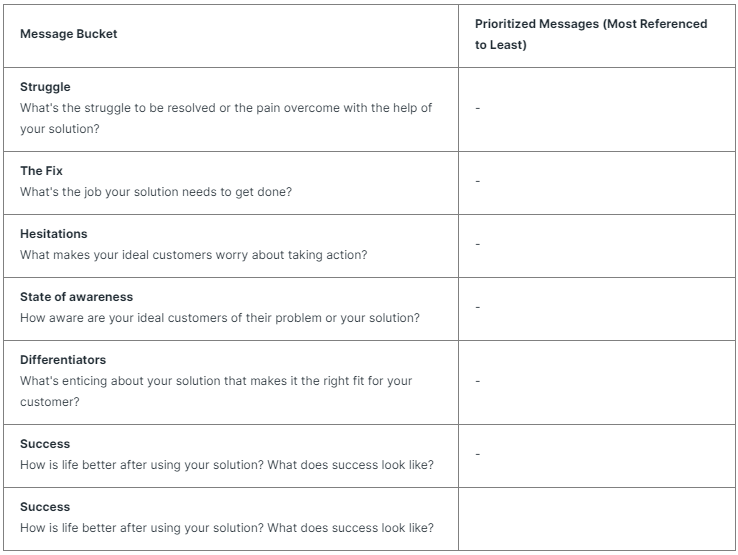
A Jobs To Be Done approach to building personas provides a clear understanding of what the customer is trying to accomplish and how your product can play a role in that journey. Effective messaging therefore includes 6 key elements that the author identifies – Struggle, The Fix, Hesitations, Awareness Level, Differentiators, and Success.
Define clear goals and objectives before starting the customer research. These will drive the questions you need to ask and ultimately get the insights you need. While there are different ways of doing customer research, this book focuses on surveys and customer interviews. Some useful tips on how to conduct surveys and interviews are provided.
When you don’t have customers, the best places to look are reviews of competitor’s products, Quora, community forums, subreddits, and review sites like G2.
Analyze and determine your key messages by identifying messages that frequently reoccur, put them into a Prioritized Messages List for each of the 6 messaging elements. Get top 10 quotes from your data set that are insightful, well summarized, and where customers are raving about something.
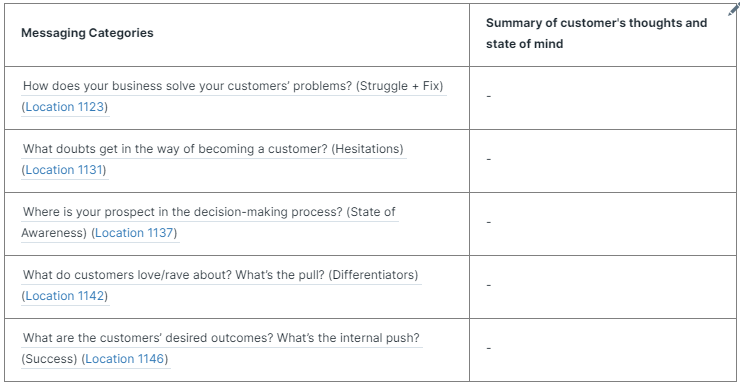
To understand what makes a customer tick, build a map of the customer’s mindset. This map represents the intersection of the customers’ thoughts and your product’s features. Make a table with the left column based on the messaging elements:
How does your business solve your customers’ problems? (struggle + fix)
What stops them from becoming your customer? (Hesitations)
Where is your prospect’s state of awareness?
What pulls the customer in? (Differentiators)
What are the customers’ desired outcomes (Success)
Applying the same JTBD framework, look at the website and your other marketing assets as one of your employees that you’ve hired to get a job done. Once your goals are clear, you can then set about aligning them with the customers’ goals.
Using the insights from the priority messages list and the customer mindset map, you should be articulate your positioning statement which should address what is the biggest pain point, how do you solve it, and why is the customer motivated to solve it.
Applying Voice of Customer (VOC) insights to features and benefits:
For each feature you’ve listed down, write down its most compelling benefit
Look at the priority messages list, in particular the fix and success categories where you will find features and benefits that customers care about the most.
Long Summary::
6 reasons why your company hasn’t done audience research yet (and what you can do about it):
No leadership buy-in: Business leaders and senior management don’t believe audience research is a good use of resources. This could be because of a lack of understanding of how modern targeted marketing works.
Lack of internal resources: Audience research is resource-intensive and takes time. And amidst all non-stop marketing activities that are immediate and urgent, you don’t have the time to do it.
Siloed thinking: Product teams feel they know who the customers are. The marketing team believes their assumption-based personas are on the mark. And sales teams feel they know best.
Expertise gap: Not only is audience research resource-intensive, but it also requires expertise and preferably some prior experience.
Inertia: You don’t have any of the above 4 problems, or you’re able to address them, but there is a lack of drive because the internal processes slow everything down.
Creativity: You rely on your assumptions and creative thinking to determine how and why your customers are deciding. It’s also the route of least resistance.
Quantitative research tells you the “what”, qualitative research tells you the “why”
Buyer Personas are based on emotions and stories behind the “why”.
People short on time will settle for “good enough” answers to their questions. (Satisficing = satisfy + suffice)
JTBD framework puts a JTBD framework on traditional buyer personas. Every action and decision of the customer is viewed as a job they need to get done using a tool/solution to solve their problems. The customer is “hiring” your tool to make progress in their journey from experiencing problems to achieving their desired outcome. A key principle in JTBD is that tools come and go, but the struggle people seek to overcome in their lives always remains.
JTBD buyer persona seeks to understand what role does your tool plays in the lives of the customer. It focuses on why customer makes certain choices and document it in their own words.
6 Elements of Effective Messaging
Struggle – This represents the pain the customers experience when they are faced with a problem. In Adele Revela’s book ‘Buyer Personas’, she refers to them as Priority Initiaitives
The Priority Initiative insight explains the most compelling reason that buyers decide to invest in a solution similar to the one your organization offers, and why others are content with the status quo.
The Fix – The solution that a client is looking for that specifically solves their problems. The solution as they see it and not usually described in terms of features and benefits.
Hesitations – Buyer Personas calls this Perceived Barriers. It categorizes customer responses to questions that show their hesitations, friction and barriers to them buying the solution. We need to watch out for the ‘ambiguity effect’ behaviour where a customer prefers to choose an option with a known favourable outcome versus one that is unknown.
A common barrier cited by customers is price, but if you dig deeper, the reason might lie with the uncertainty of value.
Awareness Level – There are 5 states of customer awareness on a continuum as they go through the journey:
Eugene Schwartz in his book, [[Breakthrough Advertising]], a prospect’s state of awareness of their problem, the solutions available, and a brand all play into what words they need to see as they move towards becoming a customer.
Most aware: Your prospect is already sold on your product and just needs the facts.
Product aware: Your prospect is familiar with your brand, but has not decided if your product is a good fit.
Solution aware: Your prospect knows what they want to achieve, but not that you can help her.
Problem aware: Your prospect is pretty sure there’s a problem, but has no idea if there’s a solution.
Not aware: Your prospect has no idea about their problem, solution, or anything to do with your brand.
Success – In Buyer Persona, this is referred to as “Success Outcomes”. This reflects the progress the customer has made in their journey. And so the product has to “fix” their problem and also help the customer reach their imagined version of the future. It is therefore, both personal and professional outcomes of success.
Questions to Ask Customers
To find the right message, we need to ask the right questions to customers. Their answers will then be revealing, insightful, and in some cases unexpected. These are the insights we’re after.
There are many ways to get inputs from customers on the buying process. This book focuses on surveys and customer interviews.
Surveys
Questions to ask in surveys:
“What was happening in your life/business that made you realize you needed a product/service like ours?”
“What problem does our product/service lessen or fix for you?”
“What alternatives did you use before buying from/working with us?”
“What concerns or hesitations did you have before you decided to buy from/work with us?”
“After you finish your course/working with us/using our product, what personal/professional goal are you hoping to achieve?”
“How aware were you of (the type of products/solutions) before you purchased/signed up for our product/free-trial?”
Pop-up surveys can be run on the website at critical points in the visitor’s journey to collect valuable information. For example, a popup on a thank you page after a visitor has bought something or when a visitor is leading the website without doing anything.
A simple yes/no question can be a quick way to get the visitor to answer, commit and then ask the more important question next.
Based on website data, popup surveys can be at potential points of friction to understand what is causing it and how they’re feeling at that point in their journey.
How to get audience insights when you don’t have customers?
Review mining – scanning for customer reviews from competitor websites and other 3rd party sites and collecting the most compelling snippets that correlate to the 6 elements of messaging.
Where to look:
Putting yourself in the shoes of the customer faced with a problem and answering the question “where can I find answers to my problems” can help you narrow down on sources of your information.
Here are several other places to search for gold:
Community forums: Try searching for the problem your product or service solves, and include the word forum in your search.
Reddit: This site contains forums called “subreddits” on just about every subject imaginable.
Quora: Go here to find answers to just about any question. Search for a product or topic, and you’ll find people writing about it.
Competitor blog posts and testimonials: Look at the comment section of blog posts and the testimonials on competitor sites. These can give you clues about what questions and praise people have for your competitors.
G2 and Capterra: These sites provide aggregated reviews for software companies.
Compiling Your Research
By the end of the research phase, you will have lots of data from many different sources. Organizing them so that they will serve as a repository for the future and also help mine for insights is critical.
The simple rules to follow are:
Organize them based on the messaging element categories in a document or spreadsheet
Make a list of commonly used words and phrases. Keep a count as well.
Rearrange the list from most used to least
Finding The Key Messages
Priority Messages List
Bucket the messages into the 6 categories of messaging identified earlier:
Top 10 Compelling Customer Quotes
Using the customer words to build your insights is key so that your eventual marketing copy can use the words that the customers use to describe their fears, hope, and desire.
Shortlist quotes that are insightful, well summarized and when customers are excited about something.
Customer Mindset Map
This is the intersection of your customers’ thoughts and your solution’s features/benefits.
Website Copy and Value Proposition
Value Proposition
Look through the messages from the Priority List and the Customer Mindset map and answer the following questions:
What is the biggest pain point of the customer?
How does my product solve that pain point for the customer?
Why are customers motivated to solve the pain point and what are they hoping to achieve?
Website Copy
Make a list of your solution’s features
Write down a compelling benefit for each of them
Look through the Fix and Success categories in the documents to find features and benefits customers care about the most
Use this understanding to write customer centric and conversion optimized cop y
Understanding who your customer is, what they want and how you can help is a never-ending quest. Most of the clients at my agency are from the B2B space. And so I wanted to explore the latest trends and how the pandemic affected this space.
We’ve seen a once-in-a-century scale disruption with the B2B market being no exception.
B2B buyers favour a considered decision-making process when the ticket size is high. The buyer journey involves many people. and there is usually procedures to follow.
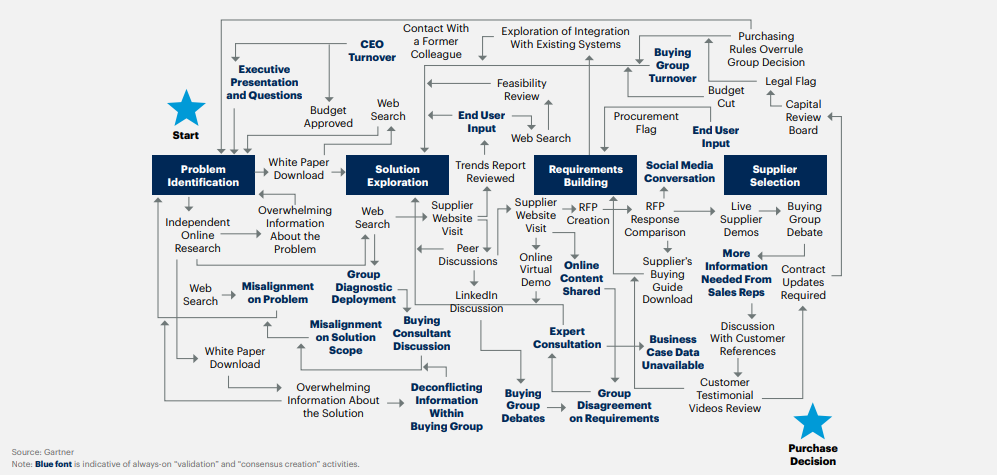
Source: Gartner – The number of people involved in a B2B purchase ten years ago were 5, today it ranges from 11-20.
As the infographic above shows, the B2B journey is a complex non-linear path.
With that in my mind, I set out to find what the data has to say and found a few that surprised me.
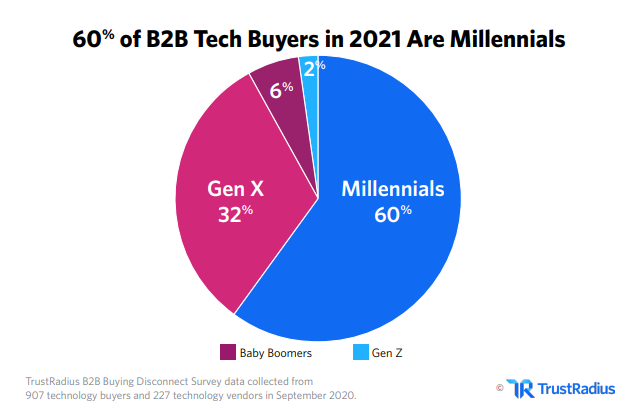
The profile of the B2B buyer is also changing. 60% of all B2B tech buyers in 2021 are millennials.
The millennials entering senior positions in organizations are influencing the decision-making process. Their worldview is different. And their experiences of the digital world will influence the decision-making journey.
Source: B2B Report on Millennials – Merit
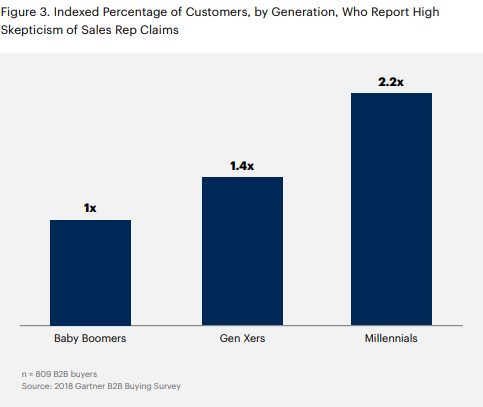
The millennial buyer is sceptical of the traditional sources of information – sales reps, analyst reports and mass media. The buyer expects the digital experiences of the B2C world in their B2B interactions. The Millennial B2B buyer is also 2.2 times more sceptical of a sales rep than a Baby Boomer.
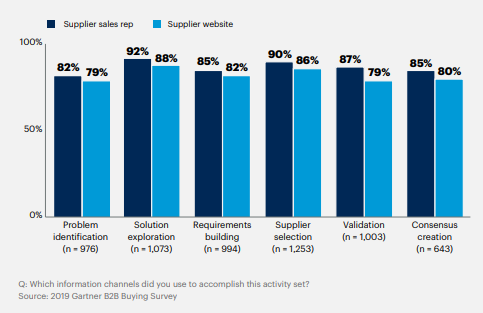
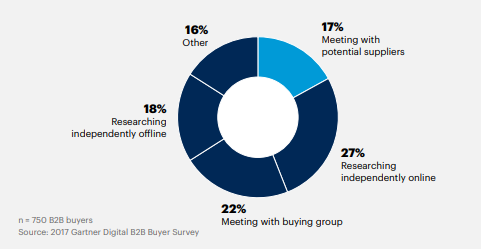
The B2B buyers rely on information from places they trust, deem critical and find useful. But, there is a glut of information for buyers to read and review now.
For a vendor, it’s harder to stand out in the noise because everyone has a content marketing strategy.
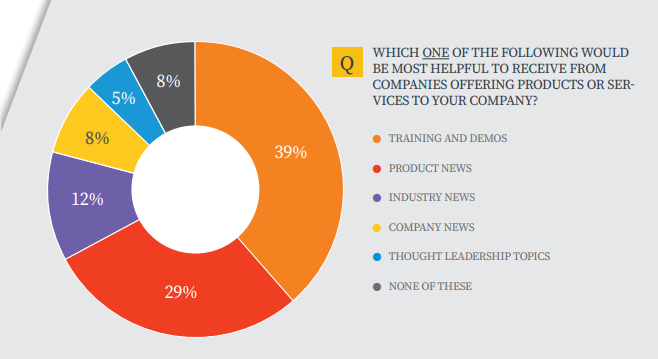
The survey data suggests marketers spend their limited resources on product-led marketing.
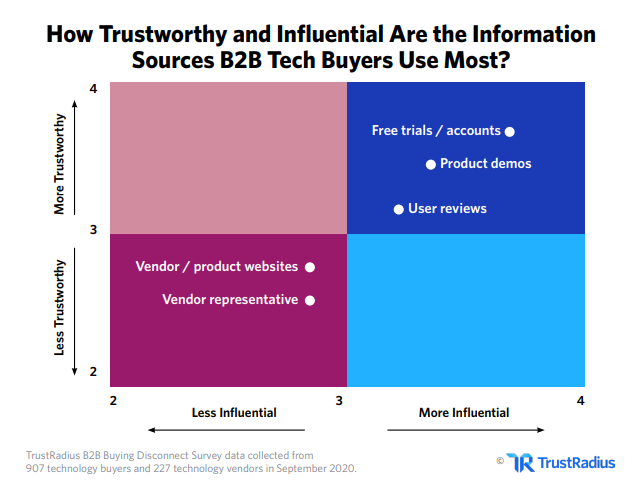
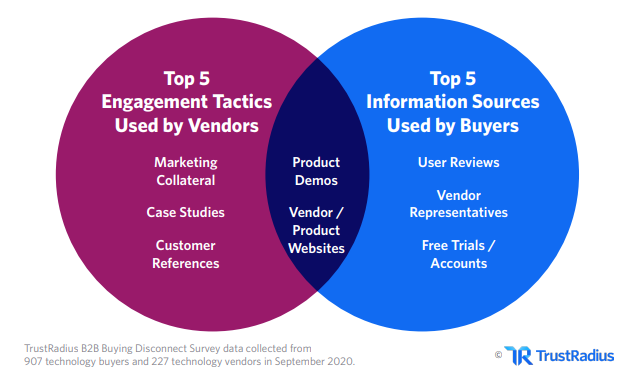
PR based crafted and sanitized narrative is not regarded as much in their buying journey. The B2B buyer is instead seeking control and self-service. Product demos, free trials, user reviews and vendor websites can serve this need.
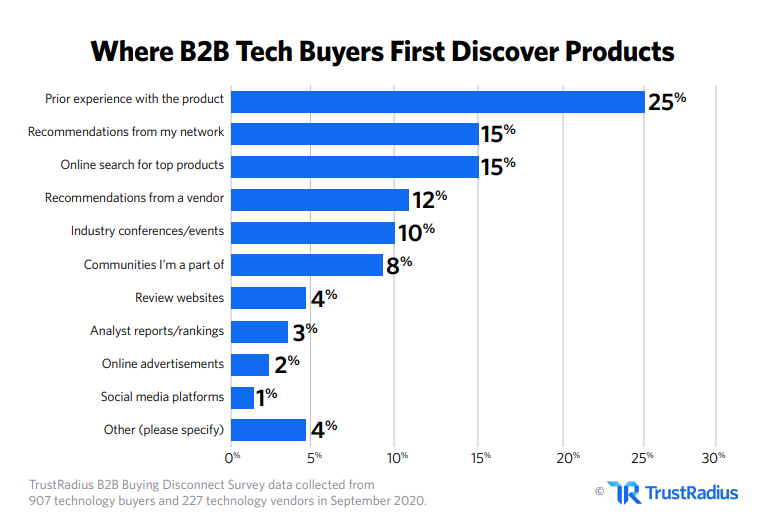
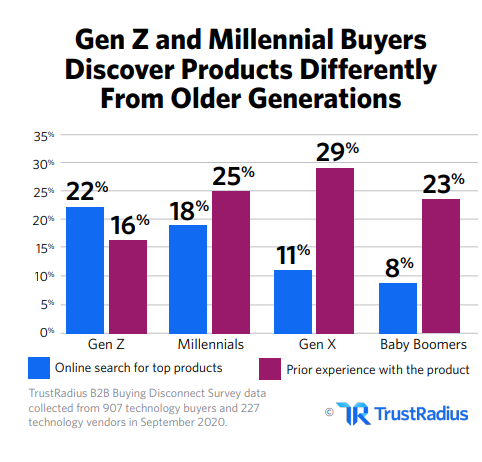
How buyers discover products have evolved and diverged from the baby boomer generation.
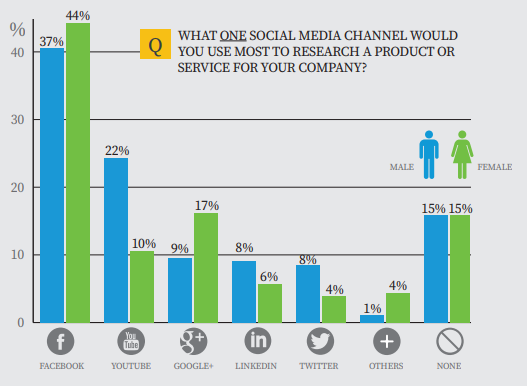
When it comes to discovering products, B2B tech buyers don’t prefer social media. But, other non-tech B2B buyers use it. And Facebook seems to feature prominently in that.
85% of millennials use social media to research products and services.
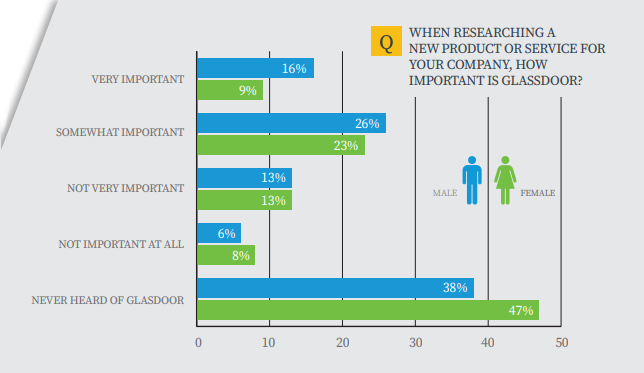
When buyers are considering a long term engagement they look at Glassdoor reviews.
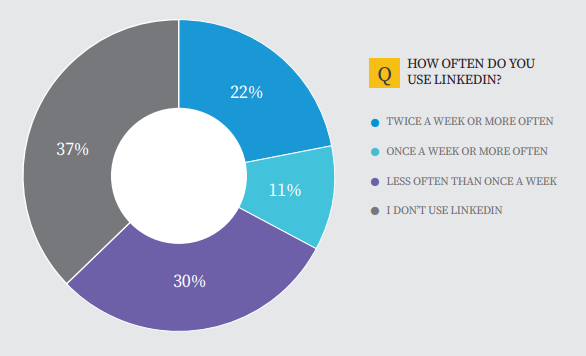
Not surprising that among Millennials with an education degree, most are on Linkedin.
Gap in understanding the buyer’s needs
While buyers seem to want information from certain places, marketers seem to prioritize areas that are not always deemed as high priority by buyers.
Here are marketing assets that companies waste their money on (according to a survey by TrustRadius)
Marketing collateral
Case Studies (this one’s surprising)
Customer References
And where companies should be spending more of their marketing budget on:
User reviews
Sales enablement
Product marketing
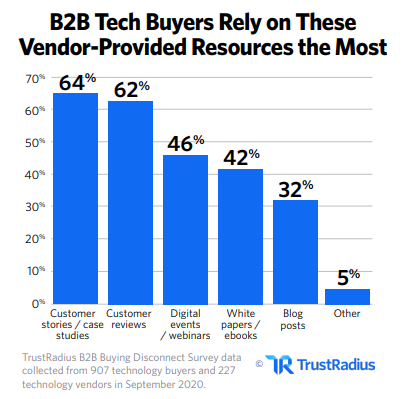
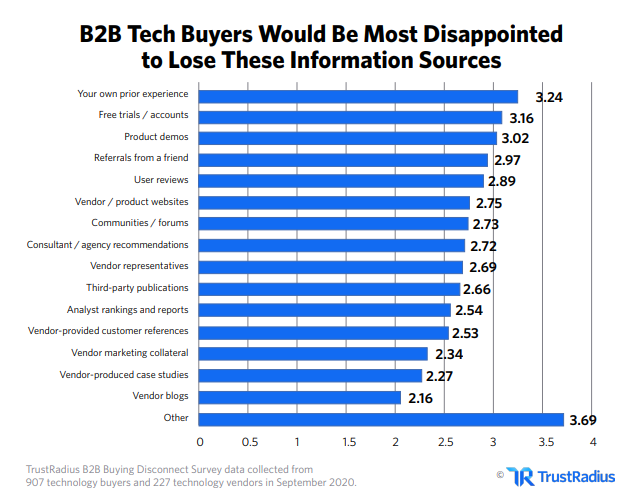
While buyers rely on vendor-provided resources like case studies the most, they wouldn’t miss it. This suggests that there are hygiene marketing assets one has to create. But also provide information buyers deem critical.
Transparent communication on the pros and cons about the product and service
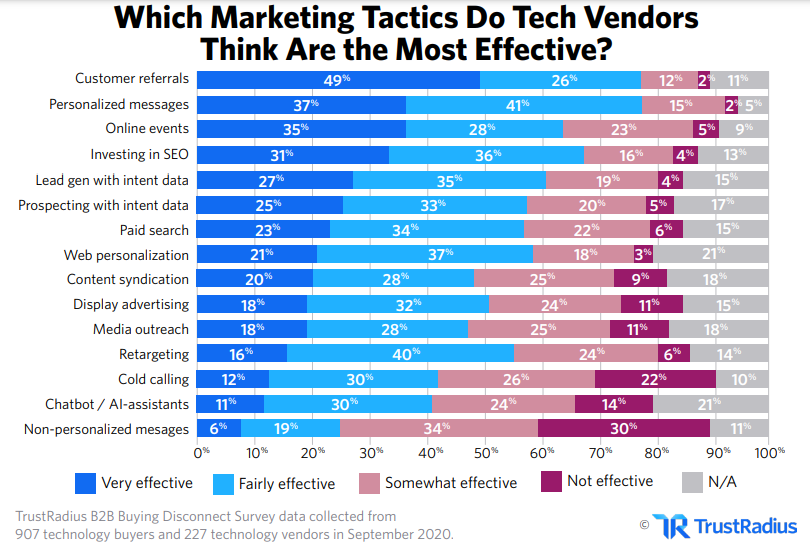
What B2B tech vendors believe are the most effective marketing tactics:
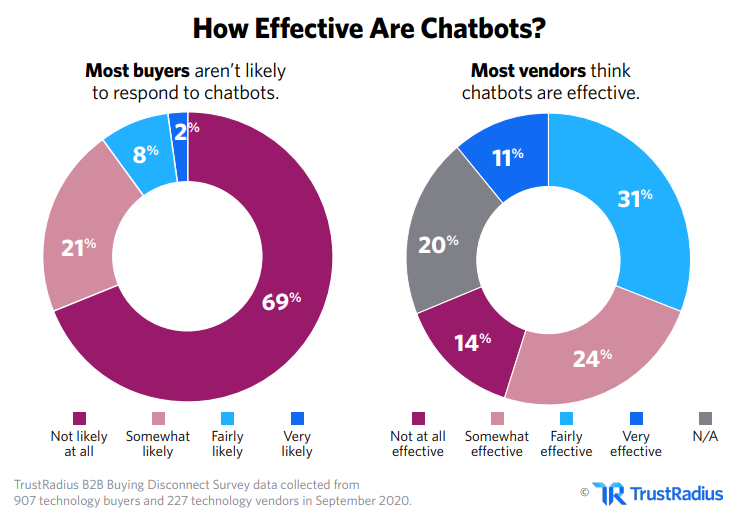
While 41% of marketers believe chatbots are effective, only 10% of buyers were likely to respond to them.
43% of marketers thought cold-calling was effective, but only 7% of buyers were likely to respond to it.
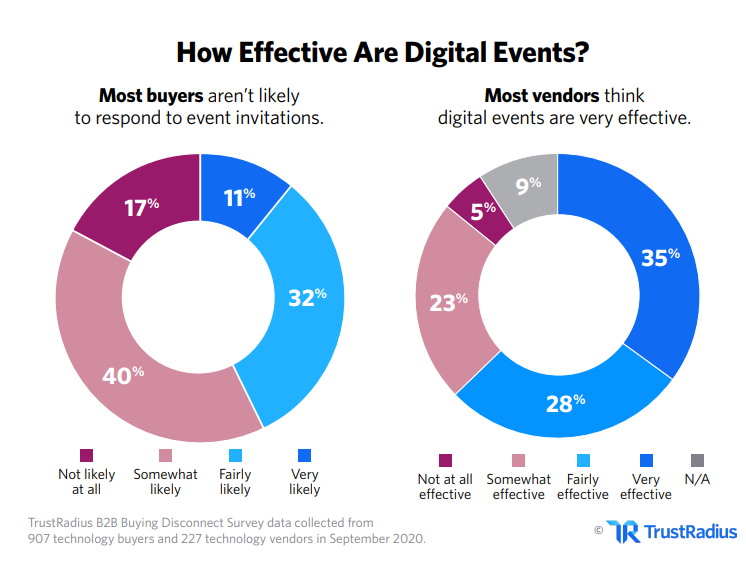
Webinars have become popular post pandemic, but what buyers and vendors think of them differ.
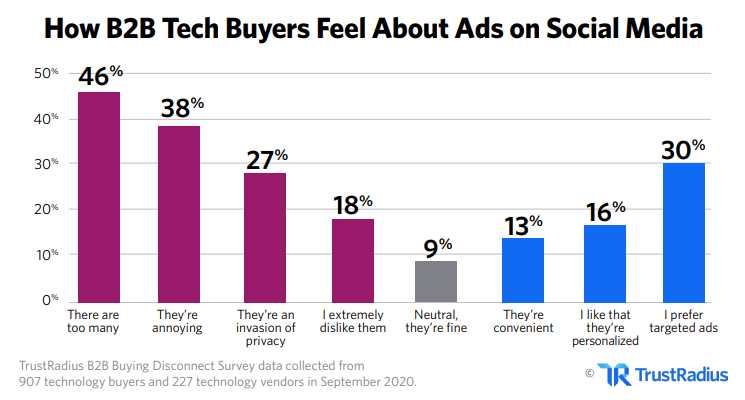
And what about ads on social media – annoying or useful when targeted well?
Remote sales during the pandemic
Remote sales is now a reality. Given the uncertainty around the pandemic and a shift to WFH for many, remote sales is here to stay.
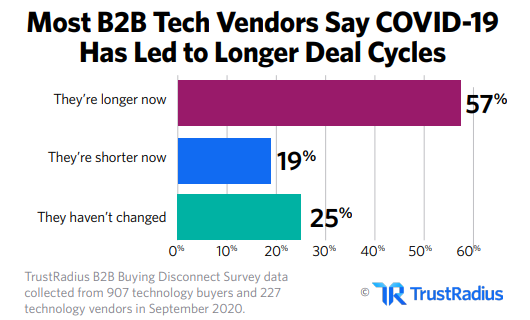
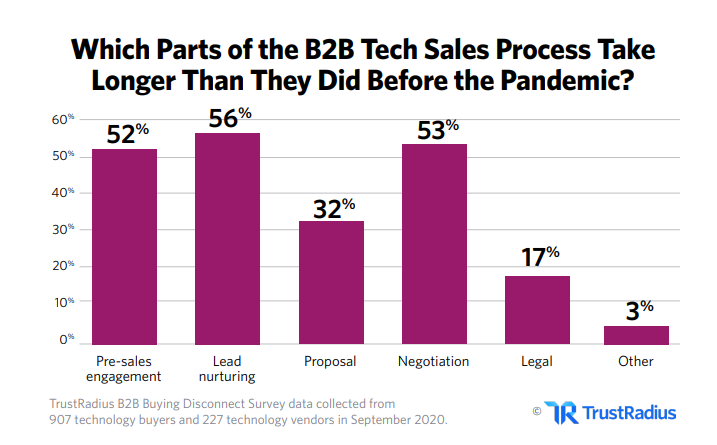
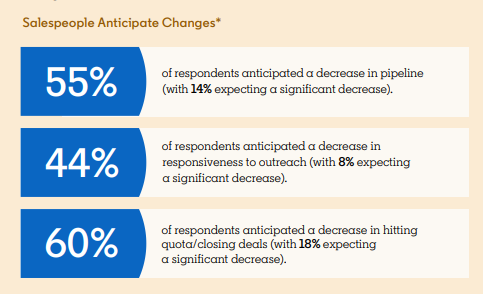
But, with remote sales come some obvious challenges. The loss of face to face interaction leads to a loss of influence. It also means longer sales cycles.
The availability of information has resulted in empowering the buyer to make their own decisions. The power and control are now in their hands. The sales rep needs to provide guidance through the digital channels and digital journeys of the buyer.
Spec sheets and product brochures won’t cut it for the digital buyer. Digital assets can offer valuable information to users through an interactive digital experience.
Therefore, a sales team will now act more as a guide or consultant to the buyer’s digital self-service oriented journey.
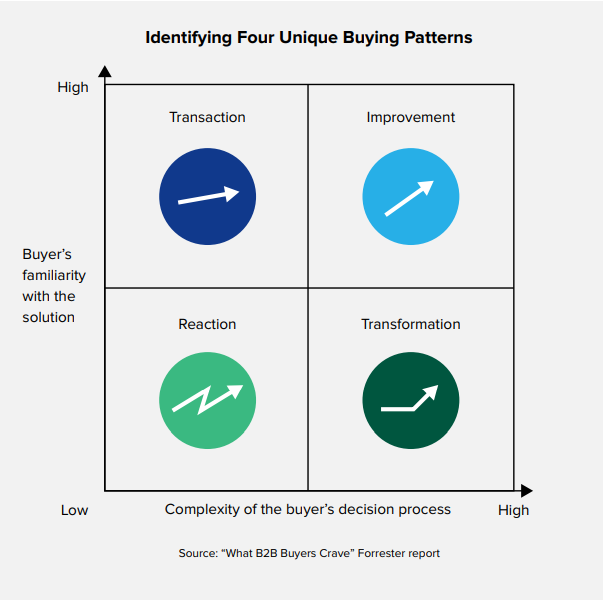
Forrester’s ‘Winning the New B2B Buyer‘ provides a framework for understanding the new buying patterns.
Transaction – high familiarity, low complexity:
Low-risk and defined decision making model
Mature markets
Eg: Office supplies, business laptops
Buyers want openness and immediacy. Pricing transparency will be table stakes
Improvement – high familiarity, high complexity
Significant business change, disruption and risk
Eg: migrating legacy applications, outsourcing non-core processes like payroll
Buyers expect vendors to be familiar with who they are, what they want to achieve
Transformation – low familiarity, high complexity
Disruptive solution in new markets
Buyers are problem-aware, but not solution-aware. They expect vendors to enlighten them through a collaborative and consultative sales approach
Where is your prospect in the decision-making process? (State of Awareness)
High-risk decisions often initiated by senior-level executives and involves a protracted buying cycle. Contextual and relevant marketing can be an aid
Reaction – low familiarity, low buying process complexity
Immediacy is the driver, driven by competitors moves, disruption in the market or a mandate from the CEO
Best served through self-service digital assets
Low familiarity means they may not all of the risks and implications of their choices. Customer references can help/
How should marketing teams adapt to the changing needs of a tech B2B buyer
Websites were and still are the responsibility of the marketing departments. But it now needs to be a joint effort of the sales, marketing and customer support teams.
Make it easy to schedule a product demo on the website. Even better if there is a self-service option or a free trial account.
Product website has to be on point. The copy, design and UX needs to be customer focused and updated.
Encourage and incentivize existing users to leave reviews on 3rd party review platforms.
Be active in communities and forums relevant to your product and industry
Have a digital PR strategy
Have a content strategy to help buyers through their decision making journey
Microsites, landing pages, resource hubs, self-assessment tools can be built on top of the main product website
Thought leadership and content marketing is par for the course. New content formats, mediums and digital storytelling has to be embraced.