
- Remarkable, consistent and authentic stories, not facts, to people who are inclined to believe.
- Needs are practical and objective. Wants are irrational and subjective. (How to understand your audience)
- Path to profitable growth is in satisfying the wants, not needs
- Characteristics of a great story
- It’s true. Not because it is factual, but it is authentic and consistent
- Consumers are very good at detecting inconsistencies
- They make a promise – bold and audacious
- They are trusted. A marketer needs to earn the credibility to tell the story
- They are subtle, allowing the consumers to draw their own conclusions
- They happen fast
- They don’t appeal to logic, but to our senses
- They are not aimed at “everyone”. Average people have many different points of view about life and are by and large satisfied
- They don’t contradict themselves
- They agree with our worldview
- It’s true. Not because it is factual, but it is authentic and consistent
- Consumers are complicit in marketing. They believe the stories. Without this belief, there is no marketing.
- Successful marketers are just the providers of stories that consumers choose to believe
- Marketing is about spreading ideas.
- How Marketing Works
- Consumer’s worldview is already formed
- People only notice the new and make a guess
- First impressions start the story
- Great marketers tell stories we believe
- Marketers with authenticity thrive
- The curve of making stuff vs the curve of making stuff up
- The value in creating and producing something new has dropped. Mass production and advertisements can’t generate profits
- Creating something remarkable and then marketing it through storytelling generates profit. Product and service life cycles are much shorter now
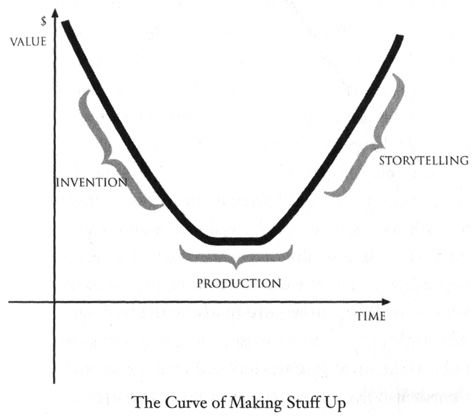
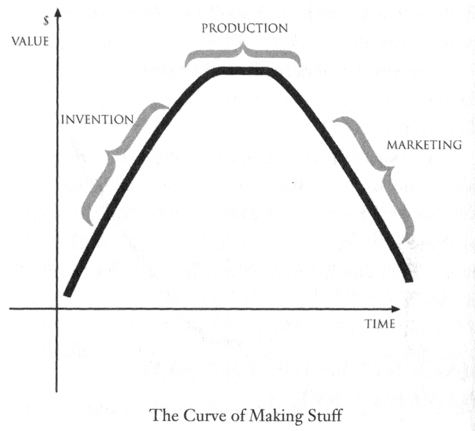
- Most people selling services/products struggle because they focus on production – making stuff cheaper,better
- Remarkable product + storytelling has a better chance of succeeding
Step 1: Worldviews and Frames
- Each person has a different worldview
- WV = biases + values + assumptions
- WV influenced by people, places and life experiences
- WV is not about world-sized issues, it more often than not affects how we think about small day-to-day issues
- WV = lens for decision making
- Frames are elements of a story painted to leverage a worldview a consumer already has. – George Lakoff on political discourse
- Frames is the way you hang a story on a consumer’s existing worldview
- Frames are the words and images and interactions that reinforce a bias someone is already feeling
- Different WVs, different frames
- Don’t change WVs. Instead, identify a group with a certain wv, frame your story in terms of that worldview and you win.
- Changing WVs is expensive and glamorous work, but doesn’t lead to a lot of profits
- People don’t want to change their WVs. They like it, embrace it and want it to be reinforced.
- Marketing succeeds when enough people with similar WVs come together in a way that allows marketers to reach them cost-effectively.
- Be a big fish in a small pond. Then move to adjacent ponds. – Geoffrey Moore – Crossing the Chasm
- Opportunity = find a neglected WV and frame your story for them
- People group together into common worldviews and your job is to find a previously undiscovered group and frame a story for those people
- Find overlooked big markets by clumping together people with complementary worldviews
- WV is not who you are, but what you believe and your biases.
- WV is not forever. It’s what the consumer believes right now.
- WV affects three things
- Attention – whether we pay attention to something new
- As a marketer, you cannot force people to pay attention
- Push marketing like ads are random interruptions which are not predictable or scalable for marketers
- Bias – new information received is coloured with our biases
- Euphemisms help you frame a story to get past people’s biases
- Vernacular – choice of media, tone of voice, words that are used and even smell
- Copywriting
- Photography
- web design
- branding
- Attention – whether we pay attention to something new
- Examples of marketing to a previously ignored community with a worldview
- Examples of new tea brands challenging old brands like Tetley and Lipton
- Republic of Tea
- Tazo
- Selling wine and alcohol through stories
- Examples of new tea brands challenging old brands like Tetley and Lipton
- Not all ignored worldviews are markets in waiting. They’re either too small or too much on the fringe
- Conventional wisdom has ignored many small communities for long. Such small groups along with other groups that have complementary WVs can turn into a cult -> movement -> trend -> mass market. Leap from the “none-of-the-above” group to the general population.
- Unlike Moore’s simple curve, it is a multi-dimensional mess that occurs across populations and WVs and markets
- Difference between early adopters and the mass market is one of worldview
- It’s a mistake to assume that there’s only one product adoption lifecycle curve and that the only WV that matters is where people are more likely to adopt new tech
- Edges of the curve are where there are people with an unfulfilled worldview
- Speaking respectfully to a person’s worldview is the price of entry to get their attention
- Best marketing stories are told with frames but ultimately spread to people who are open to being convinced of something brand new
- It’s not enough to find a niche that shares a WV. That niche has to be ready and able to influence a large group of their friends
- [[ToResearch]] How to influence a group to spread the word
- A shared WV doesn’t make a community. They just share a bias, but don’t talk to each other because they’re not interested in why others have the same negative view (like hating car dealers)
- Best marketing happens when you talk to a group that shares a WV but also talks about it which makes it a community
- It’s not enough to find a niche that shares a WV. That niche has to be ready and able to influence a large group of their friends
- The desire to do what other people we admire are doing is what helps successful marketing efforts
- People buy art at an auction because of their friends. They’re not interested in something that no else is looking for.
- Step 2: People notice only the new and make a guess
- How the brain processes new information
- Look for a difference
- Look for causation (coincidence) Three rules for the road between setup and payoff
- Use our prediction machine Setup triggers anticipation – what happens next. This leads us to an adrenaline-fuelled insight from making connections ourselves which results in engagement
- Rely on cognitive dissonance
- In the face of random behaviour, people make up their own lies
- We drink the can, not the beverage
- People only notice stuff that’s new and different. Once they do, they start making guesses about what to expect next.
- How the brain processes new information
- Step 3: First Impressions Start the Story
- You don’t get much time to tell your story.
- Short attention spans
- The animal brain inside us and things we do instinctively. The subconscious mind.
- To avoid the onslaught of choices, we make snap judgements.
- If the story is compelling and addresses basic human desires like fear or power or acceptance, it might be embraced
- Acceptance, the need for approval
- Curiosity, the need to learn
- Eating, the need for food
- Family, the need to raise children
- Honor, the need to be loyal to the traditional values of one’s clan/ethnic group
- Idealism, the need for social justice
- Independence, the need for individuality
- Order, the need for organized, stable, predictable environments
- Physical activity, the need for exercise
- Power, the need for influence of the will
- Romance, the need for sex
- Saving, the need to collect
- Social contact, the need for friends (peer relationships)
- Status, the need for social standing/importance
- Tranquillity, the need to be safe
- Vengeance, the need to strike back/to win
- We have no control over when the first impression happens.
- Superstitions are incorrect theories based on snap judgements
- Facts are not the most powerful antidote to superstitions. Authentic, personal interaction is.
- You don’t get much time to tell your story.
- Step 4: Great marketers tell stories we believe
- Marketing = advertising (pre-internet world)
- Marketing = storytelling
- Tell a story worth sharing and a lie worth remembering
- The only way to change minds is to get past the filters and safeguards people erect to insulate themselves from opposing points of view and then to tell a story that spreads
- Stories only work because consumers buy what they don’t need
- The reason people buy stuff is because of the way it makes them feel
- Step 5: Marketers with authenticity thrive
- Before we are able to share a story with our friends and family, we should be able to tell it to ourselves
- How to start your authentic marketing story
- Copy someone from a different industry who is telling a similar story
- Discover the cues and signals used
- Do them all, not just a few. (Story is a symphony, not a note)
- Stories promise to fulfil the wishes of the customer. They offer:
- a shortcut
- a miracle
- money
- social success
- safety
- ego
- fun
- pleasure
- belonging
- Competition
- You can’t tell a better version of your competitor’s story. Once the customer has bought someone else’s story and believes that lie, persuading the customer to switch is the same thing as persuading the customer to admit that he was wrong. People don’t like to admit they’re wrong
- 4 reasons why a new product launch failed
- No one noticed it – because they were not looking. People only notice something that is remarkable or exceptional.
- People noticed it but didn’t want to try it – because they don’t share the worldview as they’re not interested
- People used it but didn’t return to it – no sticky enough or lack of habit loops
- People liked it but didn’t tell their friends – worldview
- The stories that work are the ones that spread.
- You succeed by being an extremist in your storytelling, then gracefully moving your product or service to the middle so it becomes more palatable to audiences that are persuaded by their friends, not by the storyteller.
- Examples of stories framed around worldviews
- “I believe home-cooked meals are better for my family” – Crockpot
- “Organic food is better”
- You can’t just sit down and make up a story and expect people to believe it. You have to tell a story, not give a lecture
- You cannot prove anything to the customer. You gain a customer when she proves to herself that you’re a good choice. The process of discovery is more powerful than being told the right answer.
- Expectations are the engine of our perceptions
- Storytelling works when the story actually makes the product or service better
- Fibs are lies that make the story come true. It’s a way of describing your offering (in human terms) that makes the thing itself more enjoyable or more effective
- Fraud is a marketing pitch that once revealed as a story makes the customer angry. Fraud is a story told solely for the selfish benefit of the marketer
- Just because people might believe your story doesn’t give you a right to tell it!
- Marketing is the art of making promises using non-verbal techniques
- Successful stories don’t offer better quality or a good price
- Don’t rely on marketing as a crutch. If it requires to change your story or your offering, then that is what you need to do.
- Oxymorons – framing a statement around a worldview and then deliberately confounding expectations
- compassionate conservatism
- socially conscious investing
- OMs might help you address a small but previously unaddressed group that actually wants both
- Questions to ask
- Which worldview are you addressing?
- which frame are you using?
- what’s the story that’s worth noticing
- how will you live your story
- what hard decisions are you willing to make in order to keep your story real and pure and authentic?
- what are the shortcuts your fans can use to tell the story to their friends? how can you help them frame that story?
- how can you radically change your product or service so that the story is natural and obvious and easy to tell?
- what is the value of the permission the customer gives you to tell them something
Leave a Reply