Blog

  • Book Summary – Grit

    Book Summary – Grit

    Why::

    You might read lots of books that focus on building daily habits. This is the science behind the behaviours that influence our actions. And why some people tend to stick with it and others give up. Understanding this is the first step to creating long-lasting habits.

    This book is a must-read if you want to develop good habits, be a better parent or a leader who wants to create the right culture at work.

    Our misunderstanding of passion and interests leads us to try new things but also to give up too soon. What we lack is a connecting thread that bridges our daily, weekly, yearly and life goals together.

    We appreciate the talented genius more than the hardworking elite performer. This thinking seeps into our lives in how we view ourselves or those around us.

    Short Summary

    Atomic Essay – The secret to building long-term habits.

    Long Summary::

    Passion is misunderstood

    Grit is a combination of passion and perseverance.

    If your passion is like fireworks, it will light up and then fizzle out. However, people with grit use it more like a compass that guides them on a long journey.

    Passion is about consistency over time and not a short-lived obsession. Enthusiasm is common. Endurance is rare.

    Talent gets all the attention

    Humans have a naturalness bias against people who seemed to have worked to achieve something versus those who achieved it through their natural talent.

    Focusing all of our attention on talent means we risk neglecting other important factors like grit that contribute to success. “Gifted students program” is one example that comes to mind.

    Best of human achievement = sum of ordinary individual elements

    Effort matter more than talent

    Effort is the secret to success, because it counts twice.

    If you have 2x the talent, but 0.5x the effort, you will reach the same level of skill as the other person but will produce much less.

    Talent x Effort = Skill ????

    Skill x Effort = Achievement ????

    Talent influences how quickly we acquire skills, but effort not only builds skills it makes it productive by employing it.

    Talent – Effort = Unmet potential

    Skill – Effort = Unproductive

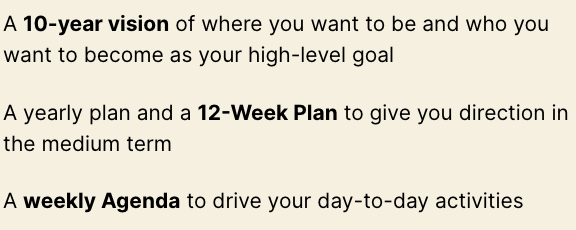
    Grit and Goals Hierarchy

    Grit is about pursuing the same high-level goal for a long time. Connecting your day to day activities to long-term goals is the key to success.

    Breaking down your goals into the following categories helps building a roadmap from where you are to where you want to be:

    High-level Goals – an end in itself

    Mid-level Goals – unify your low-level goals with your high-level goal

    Low-level Goals – means to an end
    Warren Buffett s three step process for prioritising goals

    • First, you write down a list of twenty-five career goals.
    • Second, you do some soul-searching and circle the five highest priority goals. Just five.
    • Third, you take a good hard look at the twenty goals you didn’t circle. These you avoid at all costs. They’re what distract you;

    Focusing only on the low-level goals without any sense of direction or them adding up to something meaningful seems wasteful. On the other hand setting a long-term goal and fantasizing about the future feels good but if it doesn’t translate into reality, you live with life-long disappointment. Gabriele Oettingen, a psychologist calls this Positive Fantasizing.

    Low-level goals are experiments you take on in the short-term. Some of them work. Some of them don’t. But the cost of failure is minimal if you learn from it and change your low-level goal accordingly. A project that failed, your article submission that was rejected and so on can only be temporary disappointments if you’re clear on your long-term goal.

    This kind of mindset will help in finding a more efficient or fun way of reaching the same goal, only the means of achieving it have changed.

    There’s no reason why you shouldn’t have more than one goal hierarchy – one for professional life and another for personal. And conflicts between the two are to be expected.

    “high but not the highest intelligence, combined with the greatest degree of persistence will achieve greater eminence than the highest degree of intelligence with somewhat less persistence.”

    Stanford psychologist, Catharine Cox

    Are you born with grit or can you build it?

    All human traits are influenced by more than one gene, so there’s no one single factor that influences our behaviour.

    All our psychological traits like grit are influenced by genes and experience. Nature and nurture.

    Genes that we inherit can explain why we differ from the average, but it says nothing about the average itself.

    Flynn effect, a study that shows an increase of 3 IQ points every decade, indicates that we as a species are getting smarter at abstract reasoning. If people a century ago were scored against today’s norms, they would score an average of 70, borderline for mentally retarded. And people today would be rated as mentally gifted against norms of a century ago. Flynn called this the social multiplier effect

    Another study shows that older people are grittier than younger people. Psychologists call this the maturity principle

    Psychological assets of gritty people to overcome mental hurdles:

    Boredom – Interest

    Difficulty – Practice

    Irrelevance – Purpose

    Despair – Hope

    Interest

    An interest is not like “love at first sight”. It is only the beginning of a potentially life-long interest. Unreal expectations can ruin your early interests from developing further.

    Interests are developed through action, not introspection.

    The process of discovery is messy and serendipitous.

    Post interest discovery period is a proactive and lengthy period of interest development. The initial trigger of interest discovery must be followed by repeated triggers for the interest to develop further

    Interests thrive when there is a supportive community that provide ongoing stimulation and feedback

    For a beginner, novelty is new. For an expert, novelty is nuance.

    To develop interests, set low-level goals first.

    Practice

    The Japanese word Kaizen literally translates to continuous improvement, a popular approach in the software world.

    If practice is about the number of repetitions(quantity),

    then deliberate practice is about quality of time, not just quantity.

    Deliberate Practice vs Flow

    Deliberate practice is a behaviour. Flow is an experience

    Deliberate practice is for preparation, and flow is for performance.

    When challenge > skill level, it is Deliberate practice.

    When challenge = skill level, you experience Flow.

    Deliberate practice can be frustrating, uncomfortable and painful. Flow is immersive and enjoyable.

    the thrill of getting better is one, and the ecstasy of performing at your best is another

    How to setup deliberate practice:

    1. Set a stretch goal that focuses on a specific weakness
    2. Apply maximum concentration and effort
    3. Seek immediate feedback
    4. Reflect, refine and repeat
    5. Make it a habit
    6. Have the self-awareness to be in the moment and avoid critical self-judgement

    Hope

    Two kinds of hope – one that relies on the external sources and another that relies on internal effort

    Suffering doesn’t lead to hopelessness, but the suffering we think we can’t control – Learned Helplessness

    “Whether you think you can, or think you can’t-you’re right.”

    Henry Ford

    Psychologists originally believed that humans responded only to incentives and punishments and did not consider that our thoughts could influence our behaviour.

    Optimists look for temporary and specific causes of their suffering while pessimists believe the reasons for their suffering are permanent.

    Aaron Beck developed the Cognitive Behavioral Therapy which helps individuals objectively look at their thoughts and resulting behaviours to then change them for the better. It’s a popular form of therapy today for treating depression and anxiety disorders.

    Carol Dweck known for her work on Mindset suggests there are two types – Growth Mindset and Fixed Mindset. And these are the 4 questions she uses to assess an individual’s theory of intelligence:

    1. Your intelligence is something very basic about you that you can’t change very much.
    2. You can learn new things, but you can’t really change how intelligent you are.
    3. No matter how much intelligence you have, you can always change it quite a bit.
    4. You can always substantially change how intelligent you are.

    A joint study by Angela Duckworth and Carol Dweck with 2000 high school students who took the Growth Mindset Questionnaire showed that students with a growth mindset are grittier than others.

    People have both tendencies in them – optimism and pessimism. But the environment around them can accentuate and amplify one of these. Whether it is parenting or work culture, it is important to foster an optimistic and growth mindset oriented outlook. And since our actions speak louder than words, it is important that we mirror our words and actions.

    Just telling someone to be more optimistic or to overcome their challenges won’t help. They need to experience mastery and adversity at the same time for the brain to register it.

    What can help is developing a growth mindset, optimistic pep talk and persevering in the face of adversity. With practice you can change how you think, how you feel and ultimately how you act.

    Parenting

    As a parent you don’t want to mollycoddle your child to the point where they will never listen to you. Neither do you want to show them tough love with an intention to only get them to follow your instructions. A selflessness to tough love is different.

    Parenting styles

    • Permissive Parenting – Undemanding, Supportive
    • Neglectful Parenting – Undemanding, Unsupportive
    • Wise Parenting – Demanding, Supportive
    • Authoritarian Parenting – Demanding, Unsupportive

    “One of the major discoveries of parenting research is that what matters more than the messages parents aim to deliver are the messages children receive.”

    Not all children whose parents practice wise parenting grow up to be gritty. Though they might be supportive and demanding, they may not show passion and perseverance for their own long-term goals.

    Research shows kids who are more engaged in extracurricular activities always have better outcomes in grades and higher self-esteem. Pursuing and sticking with extracurricular activities requires grit and also builds it.

    When children are trained on difficult tasks, it leads to Learned Industriousness. If we don’t experience the connection between our effort and reward, we default to laziness.

    As parents we have the tendency to praise kids enthusiastically and complementing their talent or intelligence. A coach in an extracurricular activity will give them the feedback and praise with a neutrality a parent finds difficult.

    Ideas for parents to practice:

    • Show the children one hard thing you are working on that requires daily deliberate practice
    • Children should pick at least one extracurricular activity of their choice
    • and stick with it for at least a year (passion can be fleeting, interest takes time to develop)

    Culture of Grit

    Dan Chambliss said “The real way to become a great swimmer is to join a great team.

    Use the human tendency of conformity by finding and joining a group of gritty people to build your own grit.

    We don’t always do a cost-benefit analysis before taking action. It’s often based on our identity of who we think we are. And by being a part of a group that practices grit, we imbibe those and internalize them.

    Finns think of themselves as the grittiest people in the world. They even have a word for it – sisu. Thoughts influence behaviour and behaviour creates our identity. It can be a virtuous cycle or a vicious cycle.

    “The true joy in life is to be a force of fortune instead of a feverish, selfish little clod of ailments and grievances complaining that the world will not devote itself to making you happy.”

    George Bernard Shaw

    Grow grit “inside out” with daily habits, deliberate practice, and “outside in” with help of parents, coaches and mentors

    Grit leads to a healthy emotional life and well-being.

    Grit and other character virtues:

    Intrapersonal character (Will)

    • Grit, self-control, self-management skills
    • David Brooks calls them “resume virtues”

    Interpersonal character (Heart)

    • Gratitude, social intelligence and self-control over emotions
    • “Eulogy virtues”

    Intellectual character (Mind)

    • Curiosity and zest

    Longitudinal studies show each group of virtues can predict different outcomes.

    Strong intrapersonal character predicts academic achievement.

    Your interpersonal character will determine how many friends you have.

    And the intellectual virtue shows an independent and positive outlook to learning new things.

    But our plurality of character means all 3 groups plays a role.

    • Author:: [[Angela Duckworth]]
    • Rating: 5/5
    • Full Title:: Grit – Why passion and resilience are the secrets to success
    • Source:: Physical Book
    • Date Finished:: [[October 17th, 2021]]

  • The secret to successful people’s habits

    The secret to successful people’s habits

    The two common traits in successful people across disciplines and professions are passion and perseverance.

    Effort matters twice as more than talent because its involved in skill development and putting that skill into practice that eventually leads to achievement.

    The secret to having a long-term goal and sticking with it for an extended length of time is goal hierarchy. Creating a long-term goal feels good due to the ‘Positive Fantasizing’ effect. But without a roadmap we are less likely to attain it.

    Our psychological traits like Grit are influenced by nature (genetics) and nurture (experience).

    Gritty people develop interests to overcome boredom, practice more than others to deal with difficult challenges. have a purpose in life that drives them and are optimistic about life.

    The idea of finding and developing “interests” if misunderstood. Interests are developed by doing and not by thinking. And the how we discover interests are often messy and serendipitous. But once the novelty of a new interest wears off is when gritty people persevere by developing habits to repeatedly practice it.

    When you consistently practice challenging tasks that pushes beyond your skill level, you achieve mastery. The process of deliberate process is painful and uncomfortable, but gritty people stick with it because of the habits they’ve built.

    Our thinking influences our behaviour and that in turn builds our identity. Gritty people are optimistic and this aids their grittiness causing a virtuous cycle. An optimistic outlook and a growth mindset can help kickstart the journey, however, one needs to experience mastery and adversity at the same time for the brain to register it as a worthwhile endeavor.

    We can build mindsets and habits that rely on internal efforts. Using external support of communities, coaches, teachers and family who demonstrate values of grit you want to develop can accelerate your journey.

    Children absorb values of grit more if their parents demonstrate it in their lives as opposed to parents instructing them to do so. Numerous research studies suggest extracurricular activities develop grit. It leads to better grades, higher self-esteem and success later on in life.

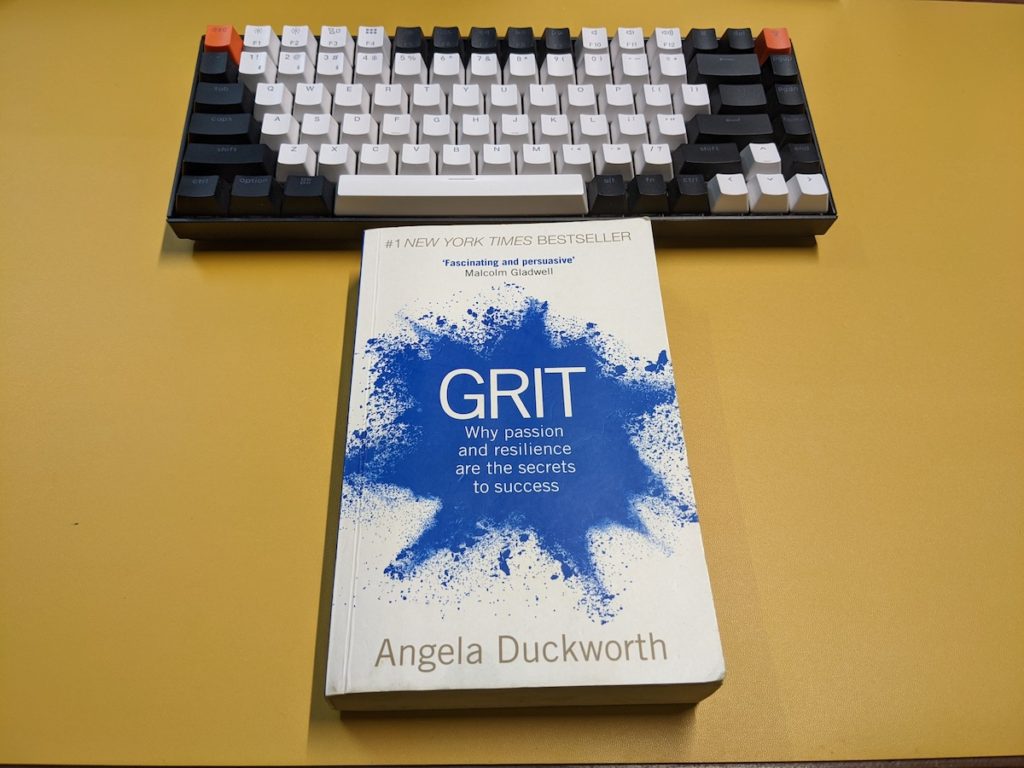
    My notes from the book Grit – The Power of Passion and Perseverance by Angela Duckworth is here.

    Grit by Angela Duckworth
  • Why we need a customer status map?

    Why we need a customer status map?

    Our status in society influences our decision-making. We use status as a shortcut to decide where to place people and entities.

    “there are two types of Social Influence: normative social influence and informational social influence”

    https://www.ncbi.nlm.nih.gov/pmc/articles/PMC4718651/#pone.0146536.ref006

    “Normative social influence – The influence is based on people’s motivation to gain approval and avoid rejection by conforming with others’ expectations.”

    “informational social influence arises from useful and valid information that another’s opinion or behavior provides to improve a decision or judgment”

    https://www.ncbi.nlm.nih.gov/pmc/articles/PMC4718651/

    When we make decisions on buying a product/service, we are considering its impact on our status.

    In the journey from where a customer is to where they want to go, their status is going to change. And can your product or service help with that?

    Iconic brands have achieved a level of status that by being a customer of those brands your status goes up. Think Apple. Think Nike. Think Starbucks.

    Luxury brands do the same. When customers drive a sports car or wear an expensive watch, it’s a public statement of their status.

    When a product or service can do that, it becomes aspirational and desirable.

    How do non-luxury goods or a B2B product or service achieve that?

    Can owning a piece of software or hiring a vendor, elevate your status? Or do the outcomes from these engagements cause your status to go up and get peer recognition?

    If it does, then people are going to tell others about it.

    While money and power are two obvious status symbols, status is also very contextual. Dynamics of status in society and status in peer groups are different. The scale differs, but it still influences us in how we make decisions.

    Customer Journey maps and Empathy maps are important tools in marketing. Influence maps as Rand Fishkin argues help us understand who influences customers. If status plays a role in decision-making, we should be studying status and changes in status.

    A Customer Status map adds another layer to our understanding of the customer. With this insight, we can see how our product and marketing affect a customer’s status.

    Some questions we should seek to understand:

    1. What is their current status?
    2. What is the status in comparison to you?
    3. If there’s a status gap how can you help them overcome it?
    4. Who is the higher ranking status person that influences them?
    5. Can your service help them fit in or help them stand out in a way that elevates them?

    In a B2B scenario, the situation is further complicated because the buyer is not singular. And even the decision-maker is spending someone else’s money (budget).

    A visual representation of this complex environment will help us be more mindful of our marketing.

  • Marketing is signalling

    Marketing is signalling

    In 1974 the most powerful signal ever was sent into space towards other galaxies with information of our human race like the DNA sequence. We haven’t heard back yet.

    Does your marketing feel a bit like that?

    What do you want your signals to say about you? What do you want your audience to think when they notice your signal?

    Should your first signal be about promoting your service regardless of who is receiving it?

    You send out signals into the world every time you do something. Whether it is a “marketing activity” or not.

    Who picks up your signal is a factor of signal quality, distribution, and targeting.

    Is the signal interrupting them and asking for attention? Or is the signal mindful of their situation and asking for permission instead?

    The signal quality received is dependent on how unique the message is, how relevant and timely it is, and ultimately whether it is valuable enough to warrant attention and engagement.

    Do you send out mixed signals? Your website says one thing. Your product says something else. And your “marketing” communication is saying something different altogether.

    Are your signals consistent? Do you have patterns that the audience can recognize, like a birdsong?

    Can one high-intensity signal be enough to convert someone into a paying customer? Or would you rather have a sequence of signals sent consistently and draw the ideal customer in the audience closer to you one step at a time?

  • A  better way to create marketing personas

    A better way to create marketing personas

    Harvard Business School marketing professor Theodore Levitt said, “People don’t want to buy a quarter-inch drill. They want a quarter-inch hole!”

    Over the last five years, I’ve worked with edtech, IoT, interior design, and IT services companies to interview their customers and build marketing personas for them.

    And here’s my current approach to building a modern marketing persona for a business with high-consideration buying.

    Jobs To Be Done Theory centers around the idea that products exist to get a job done in a customer’s life.

    A traditional marketing persona uses demographics and psychographics to create a buyer’s identity. It relies on surveys, market data, and focus groups. 

    A modern marketing persona revolves around the idea of speaking to a few customers directly, particularly in B2B environments, and understanding the buying process better.

    There are six elements of a JTBD Persona that you need to find insights on:

    The hole and the drill

    What is it that the customer is struggling with? How are they currently solving that problem – what is their temporary fix? What is the ideal solution they are looking for as described in their words?

    The valley of doubt

    What perceptions do they have about a brand, a category, or the product/service itself? Are there hurdles they need to cross that stop them from taking action? What are their fears? What is their status in comparison to the company?

    Apathy to awareness

    Where do they site on the Eugene Schwartz Awareness Level scale – not aware, problem aware, solution aware, product aware, and most aware?

    Zero to hero

    What are the personal and professional factors that motivate them to take action? What does success look like personally and professionally?

    Sources of influence

    What is the kind of work a customer is doing behind the scenes to source information, evaluate options and shortlist their possibilities. Whom are they speaking to and what are they reading, and where?

    The difference-maker

    Which specific features and attributes of a product/service category do they evaluate to make their final decision? When all things (price, quality) are equal, how do they decide on the final choice?

  • How to make your marketing message memorable and relatable?

    How to make your marketing message memorable and relatable?

    Have you eaten at a restaurant where the ambience and the food transported you to another place?  

    To help the audience understand your message, it needs to paint a picture in their mind. We don’t store words and sentences in our heads. We store them as images and memories.

    A key marketing ingredient, tension, is useful in getting someone’s attention.

    But once you get the attention, how do you get your point across and ensure it stays in their head for a while.

    We tell a story.

    Not any story. A marketing story.

    A marketing story is like the “hero’s journey“.

    And the hero in the story, is not your product or brand, but the customer.

    Your marketing story should depict the customer’s transformation from before to now. And what did they realise as a result of that transformation.

    Your product or brand is the mentor and guide in this transformation journey.

    Tip: Customer transformation stories make for effective testimonials.

    Be like Yoda, not Luke Skywalker.

    Another useful mechanism to help your audience understand your message is – analogies. 

    We use them often without realising.

    Some of them cliched:

    • “Let’s put a pin on it”
    • “Grab the low-hanging fruit”
    • “Move the needle”
    • “Put your ducks in a row”

    “Uber for X” is a popular analogy used by many startups these days.

    Can you describe what you offer using a reference the audience is familiar with?

    Are you like Tesla for B2B CRM? Or are you like Toyota for B2B CRM?

    Analogies use the familiar to explain the unfamiliar. 

    Effective analogies resonate emotionally.

    Analogies help in positioning your offer in customer’s mind. Use analogies to frame the situation and argument in your favour.  

    “Just as music is noise that makes sense, a painting is colour that makes sense, so a story is life that makes sense.”― Yann Martell

  • Productivity for the easily distracted

    Productivity for the easily distracted

    I probably have ADHD. Distractions and time are my enemies.

    Finding a practical and sustainable productivity system is an ongoing struggle.

    If sticking to a plan is hard, if you get distracted all the time and you tend to procrastinate a lot, then I feel your pain.

    Here are some ideas that might help:

    1. Weekly Goals

    Put down your goals for the week. If you have a quarterly plan, then your weekly goals can be derived from that to align your short-term objectives with the long-term.

    2. Task prioritization

    Take your bucket list of ideas and tasks for the week and plot it on a 2 X 2 grid of Urgent-Not Urgent, Important-Not Important. (Eisenhower Matrix)

    3. Micro tasks

    When you’re writing down tasks, break them down into smaller pieces of 20-30 minutes duration.

    4. Daily Plan

    • Create your daily plan the previous night before going to bed
    • Write down times for each task based on your start and end time for the day
    • Fix your start and end time for the day as your hard constraint.
    • Divide the day into blocks of time for journaling, writing, deep work and shallow work etc.
    • Based on task prioritization, pick tasks and put them into the above blocks
    • Set mini breaks of 5-10 mins between tasks. Longer if context switching is involved.

    5. Time it

    Use a kitchen cooking timer if you don’t want to keep your phone around.

    Set your phone and computer to Do not distrub/Focus mode

    6. Reset routines

    With all of the above structures in place, you will still fail on occasions. But having reset routines can help us recover and get back on track quickly.

    Here’s what you can try:

    • Shut down all apps and windows on your device.
    • Clear your mind – Take a walk or meditate or write in your journal for 10 minutes
    • Take the unfinished task and break it down further into 5 minute chunks.
    • Start with the smallest 5 minute chunk and go from there

  • Pricing lessons from building an agency

    Pricing lessons from building an agency

    Horror clients. Bad Projects. Chasing payments. Mismatched expectations. I’ve seen it all in my years of running the agency.

    Here are pricing mistakes you should avoid making:

    1. Always take an advance up front.

    50% if possible. The money is for blocking your time and ensuring the client is equally committed to the project.

    2. Charge more than you’re comfortable with.

    The imposter syndrome makes you undervalue what you do. Don’t settle for less. Push yourself to meet your own high expectations for charging more.

    3. Increase your rates between 5-20% for every new customer

    If a client didn’t negotiate what you quoted last time, it means they could have paid more. Try increasing your prices with the next customer and see how they respond. Keep doing it until you get pushback from 2-3 new customers.

    4. “You’re expensive”

    You have two ways on how you can implement that feedback:

    • fine tune your story to match the pricing
    • find a customer (niche) who can afford you

    5. Delink your pricing from time and resources

    If you play the time and resources game, it is a race to the bottom. Or you play the volume game. Either way, cost and overheads will reduce your profit margins

    6. More stakeholders involved at the client end, higher your prices should be

    Ideally, there should be one point of contact with sufficient authority within their organization to make decisions and help move the project forward. If every review session or feedback needs a committee review, then price that in.

    7. Don’t negotiate down beyond 10%

    When you quote a price, it’s a reflection of how you see yourself. If during negotiations you reduce your price by half, the client will consider you a pushover.

    Follow my Twitter thread here to read the rest of the atomic essays:

  • Repositioning, Rebranding & Brand Refresh

    Repositioning, Rebranding & Brand Refresh

    Don’t hire an agency or a brand expert until you’ve understood this.

    Your company has evolved, the products and services you once sold are no longer relevant. Or you are transitioning into a new industry niche.

    Whatever may be your reason, how do you decide whether to refresh your brand or create a new brand?

    Creating a new brand takes time and significant effort. So are you better off with repositioning and refreshing your existing brand?

    A rebrand is rethinking your entire brand and brand identity. It’s as akin to creating a new brand and it comes with significant risk as you might alienate your existing audience. 

    3 questions to ask yourself:

    • Has the audience significantly changed for my business today?
    • Has my business significantly changed or only the products and services have evolved?
    • What is the business outcome I want from this brand exercise?

    One way to answer this is to dig into your business reason behind this. The other is to understand who your audience is.

    If the audience has evolved or you want to attract a new audience that is “adjacent” to your existing audience, then a brand refresh with repositioning might suffice.

    If your business has drastically changed and so has your audience, then a rebrand or creating a new brand might be in order.

    Creating a new brand takes time and significant effort.

    Leveraging your existing brand equity to reposition and clarify what you offer and to whom might do the job better.

    Repositioning precedes a brand refresh.

    Brand refresh usually involves:

    • tweaking your logo and revamping your website
    • updating your tagline
    • using a new font and color palette

    If a brand refresh is like a fresh coat of paint, a rebrand is like reconstruction.

    A rebrand involves:

    • A new brand identity and brand positioning
    • Establishing the brand in a new market and for a new audience

    A thread of all my atomic essays on Twitter:

  • Why is tension a key ingredient in marketing?

    Why is tension a key ingredient in marketing?

    Attention = Desire x Tension

    Dopamine is the neurotransmitter of desire. Norepinephrine is the neurotransmitter of tension. Together they add up to attention.

    Tension is the struggle between what you have and what you don’t. This type of low-level conflict often leads to action.

    “Here’s a 30% discount on your favourite gadget. but hurry the offer ends tonight”

    Tension creates consequences and therefore importance.

    And this often leads to action.

    And action leads to trust. When you invest your energy into something, you follow through with it – Sunk Cost Fallacy

    The low-hanging fruit most commonly used by marketers to create tension is FOMO.

    Even when there is no deliberate marketing intervention to create tension, tension naturally exists before you sign up for an online course, buy a laptop, hire a professional or even commit to a relationship.

    The tension comes from fear.

    • Fear of missing out
    • Fear of sounding dumb
    • Fear of paying too much
    • Fear of uncertainty
    • Fear of social interaction

    Marketers can introduce tension with:

    • Novelty
    • Scarcity
    • Deadline
    • Humour
    • Promise of change in state and status

    This push-pull pattern of desire and tension is a delicate balance. Push it too far and it could escalate into a conflict or push the potential customer further away